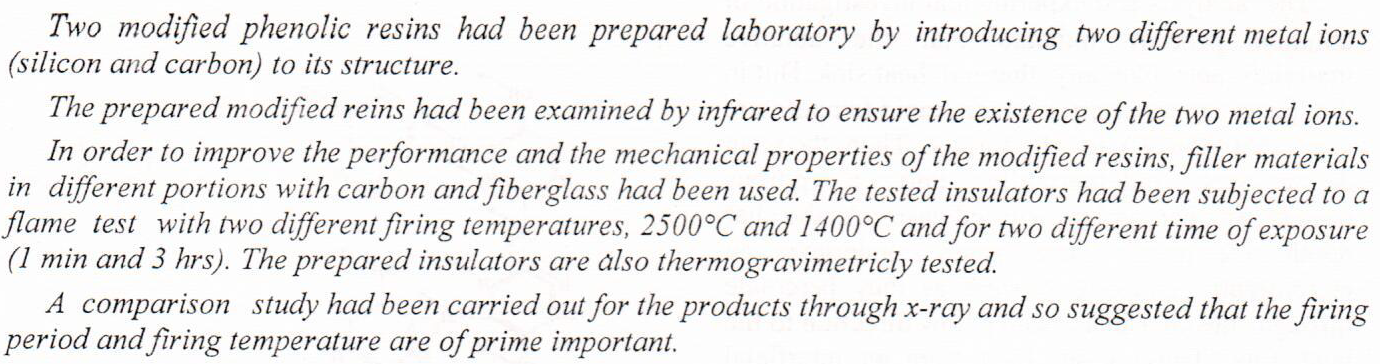
Isolation Behavior of Metal Modified Novolac Resin

Incremental sheet forming (ISF) process offers a high degree of flexibility in the manufacturing of different sheet parts, which makes it an ideal candidate for prototype parts as well as efficient at fabricating various customized products at low production costs compared to traditionally used processes. However, parts produced in this process exhibit notable geometrical inaccuracy and considerable thickness reduction. In this paper, the single point incremental sheet forming variant of the process has been implemented to manufacture a highly customized cranial implant starting from the computed tomography (CT) scan data of the patient's anatomy. A methodology, from the modeling to the realization of the implant, is presented and discus
... Show More (2)
(2)
 (2)
(2)

 (9)
(9)
Abstract In the current contribution, a novel binuclear nickel(II) and zinc(II) complexes were prepared from a hexadentate ligand prepared via condensation of 3,3'-Bipyridine-6,6'-dicarbaldehyde , 2-amino-5-chlorobenzaldehyde and 2-Aminophenol .The symmetric ligand (H2DTPE) and its metal complexes were illustrated utilizing various techniques of physicochemical containing magnetic moment, analytical analysis and spectroscopy of mass, IR, 13C and 1H NMR, TGA and UV-Vis. The particles of MO Nanoscale were created from the labeled complex applying the ways of pyrolysis and utilizing methods of XRD, FT-IR, and FE-SEM, that specified close compatibility with the typical pattern for nanoparticles of NiO, ZnO and appeared the reasonable size in
... Show MoreThe aim of the work is synthesis and characterization of bidentate ligand [3-(3-acetylphenylamino)-5,5-dimethylcyclohex-3-enone][HL], from the reaction of dimedone with 3-amino acetophenone to produce the ligand [HL], the reaction was carried out in dry benzene as a solvent under reflux. The prepared ligand [HL] was characterized by FT-IR, UV-Vis spectroscopy, 'H, 8C-NMR spectra, Mass spectra, (C.H.N) and melting point. The mixed ligand complexes were prepared from ligand [HL] was used as a primary ligand while 8-hydroxy quinoline [HQ] was used as a secondary ligand with metal ion M(IT).Where M(IT) = (Mn ,Co ,Ni ,Cu ,Zn ,Cd and Pd) at reflux ,using ethanol as a solvent, KOH as a
... Show More
Coupling reaction of m-and p- amino acetop henone and p-amino benzoic acid with (LHistidine) gave the new bidentate azo ligands (L1, L2 and L3). The prepared ligands were identified by FT-IR, UV-Vis, 1HNMR and GC- mass sp ectroscopic technique. Treatment of the prepared ligands with the following metal ions (CoII, NiII, CuII, ZnII, CdII and HgII) in aqueous ethanol with a 1:2 M:L ratio and at optimum pH, yielded a series of neutral complexes of the general formula [M (L)2 Cl2]. The prepared complexes were characterized by using flame atomic absorption, FT-IR, UV-Vis and 1HNMR spectroscopic methods as well as magnetic susceptibility and conductivity measurements. Chloride ion content was also evaluated by (Mohr method). The nature of the com
... Show MoreA mathematical model has been introduced to investigate the effect of nuclear reaction constant ( A ), probability of the BEC ground state occupation Ω i, nD is the number density of deuteron (d) and the overall number of nuclei ND on the total nuclear d-d fusion rate (R). Under steady-state of the condensates of Bose-Einstein, the postulate of quantum theory and Bose-Einstein theory were applied to evaluate the total nuclear (d-d) fusion rate trapping in Nickel-metal The total nuclear fusion rate trapping predicts a strong relationship between astrophysical S-factor and masses of Nickel. The reaction rate trapping model was tested on three reaction d(d,p)T, d(d, n)3He and d(d, 4He)Q = 23.8MeV respectively. The reaction rate has described
... Show More

Some metal ions (Mn+2, Co+2, Ni+2, Cu+2,Zn+2 and Cd+2) complexes of quodridentats Schiff base derived from (2-hydroxy benzaldehyde and 4,4'-methylenedianiline as primary ligand and 3-picoline (3-pic) secondary ligand have been synthesized and characterized on the basis of their 1H ,13C-NMR, FT-IR, UV-Vis spectroscopy, conductivity measurements, elemental analysis, and magnetic moments, metal to ligands ratio in all complexes has been found to be (1:1:2) (M:Schiff base:3-pic), Schiff base behaves as neutral tetra dentate ligand with (N2,O2) system from the results obtained, the following general formula has suggested for the prepared complexes [M+2(2-mbd)(3-pic)2] and octahedral stereochemistry, Where M+2 = (Mn , Co , Ni , Cu , Zn and Cd), 2
... Show MoreTungsten inert gas arc welding–based shaped metal deposition is a novel additive manufacturing technology which can be used for fabricating solid dense parts by melting a cold wire on a substrate in a layer-by-layer manner via continuous DC arc heat. The shaped metal deposition method would be an alternative way to traditional manufacturing methods, especially for complex featured and large-scale solid parts manufacturing, and it is particularly used for aerospace structural components, manufacturing, and repairing of die/molds and middle-sized dense parts. This article presents the designing, constructing, and controlling of an additive manufacturing system using tungsten inert gas plus wire–based shaped metal deposition metho
... Show More
(13)
(9)
(1)
(1)
The melting duration in the photovoltaic/phase-change material (PV/PCM) system is a crucial parameter for thermal energy management such that its improvement can realize better energy management in respect to thermal storage capabilities, thermal conditions, and the lifespan of PV modules. An innovative and efficient technique for improving the melting duration is the inclusion of an exterior metal foam layer in the PV/PCM system. For detailed investigations of utilizing different metal foam configurations in terms of their convective heat transfer coefficients, the present paper proposes a newly developed mathematical model for the PV/PCM–metal foam assembly that can readily be implemented with a wide range of operating condition
... Show More
(42)
(45)