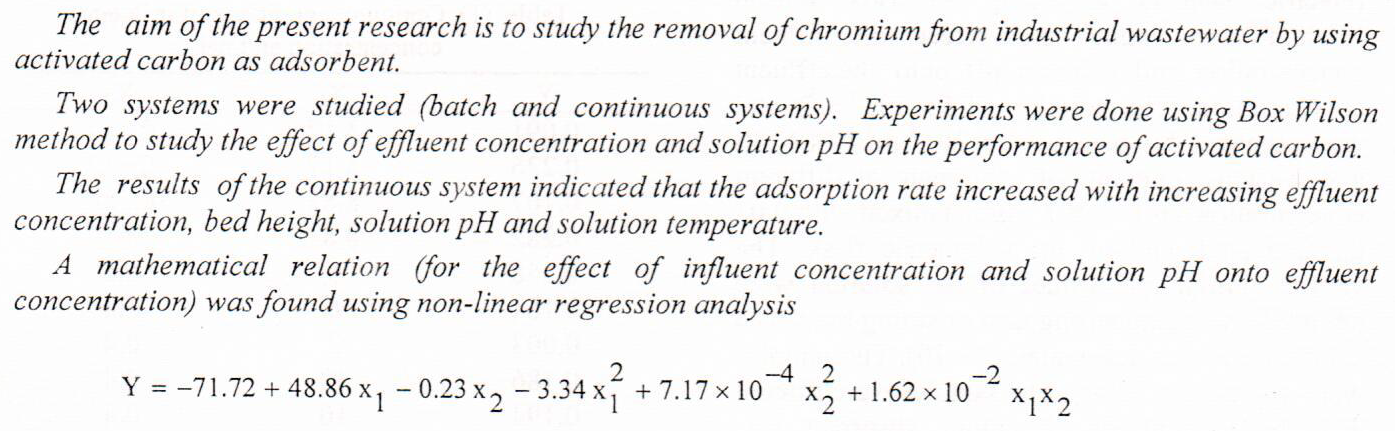
Removal of Chromium from Wastewater by Adsorption

This study evaluates the performance of magnetic abrasive finishing (MAF) of aluminum alloy in terms of achieving materials removal (MR). A vertical milling machine is used to perform the finishing process using a developed MAF unit that consists of an inductor made out of a 150 mm long and 20 mm diameter iron core wound with 1500 turns and 0.5 mm copper wire. The commutator and magnetic pole are attached at the top and bottom of the inductor, respectively. The required current is supplied using a DC power supply. The South Pole workpiece is a 100×50×3 mm3 plate of AA 1100 aluminum alloy, whereas the magnetic pole represented the North Pole. Pole rotational speed, applied current, and abrasive finishing time was selected as
... Show More (1)
(1)


This study reports on natural convection heat transfer in a square enclosure of length (L=20 cm) with a saturated porous medium (solid glass beads) having same fluid (air) at lower horizontal layer and free air fill in the rest of the cavity's space. The experimental work has been performed under the effects of heating from bottom by constant heat flux q=150,300,450,600 W/m2 for four porous layers thickness Hp (2.5,5,7.5,1) cm and three heaters length δ(20,14,7) cm. The top enclosure wall was good insulated and the two side walls were symmetrically cooled at constant temperature. Four layers of porous media with small porosity, Rayleigh number range (60.354 - 241.41) and (Da) 3.025x10⁻⁸ has been investigated. The obtained data of temperatu
... Show More (6)
(5)
(6)
(5)
This study investigates the phonotactics of English obstruent clusters in the word-final position from a markedness theory perspective among Iraqi EFL College Students whose native language, Arabic, prefers only two-member word-final obstruent cluster as a maximum. The markedness of clusters is measured depending on Iraqi EFL College Students’ utilization of the simplification strategies. This study tries to answer whether or not word-final obstruent clusters are marked or unmarked for Iraqi EFL College Students, and whether or not the markedness of the obstruent cluster increases as to its length. In order to answer these questions, a test has been distributed among 60 Iraqi EFL Fourth-Year College students, Department of English, Colleg
... Show More
(58)
(52)

In this study, biodiesel was prepared from chicken fat via a transesterification reaction using Mussel shells as a catalyst. Pretreatment of chicken fat was carried out using non‐catalytic esterification to reduce the free fatty acid content from 36.28 to 0.96 mg KOH/g oil using an ethanol/ fat mole ratio equal to 115:1. In the transesterification reaction, the studied variables were methanol: oil mole ratio in the range of (6:1 ‐ 30:1), catalyst loading in the range of (9‐15) wt%, reaction temperature (55‐75 °C), and reaction time (1‐7) h. The heterogeneous alkaline catalyst was greenly synthesized from waste mussel shells throughout a calcin
... Show More
(8)
(6)
In this study, biodiesel was prepared from chicken fat via a transesterification reaction using Mussel shells as a catalyst. Pretreatment of chicken fat was carried out using non‐catalytic esterification to reduce the free fatty acid content from 36.28 to 0.96 mg KOH/g oil using an ethanol/ fat mole ratio equal to 115:1. In the transesterification reaction, the studied variables were methanol: oil mole ratio in the range of (6:1 ‐ 30:1), catalyst loading in the range of (9‐15) wt%, reaction temperature (55‐75 °C), and reaction time (1‐7) h. The heterogeneous alkaline catalyst was greenly synthesized from waste mussel shells throughout a calcin
... Show More
(8)
(6)
(3)
Hydrogen sulfide removal catalyst was prepared chemically by precipitation of zinc bicarbonate at a controlled pH. The physical and chemical catalyst characterization properties were investigated. The catalyst was tested for its activity in adsorption of H2S using a plant that generates the H2S from naphtha hydrodesulphurization and a unit for the adsorption of H2S. The results comparison between the prepared and commercial catalysts revealed that the chemical method can be used to prepare the catalyst with a very good activity.
It has observed that the hydrogen sulfide removal over zinc oxide catalyst follows first order reaction kinetics with activation energy of 19.26 kJ/mole and enthalpy and e
... Show More