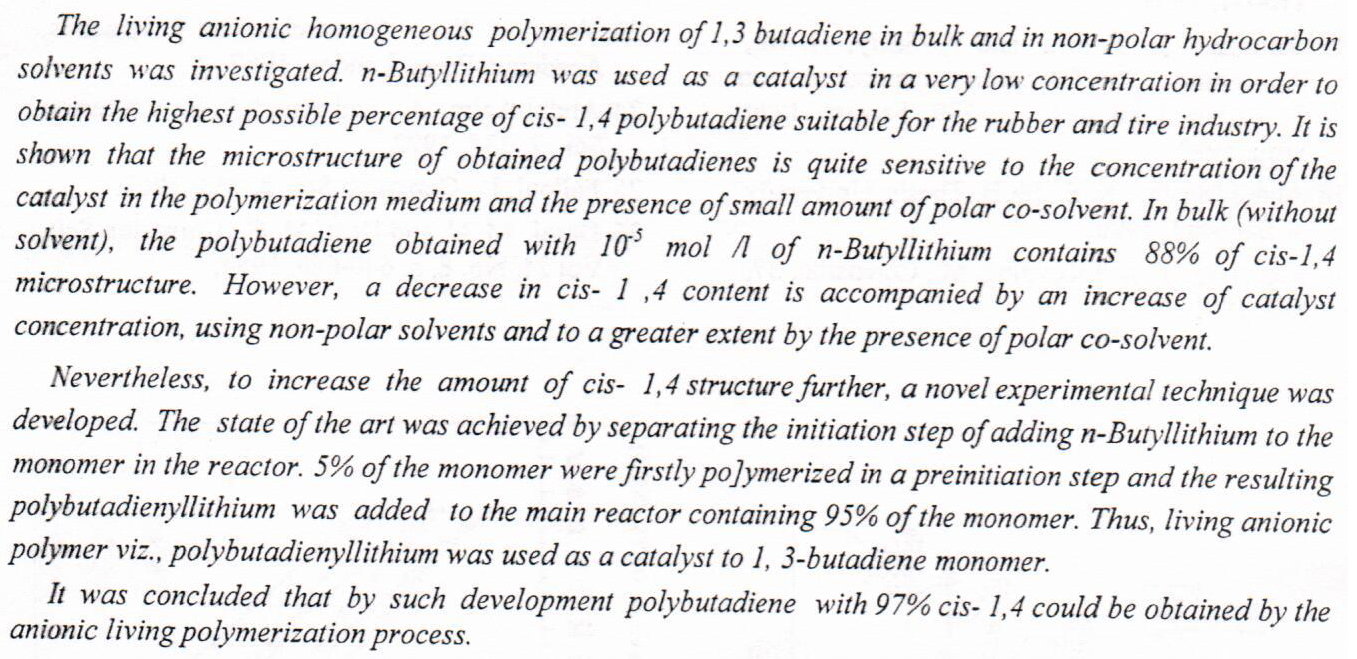
New Development in the Process for the Production of Polybutadiene Rubber




Morphological and phonological studies of fungal pathogen infecting alfalfa weevil Hypera postica (Gyllenhal) indicating that infection has been shown to develop along two distinct physiological lines, each culminating in the production of either conidial or resting spores, in host cadavers which are morphologically distinct. The percent of infection and epizootic development appeared to be dependent on host density. Farther evidence to entail proper correlation between conidia and resting spores suggest that these two forms of spores are stages in the development of one pathogen.
The research endeavors to harness the benefits stemming from the integration of constraint theory into construction project management, with the primary goal of mitigating project completion delays. Additionally, it employs fuzzy analysis to determine the relative significance of fundamental constraints within projects by assigning them appropriate weights. The research problem primarily revolves around two key issues. Firstly, the persistent utilization of outdated methodologies and a heavy reliance on workforce experience without embracing modern computerized technologies. Secondly, the recurring problem of project delivery delays. Construction projects typically encompass five fundamental constraint types: cost restrictions, tim
... Show More
In this study, genetic algorithm was used to predict the reaction kinetics of Iraqi heavy naphtha catalytic reforming process located in Al-Doura refinery in Baghdad. One-dimensional steady state model was derived to describe commercial catalytic reforming unit consisting of four catalytic reforming reactors in series process.
The experimental information (Reformate composition and output temperature) for each four reactors collected at different operating conditions was used to predict the parameters of the proposed kinetic model. The kinetic model involving 24 components, 1 to 11 carbon atoms for paraffins and 6 to 11 carbon atom for naphthenes and aromatics with 71 reactions. The pre-exponential Arrhenius constants and a
... Show MoreMany of accurate inertial guided missilc systems need to use more complex mathematical calculations and require a high speed processing to ensure the real-time opreation. This will give rise to the need of developing an effcint
Sustainable development (SD) is an improvement that meets present needs but jeopardizes the ability of new populations to do the same. It is vital to acquaint EFL students with the terminology and idiomatic expressions of this discipline. Nowadays, sustainable development and the environment have been prioritized in every aspect of life. Since culture and the teaching of Foreign language English cannot be separated, the English language becomes the mean of communication in health, economics, education, and politics. Thus, integrating sustainable development goals within language learning and teaching is very important. This descriptive quantitative study aims to investigate the perception of EFL pre-service teachers of sustainable developme
... Show More
Sustainable development (SD) is an improvement that meets present needs but jeopardizes the ability of new populations to do the same. It is vital to acquaint EFL students with the terminology and idiomatic expressions of this discipline. Nowadays, sustainable development and the environment have been prioritized in every aspect of life. Since culture and the teaching of Foreign language English cannot be separated, the English language becomes the mean of communication in health, economics, education, and politics. Thus, integrating sustainable development goals within language learning and teaching is very important. This descriptive quantitative study aims to investigate the perception of EFL pre-service teachers of sustainable develo
... Show MoreThe areas surrounding Iraqi international airports generally suffer from a lack of interest in their planning in a manner compatible with the airport with the absence of integrated planning between the airport and the city. From here, the search problem appears. It is represented by a lack of interest in the integration of urban planning and airport planning and the lack of a clear policy to deal with the areas surrounding international airports. A desire to achieve the research aims to introduce compatible uses in the vicinity of airports and review the planning and global directions for dealing with the areas surrounding the airports within urban areas. In contrast, the second aspect of the research aims to assess the
... Show More
The present investigation developed the ester prodrugs of Non-steroidal anti inflammatory drugs (NSAIDs), Mefenamic acid and Flurbiprofen by conjugating with the natural antioxidant, 4-methyl umbelliferone that resulted the formation of Mefenamic acid-umbelliferone ester prodrug and Flurbiprofen-umbelliferone ester prodrug .The principal objective this study is the synthesis of the ester prodrugs of NSAIDs with the enhanced therapeutic activity and minimized side effects. Prodrugs were synthesized by coupling method using N,N’- dicyclohexylcarbodiimide/4-dimethylaminopyrimidine, subjected to physical, chemical characterization, spectral characterization (IR, 1H NMR, 13C NMR and Mass spectra),hydro
... Show More (9)
(9)
 (8)
(8)