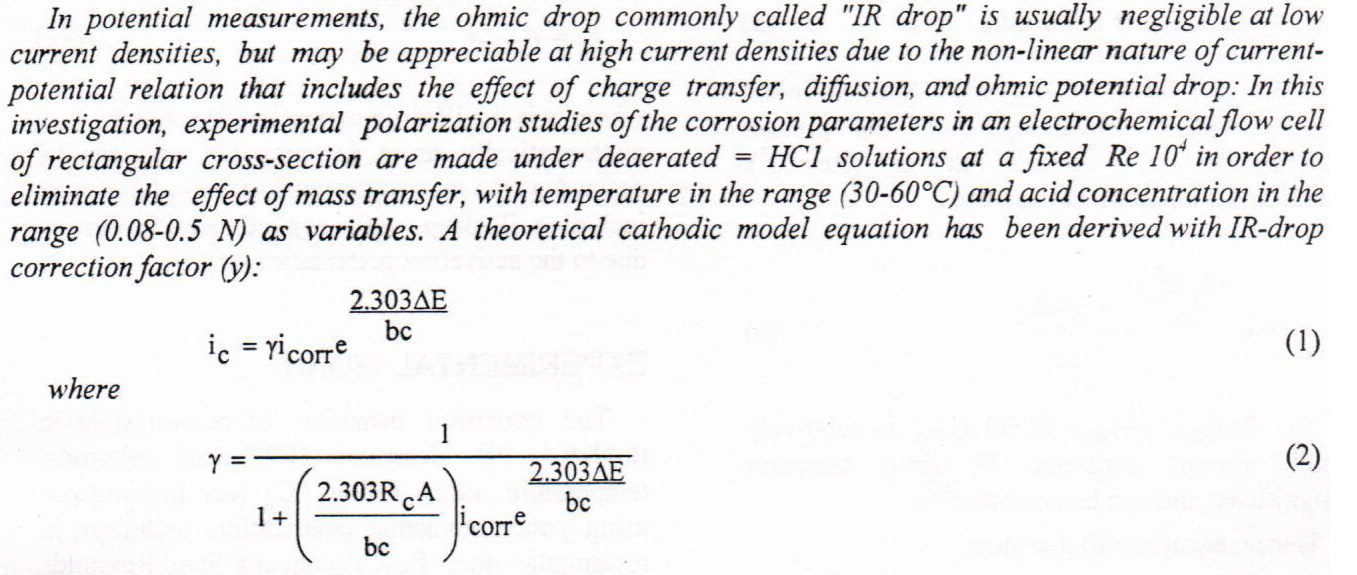
Determination of Corrosion Parameters for a Cathodic Reaction Complicated by IR Drop Effect in a Flow System

In this work, a CW CO2 laser was used for cutting samples of the fiber-reinforced
plastics (FRP) of three different types of reinforcing material; aramide, glass and carbon.
Cutting process was investigated throughout the variation of some parameters of cutting
process and their effects on cutting quality as well as the effect of an inert gas exist in the
interaction region and finally using a mechanical chopper in order to enhance the cutting
quality. Results obtained explained the possibility to perform laser cutting with high
quality in these materials by good control of the parameters and conditions of the process.
Background: The main purpose of this study is to find if there is any correlation between the level of C-reactive protein (CRP) in gingival crevicular fluid with its serum level in chronic periodontitis patients and to explore the differences between them according to the probing depth. Materials and methods: Forty seven male subjects enrolled in this study. Thirty males with chronic periodontitis considered as study group whom further subdivided according to probing depth into subgroup 1 with pocket depth ≤6mm, subgroup 2 with pocket depth >6mm. The other 17 subjects considered as controls. For all subjects, clinical examination where done for periodontal parameters plaque index (PLI), gingival index (GI), bleeding on probing (BOP),
... Show MoreCorrosion of steel reinforcement is one of the biggest problems facing all countries in the world like bridges in the beach area and marine constructions which lead to study these problems and apply some economical solutions. According to the high cost of repair for these constructions, were studied the effect of using kind of chemical compounds sodium nitrite(NaNO2) and sodium silicate(Na2SiO3) as corrosion inhibitors admixture for steel bars that immersed partially in electrolyte solution (water + sodium chloride in 3% conc.) (Approximately similar to the concentration of salt in sea water). The two inhibitors above added each one to the electrolyte solution at concentrations (0.5%, 1% and 2%) for both
... Show More (1)
(1)

Geotechnical characterization of the sites has been investigated with the collection of borehole data from different sources. Using the data, grain size distribution curves have been developed to understand the particle size distribution of the alluvium present. These curves were further used for preliminary assessment of liquefiable areas. From geotechnical characterization, it has been observed that the soil profile in the two sites is dominated by sand and silty sand.Seed and Idriss (1971) approachhas been usedevaluatethe liquefaction potentialbydeterminationof the relation between the maximum ground acceleration (a max/g) valuesdue to an earthquake and the relative density of a sand deposit in the field. The results reveal that
... Show More (6)
(2)
(6)
(2)

In this study, cloud point extraction combined with molecular spectrometry as an eco-friendly method is used for extraction, enrichment and determination of bendiocarb (BC) insecticide in different complex matrices. The method involved an alkaline hydrolysis of BC followed Emerson reaction in which the resultant phenol is reacted with 4-aminoantipyrene(4-AAP) in the presence of an alkaline oxidant of potassium ferric cyanide to form red colored product which then extracted into micelles of Triton X-114 as a mediated extractant at room temperature. The extracted product in cloud point layer is separated from the aqueous layer by centrifugation for 20 min and dissolved in a minimum amount of a mixture ethanol: water (1:1) followed
... Show More
(3)
Antibiotics are essential for treating infectious diseases, but their overuse and adverse effects are raising concerns about global public health. The pervasiveness of antibiotic contamination in aquatic environments has drawn increased attention in recent years. The primary concern regarding the release of antibiotics into the environment is the potential for microorganisms to become resistant to antibiotics. This review article summarizes the analytical methods used to determine the presence of trimethoprim and metronidazole in various environmental samples. These antibiotics have traditionally been analyzed using tandem mass spectrometry or high-performance liquid chromatography coupled to mass spectrometry; fluorescence or ultrav
... Show MoreIn this study, a mathematical model is presented to study the chemisorption of two interacting atoms on solid surface in the presence of laser field. Our mathematical model is based on the occupation numbers formula that depends on the laser field which we derived according to Anderson model for single atom adsorbed on solid surface. Occupation numbers formula and chemisorption energy formula are derived for two interacting atoms (as a diatomic molecule) as they approach to the surface taking into account the correlation effects on each atom and between atoms. This model is characterized by obvious dependence of all relations on the system variables and the laser field characteristics which gives precise description for the molecule –
... Show MoreHydrochloric acid (HCl) is a substance that is frequently utilized in industrial operations for important tasks such as chemical cleaning and pickling metallic surfaces.Therefore, the corrosion inhibition ability of three newly synthesized quinazoline derivatives namely, 3-allyl-2-(propylthio) quinazolin-4(3H)-one) (APQ), (3-allyl-2-(allylthio) quinazolin-4(3H)-one) (AAQ), (3-allyl- 2-( Prop -2-yn -1-ylthio) Quinazolin - 4 (3H) - one) (AYQ) were theoretically determined and these compounds were characterized using Fourier Transform Infra-Red (FTIR) and 1H and 13C Nuclear Magnetic Resonance (NMR) spectroscopic. A series of quantum chemical properties of these derivatives: EHOMO, ELUMO, energy gap (ΔE),dipole moment (μ), hardness (η), soft
... Show MoreBackground: Optimal root canal retreatment was required safe and efficient removal of filling material from root canal. The aim of this in vitro study was to compare the efficacy of reciprocating and continuous motion of four retreatment systems in removal of root canal filling material. Materials and Methods: Forty distal roots of the mandibular first molars teeth were used in this study, these roots were embedded in cold clear acrylic,roots were instrumented using crown down technique and rotary ProTaper systemize Sx to size F2 ,instrumentation were done with copiousirrigation of 2.5% sodium hypochlorite and 17% buffered solution of EDTA was used as final irrigant followed by distilledwater, roots were obturated with AH26 sealer and Prota
... Show More