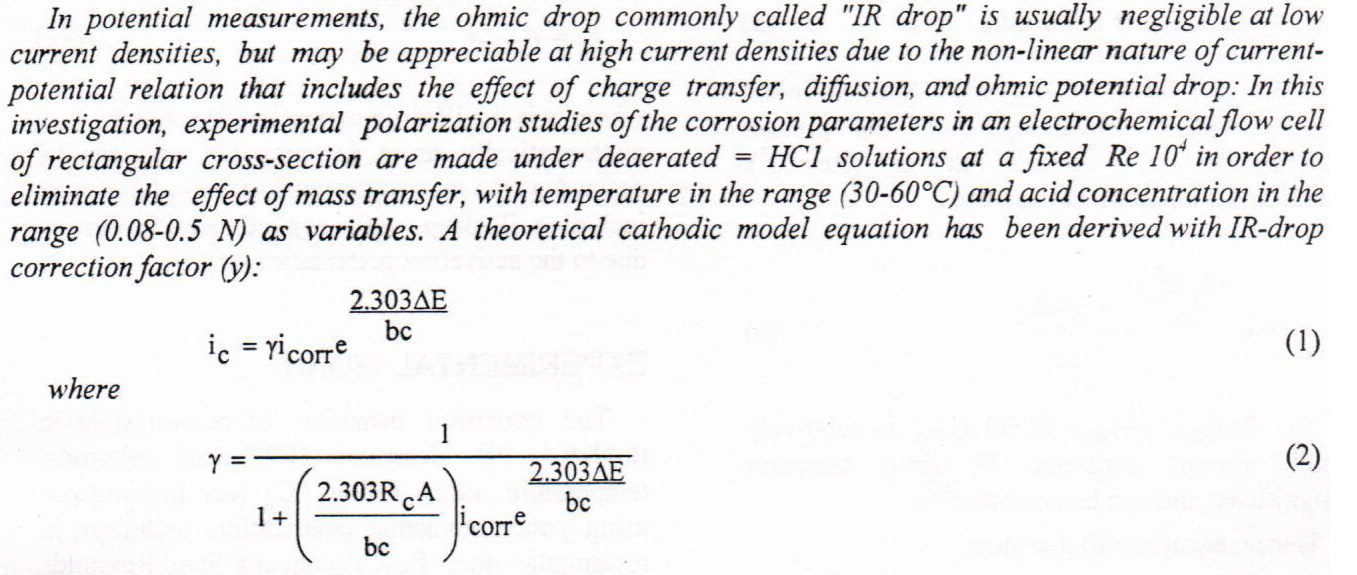
Determination of Corrosion Parameters for a Cathodic Reaction Complicated by IR Drop Effect in a Flow System

Developments are carried out to enhance the performance of vertical axis wind turbines (VAWT). This paper studies the performance of the ducted wind turbine with convergent duct (DAWT). Basically, the duct technique is utilized to provide the desired wind velocity facing the turbine. Methodology was developed to estimate the decisive performance parameter and to present the effect of the convergent duct with different inlet angles. The ducted wind turbine was analyzed and simulated using MATLAB software and numerically using ANSYS-Fluent 17.2. Result of both approaches were presented and showed good closeness for the two cases of covering angles 12 and 20 respectively. Results also showed that the convergent duct with an inlet angl
... Show More (1)
(1)

Static Synchronous Series Compensator (SSSC) is a well known device for effectively regulating the active power flow in a power system. In this paper, the SSSC linearized power flow equations are incorporated into Newton-Raphson algorithm in a MATLAB written program to investigate the control of active poweer flow and the transient stability of a five bus and a thirty bus IEEE test systems, during abnormal conduction (three phase fault near buses). A comparison of the results obtained for the base case without SSSC and with it to investigate the effectiveness of the device on both of the active power flow and the transient stability.
 (5)
(3)
(5)
(3)

Background: Fruits and their by-products are the primary sources of bioactive chemicals in plants. Because of its phytochemical richness, Annona squamosa fruits have gained the alertness of people willing in health-promoting diets. The purpose of this in vitro study was to evaluate the cytocompatibility effect of ethanolic crude extract of Annona squamosa pulp against a human normal cell line as a mouthwash for children. Material and method: The ethanolic extract of Annona squamosa pulp was extracted using the ultrasonic method and then lyophilized to make it powder. The MTT (3-(4,5-dimethylthiazol-2-yl)-2,5-diphenyl-2H-tetrazolium bromide) test was performed to investigate the cytotoxic activity of the pulp extract on a human normal cell l
... Show More
(7)
(6)
(9)
(8)

A study was carried out to analysis of some heavy metals in nine different types of vinegar, belong to Grape, Apple, Synthetic White, Date, Hawthorn, Garlic, Cactus, Pomegranate and Ginger vinegar, which are locally available in Iraqi folk medicine markets. The concentrations of heavy metals in the studied samples including, Cr, Mg, Mn, Zn, Fe, Cd, Ni, Pb and Ag, were determining by using flame atomic absorption spectrophotometry. All data were subjected to statistical analysis by calculating accuracy, precision and correlation coefficient for each concentrations level. The results indicate that Ni was recorded the highest concentration in all studied samples except, Ginger and cactus vinegar, each one receded the highest concentration valu
... Show MoreThe study aimed to investigate the effect of fungicides chlorothalonil at different concentrations ( 0.1 , 0.5 , 5 , 25 , 50 ) × 10 - 5 M on some cytogenetic parameters of human peripheral blood lymphocytes . The genotoxicity parameters were estimated by the number of chromosomal aberrations (CAs) and their types and by estimating the induced micronuclei (Mn) . Cytotoxic effect recorded by estimating the mitotic index (MI) . Results revealed that the fungicide increased the CAs in dose – response pattern with positive correlation coefficient ( r = + 0.964) , there was a significant differences among the concentrations (P<0.01) . The major CAs records chromosomal breakage at concentrations. 0.5 , 5 , 25 , and 50 , while the lowest concen
... Show More
PbxCd1-xSe compound with different Pb percentage (i.e. X=0,
0.025, 0.050, 0.075, and 0.1) were prepared successfully. Thin films
were deposited by thermal evaporation on glass substrates at film
thickness (126) nm. The optical measurements indicated that
PbxCd1-xSe films have direct optical energy gap. The value of the
energy gap decreases with the increase of Pb content from 1.78 eV to
1.49 eV.
In this research, (MOORA) approach based– Taguchi design was used to convert the multi-performance problem into a single-performance problem for nine experiments which built (Taguchi (L9) orthogonal array) for carburization operation. The main variables that had a great effect on carburizing operation are carburization temperature (oC), carburization time (hrs.) and tempering temperature (oC). This study was also focused on calculating the amount of carbon penetration, the value of hardness and optimal values obtained during the optimization by Taguchi approach and MOORA method for multiple parameters. In this study, the carburization process was done in temperature between (850 to 950 ᵒC) for 2 to 6
... Show More
(2)