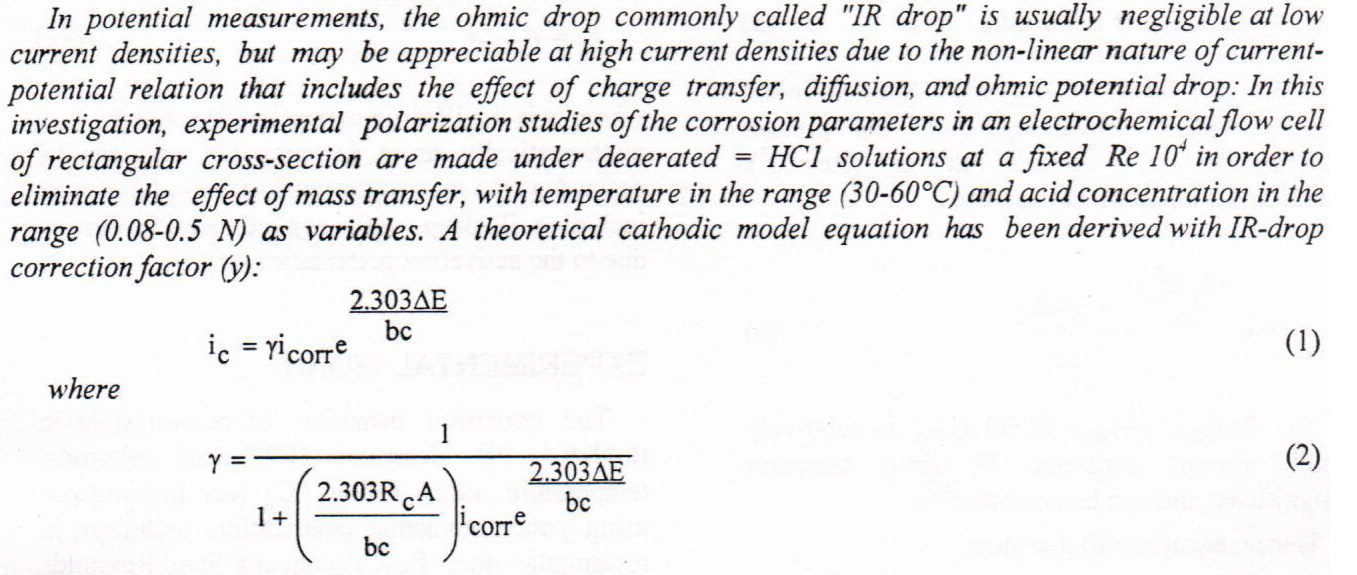
Determination of Corrosion Parameters for a Cathodic Reaction Complicated by IR Drop Effect in a Flow System

Folic acid modulates several disorders in humans, pregnancy mostly because of the mitochondria-rich placenta, is a condition that favors oxidative stress.Transitional metals, especially iron, which are particularly abundant in the placenta, are important in the production of free radicals. Adenosine deaminase (ADA), an enzyme essential for the differentiation of lymphoid cells, has been used for monitoring diseases with altered immunity. In the present study we investigated the effect of regular and irregular administered folic acid in the first and second trimester of pregnancy to be compared with non-pregnant women ,and also the effect of regular and irregular using of folic acid supplement on oxidative stress parameters an
... Show More
 (22)
(22)
 (21)
(21)

A simple, rapid and sensitive spectrophotometirc method for the determination of trace amounts of promethazine hydrochloride in the aqueous solution is described. The method is based on the complexation of promethazine hydrochloride with In (III) in the presence of sodium hydroxide to form an soluble product with maximum absorption at 304nm. Beer’s law is obeyed over the concentration range of (2- 20μg/ml) with molar absorptivity of (1.92× 10³ L.mol-1 .cm -1 ). The optimum conditions for all development are described and the proposed method has been successfully applied for the determination of promethazine hydrochloride in bulk drug.
Abstract
The Classical Normal Linear Regression Model Based on Several hypotheses, one of them is Heteroscedasticity as it is known that the wing of least squares method (OLS), under the existence of these two problems make the estimators, lose their desirable properties, in addition the statistical inference becomes unaccepted table. According that we put tow alternative, the first one is (Generalized Least Square) Which is denoted by (GLS), and the second alternative is to (Robust covariance matrix estimation) the estimated parameters method(OLS), and that the way (GLS) method neat and certified, if the capabilities (Efficient) and the statistical inference Thread on the basis of an acceptable
... Show More
In this paper, the system of the power plant has been investigated as a special type of industrial systems, which has a significant role in improving societies since the electrical energy has entered all kinds of industries, and it is considered as the artery of modern life.
The aim of this research is to construct a programming system, which could be used to identify the most important failure modes that are occur in a steam type of power plants. Also the effects and reasons of each failure mode could be analyzed through the usage of this programming system reaching to the basic events (main reasons) that causing each failure mode. The construction of this system for FMEA is dependi
... Show MoreThe economical and highly performed anode material is the critical factor affecting the efficiency of electro-oxidation toward organics. The present study aimed to detect the best conditions to prepare Mn-Co oxide composite anode for the electro-oxidation of phenol. Deposition of Mn-Co oxide onto graphite substrate was investigated at 25, 30, and 35 mA/cm2 to detect the best conditions for deposition. The structure and the crystal size of the Mn-Co oxide composite electrode were examined by using an X-Ray diffractometer (XRD), the morphological properties of the prepared electrode were studied by scanning electron microscopy (SEM) and Atomic force microscopy (AFM) techniques, and the chemical composition of the various
... Show More
The study aimed to determine of some Optimum conditions for bioremediation and removing of seven mineral elements included hexavalent chromium, nickel, cobalt, cadmium, lead, iron and copper as either alone or in group by living and heat treated cells of baker’s yeast Saccharomyces cerevisiae. The dried baker's yeast from Aldnaamaya China Company was used in this study. Biochemical tests was used to ensure yeast belonging to S. cerevisiae and then used to remove the mentioned mineral elementes under different conditions which included incubation period, pH, and temperature. It was found that the best of these conditions was 60 minutes for duration of incubation, 6 for pH, 25 ᵒC for temperature. During the study the behavior of living
... Show More