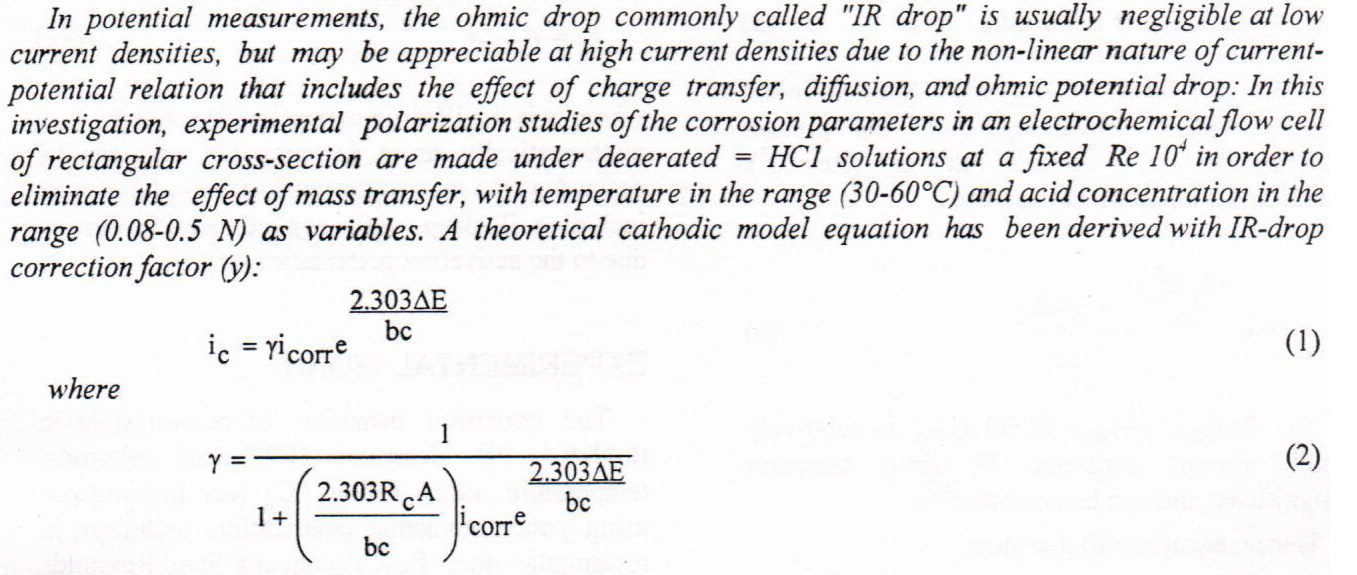
Determination of Corrosion Parameters for a Cathodic Reaction Complicated by IR Drop Effect in a Flow System

This paper deals with the Magnetohydrodynyamic (Mill)) flow for a viscoclastic fluid of the generalized Oldroyd-B model. The fractional calculus approach is used to establish the constitutive relationship of the non-Newtonian fluid model. Exact analytic solutions for the velocity and shear stress fields in terms of the Fox H-function are obtained by using discrete Laplace transform. The effect of different parameter that controlled the motion and shear stress equations are studied through plotting using the MATHEMATICA-8 software.
A new method for construction ion-selective electrode (ISE) by heating reaction of methyl orange with ammonium reineckate using PVC as plasticizer for determination methyl orange and determination Amitriptyline Hydrochloried drug by formation ion-pair on electrode surface . The characteristics of the electrode and it response as following : internal solution 10-4M , pH (2.5-5) ,temperature (20-30) and response time 2 sec. Calibration response for methyl orange over the concentrationrange 10-3 -10-9 M with R=0.9989 , RSD%=0.1052, D.O.L=0.315X10⁻⁹ MEre%=(-0.877- -2.76) , Rec%.=(97.230 -101.711) .

This study investigates the implementation of Taguchi design in the estimation of minimum corrosion rate of mild-steel in cooling tower that uses saline solution of different concentration. The experiments were set on the basis of Taguchi’s L16 orthogonal array. The runs were carried out under different condition such as inlet concentration of saline solution, temperature, and flowrate. The Signal-to- Noise ratio and ANOVA analysis were used to define the impact of cooling tower working conditions on the corrosion rate. A regression had been modelled and optimized to identify the optimum level for the working parameters that had been founded to be 13%NaCl, 35ᴼC, and 1 l/min. Also a confirmation run to establish the p
... Show More (7)
(7)


 (23)
(14)
(23)
(14)
This research work aims to the determination of molybdenum (VI) ion via the formation of peroxy molybdenum compounds which has red-brown colour with absorbance wave length at 455nm for the system of ammonia solution-hydrogen peroxide-molybdenum (VI) using a completely newly developed microphotometer based on the ON-Line measurement. Variation of responses expressed in millivolt. A correlation coefficient of 0.9925 for the range of 2.5-150 ?g.ml-1 with percentage linearity of 98.50%. A detection limit of 0.25 ?g.ml-1 was obtained. All physical and chemical variable were optimized interferences of cation and anion were studied classical method of measurement were done and compared well with newly on-line measurements. Application for the use
... Show More
The aim of this research is to calculate mass transfer coefficient, kd, during cathodic protection of low carbon steel in neutral seawater (3.5% W/V NaCl in distilled water with pH = 7). Two types of cathodic protection were used:
First: Sacrificial anode cathodic protection (SACP) were a pipeline of steel carrying seawater using zinc as a sacrificial anode and with variable temperatures ranged (0 – 45oC) and volumetric flow rate ranged (5 – 900 lit/hr). It was found that the kd increases with increasing temperature and volumetric flow rate of seawater, where kd ranged (0.24×10⁻⁶ – 41.6×10⁻⁶ m/s).
Second: Impressed current cathodic pr
... Show MoreThe research seeks to identify the comprehensive electronic banking system and the role of the auditor in light of the customer's application of electronic systems that depend on the Internet in providing its services, as a proposed audit program has been prepared in accordance with international auditing controls and standards based on the study of the customer's environment and the analysis of external and internal risks in the light of financial and non-financial indicators, the research reached a set of conclusions, most notably, increasing the dependence of banks on the comprehensive banking system for its ability to provide new and diverse banking services, The researcher suggested several recommendations, the most important of whi
... Show MoreBackground: Despite the fact that asthma is a long-term disease that may be treated, many people are unable to control their symptoms due to a lack of knowledge about their condition. The study's purpose was to find out if a pharmacist intervention improved asthma management because of this.
Objective: this study designed to assess the effect of pharmaceutical care on pulmonary functions test.
Method: The study was completed in three months. The patients who were enrolled were divided into two groups: Group 1 consists of 23 asthma patients who were randomly assigned to receive conventional therapy for chronic bronchial asthma based on disease stage and se
... Show More
(2)
(2)
Flow-injection (FI) spectrophotometric method has been developed for the analysis of thymol in pharmaceutical preparations. The method is based on organic coupling reaction between thymol and 4-amino antipyrine in the presence of alkaline medium to form an intense stable red color complex with copper nitrate that has a maximum absorption at 490 nm. Optimum conditions for determination of the drug was investigated .The calibration graph was linear over the range of 5-500 µg.ml-1 of thymol . The limit of detection (LOD) and limit of quantification (LOQ) were 1.81 ?g mL-1 and 3.60 ?g mL-1 respectively .The proposed method was applied satisfactorily to the determination of thymol in mouth wash preparations. The procedure is characterized by
... Show More
(1)