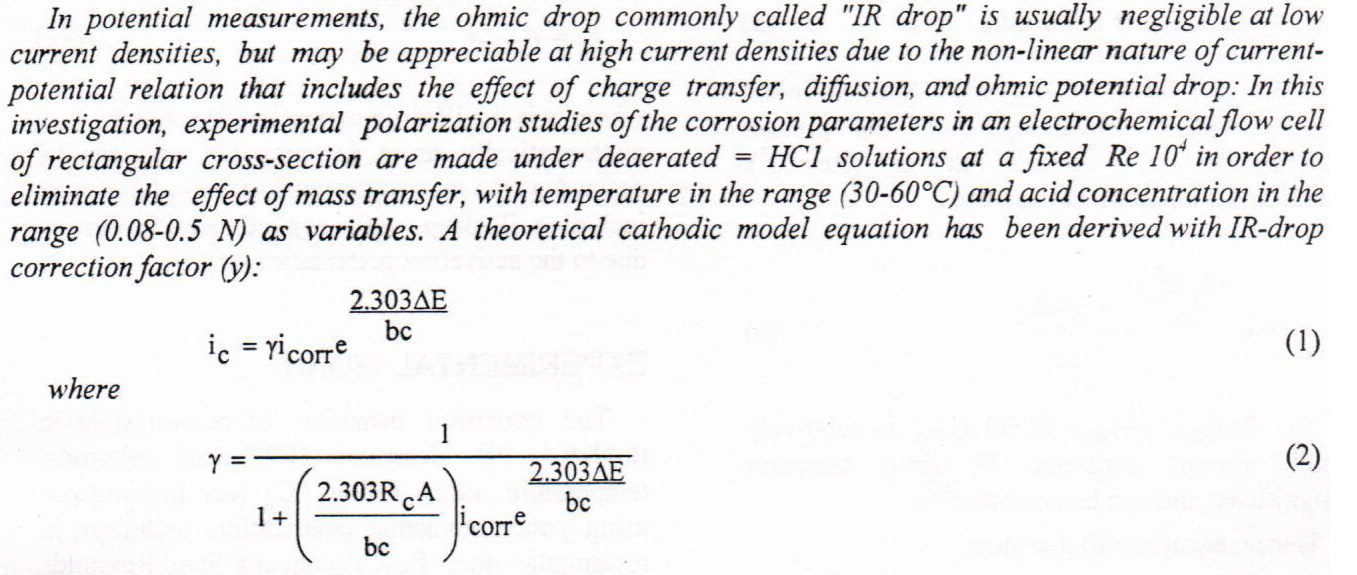
Determination of Corrosion Parameters for a Cathodic Reaction Complicated by IR Drop Effect in a Flow System

Cadmium oxide (CdO) thin films were deposited using the sequencing ion layer adsorption and reaction (SILAR) method. In this study, the effect of the pH value of an aqueous solution of cadmium acetate at a concentration of 0.2 mol of the cadmium oxide film was determined. The solution source for the cadmium oxide film was cadmium ions and an aqueous ammonia solution. The CdO films were deposited on glass substrates at a temperature of 90 ℃. The cadmium oxide film thickness was determined by the weight difference method at pH values (7.2, 8.2). X-ray diffraction (XRD) and scanning electron microscopy (SEM) showed that the size of the crystals increased with the increase in the solution (pH). While the UV-visible spectra of the fil
... Show More
 (5)
(5)
 (5)
(5)
 (5)
(8)
(5)
(8)
The current study aims to identify the artistic expression as well as the aspects of artistic expression by the painting among the kindergarten children. In order to fulfill the research's goals, a sample of (400) children were chosen randomly from 19 public kindergartens of 6 directorates at Al-Rusafa and Al-Karkh in Baghdad city. The children were asked to draw a particular view. The researcher has adopted Al-Hamedawi scale (2009) consisted of (16) items, which was exposed to group of (25) experts in psychology, education, measurement and evaluation, artistic education by painting and plastics to show the items reliability. As the researcher applied T-test for 
... Show More
(5)
(8)

Despite the antiplaque effect of mouth-rinsing with a combination composed of miswak (Salvadora persica L.) and green tea (Camellia sinensis var. assamica) extracts, no data are available regarding its effect on gingival tissue at the molecular level. This pilot study aimed to assess the effect of oral rinsing with this combination on gingival crevicular fluid (GCF) flow and IL-1β levels. Ten subjects rinsed with either the combination, 0.12% chlorhexidine gluconate (CHX) or distilled water without toothbrushing for 4 days after receiving baseline polishing. GCF IL-1β concentration, influx, resting volume and plaque quantity were measured at baseline and after 4 days for each intervention. No significant differences in GCF flow or
... Show More
(2)
(1)
This paper presents a research for magnetohydrodynamic (MHD) flow of an incompressible generalized Burgers’ fluid including by an accelerating plate and flowing under the action of pressure gradient. Where the no – slip assumption between the wall and the fluid is no longer valid. The fractional calculus approach is introduced to establish the constitutive relationship of the generalized Burgers’ fluid. By using the discrete Laplace transform of the sequential fractional derivatives, a closed form solutions for the velocity and shear stress are obtained in terms of Fox H- function for the following two problems: (i) flow due to a constant pressure gradient, and (ii) flow due to due to a sinusoidal pressure gradient. The solutions for
... Show MoreBackground: This study was conducted to evaluate the hard palate bone density and thickness during 3rd and 4th decades and their relationships with body mass index (BMI) and compositions, to allow more accurate mini-implant placement. Materials and method: Computed tomographic (CT) images were obtained for 60 patients (30 males and 30 females) with age range 20-39 years. The hard palate bone density and thickness were measured at 20 sites at the intersection of five anterioposterior and four mediolateral reference lines with 6 and 3 mm intervals from incisive foramen and mid-palatal suture respectively. Diagnostic scale operates according to the bioelectric impedance analysis principle was used to measure body weight; percentages of body fa
... Show MoreWe propose a new method for detecting the abnormality in cerebral tissues present within Magnetic Resonance Images (MRI). Present classifier is comprised of cerebral tissue extraction, image division into angular and distance span vectors, acquirement of four features for each portion and classification to ascertain the abnormality location. The threshold value and region of interest are discerned using operator input and Otsu algorithm. Novel brain slices image division is introduced via angular and distance span vectors of sizes 24˚ with 15 pixels. Rotation invariance of the angular span vector is determined. An automatic image categorization into normal and abnormal brain tissues is performed using Support Vector Machine (SVM). St
... Show More