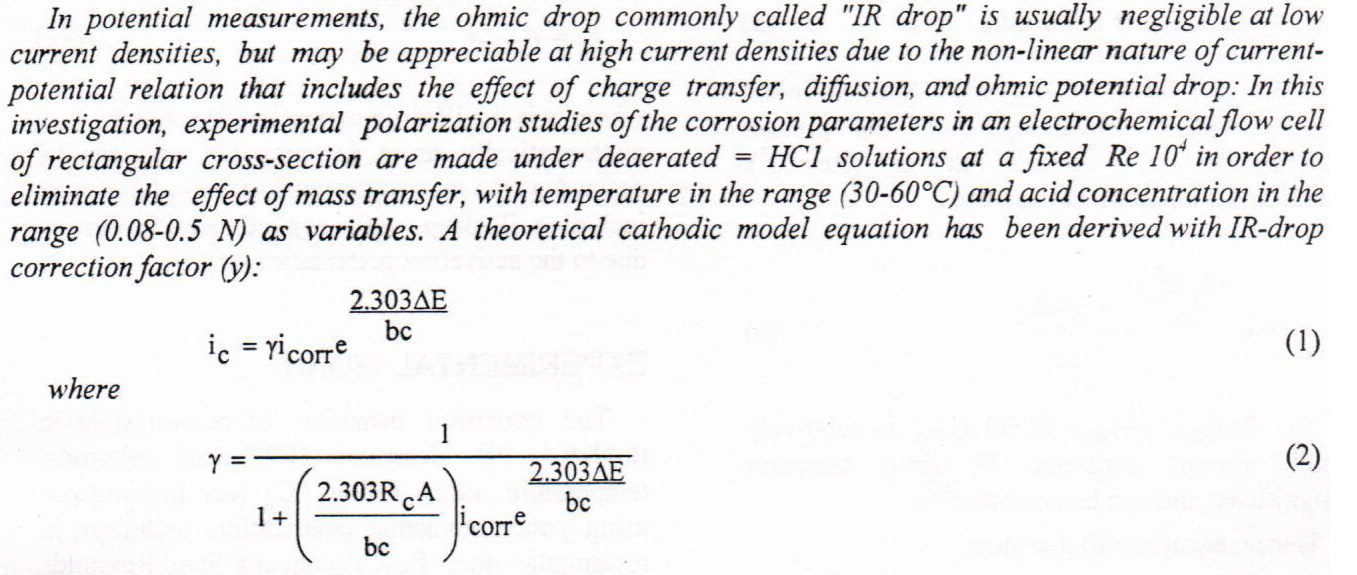
Determination of Corrosion Parameters for a Cathodic Reaction Complicated by IR Drop Effect in a Flow System

The main objective of this paper is to develop and validate flow injection method, a precise, accurate, simple, economic, low cost and specific turbidimetric method for the quantitative determination of mebeverine hydrochloride (MbH) in pharmaceutical preparations. A homemade NAG Dual & Solo (0-180º) analyser which contains two identical detections units (cell 1 and 2) was applied for turbidity measurements. The developed method was optimized for different chemical and physical parameters such as perception reagent concentrations, aqueous salts solutions, flow rate, the intensity of the sources light, sample volume, mixing coil and purge time. The correlation coefficients (r) of the developed method were 0.9980 and 0.9986 for
... Show More (30)
(30)
 (13)
(13)



The main objective of this paper is to develop and validate flow injection method, a precise, accurate, simple, economic, low cost and specific turbidimetric method for the quantitative determination of mebeverine hydrochloride (MbH) in pharmaceutical preparations. A homemade NAG Dual & Solo (0-180º) analyser which contains two identical detections units (cell 1 and 2) was applied for turbidity measurements. The developed method was optimized for different chemical and physical parameters such as perception reagent concentrations, aqueous salts solutions, flow rate, the intensity of the sources light, sample volume, mixing coil and purge time. The correlation coefficients (r) of the developed method were 0.9980 and 0.9986 for cell
... Show More
(30)
(13)
This study discussed a biased estimator of the Negative Binomial Regression model known as (Liu Estimator), This estimate was used to reduce variance and overcome the problem Multicollinearity between explanatory variables, Some estimates were used such as Ridge Regression and Maximum Likelihood Estimators, This research aims at the theoretical comparisons between the new estimator (Liu Estimator) and the estimators
(3)
(2)
A new spectrophotometric flow injection method has been establish for the determintaions of some catecholaminedrugs
Focusing on the negative role of default risk on banks, as it is one of the most important risks facing banks, which are difficult to determine accurately, and its reflection on the indicators of profitability of cash flows. The increasing competition between banks led to an increase in the credit facilities granted by banks, and was accompanied by an increase in exposure to the risks of default, which led to an impact on the level of performance of banks in terms of achieving the required return according to the levels of high competition. Therefore, the problem of this study focused on the extent to which the risk indicators of default affect the profitability indicators of the cash flows of the banks research sample in the profit
... Show More
This work examines numerically the effects of particle size, particle thermal conductivity and inlet velocity of forced convection heat transfer in uniformly heated packed duct. Four packing material (Aluminum, Alumina, Glass and Nylon) with range of thermal conductivity (from200 W/m.K for Aluminum to 0.23 W/m.K for Nylon), four particle diameters (1, 3, 5 and 7 cm), inlet velocity ( 0.07, 0.19 and 0.32 m/s) and constant heat flux ( 1000, 2000 and 3000 W/ m 2) were investigated. Results showed that heat transfer (average Nusselt number Nuav) increased with increasing packing conductivity; inlet velocity and heat flux, but decreased with increasing particle size.Also, Aluminum average Nusselt number is about (0.85,2.
... Show More
(9)
(6)
We report here the observation of 16 µm superradiance laser action generated from optical pumping of CF4 gas molecules (which is cooled to 140 Kº by a boil-off liquid-N2) by a TEA-CO2 laser 9R12 line. Output laser pulses of 7 mJ and 200 ns have been obtained.