Effect of Velocity and Temperature on Mass Transfer of Oxygen in Corrosion Processes
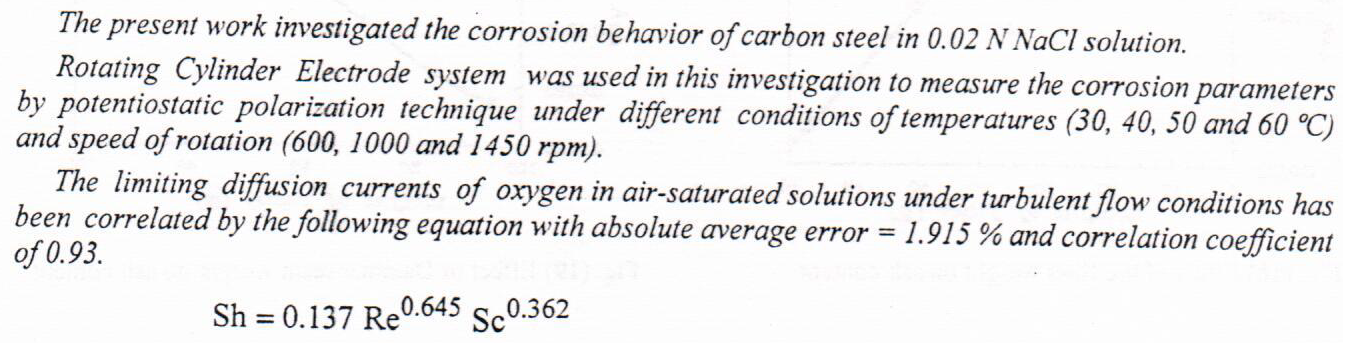

 (17)
(17)
 (2)
(2)


The photoconductivity and its dependence on light intensity have been investigated in a-Ge20Se80 thin films as a function of temperature between (293–323)K. The result showed that the photoconductivity and photosensitivity increase with increase of annealing temperature. This behavior is interpreted in terms of the dispersive diffusion –controlled recombination of localized electrons and holes.
The V2O5 films were deposited on glass substrates which produce using "radio frequency (RF)"power supply and Argon gas technique. The optical properties were investigated by, UV spectroscopy at "radio frequency" (RF) power ranging from 75 - 150 Watt and gas pressure, (0.03, 0.05 and 0.007 Torr), and substrate temperature (359, 373,473 and 573) K. The UV-Visible analysis shows that the average transmittance of all films in the range 40-65 %. When the thickness has been increased the transhumance was decreased from (65-40) %. The values of energy band gap were lowered from (3.02-2.9 eV) with the increase of thickness the films in relation to an increase in power, The energy gap decreased (2.8 - 2.7) eV with an increase in the pressure and
... Show More
(3)
Abstract: Objectives: To investigate the effect of temperature elevation on the bonding strength of resin cement to the zirconia ceramic using fractional CO2 laser. Background: Fractional CO2 laser is an effective surface treatment of zirconia ceramic, as it increases the bonding strength of zirconia to resin cement. Methods: Thirty sintered zirconia discs (10 mm diameter, 2 mm thickness) were prepared and divided to three groups (N=10) and five diffident pulse durations were used in each group (0.1, 0.5, 1, 5 and 10 ms). Group A was treated with 10 W power setting, group B with 20 W and group C with 30 W. During laser irradiation, temperature elevation measurement was recorded for each specimen. Luting cement was bonded to the treated z
... Show MoreThe optical energy gap(Eopt) and the width of the tails of localized states in the band gap (?E) for Se:2%Sb thin films prepared by thermal co-evaporation method as a function of annealing temperature are studied in the photon energy range ( 1 to 5.4)eV.Se2%Sb film was found to be indirect transition with energy gap of (1.973,2.077, 2.096, 2.17) eV at annealing temperature (295,370,445,520)K respectively. The Eopt and ?E of Se:2%Sb films as a function of annealing temperature showed an increase in Eopt and a decrease in ?E with increasing the annealing temperature. This behavior may be related to structural defects and dangling bonds.
The risk assessment for three pipelines belonging to the Basra Oil Company (X1, X2, X3), to develop an appropriate risk mitigation plan for each pipeline to address all high risks. Corrosion risks were assessed using a 5 * 5 matrix. Now, the risk assessment for X1 showed that the POF for internal corrosion is 5, which means that its risk is high due to salinity and the presence of CO, H2S and POF for external corrosion is 1 less than the corrosion, while for Flowline X2 the probability of internal corrosion is 4 and external is 4 because there is no Cathodic protection applied due to CO2, H2S and Flowline X3 have 8 leaks due to internal corrosion so the hazard rating was very high 5 and could be due to salinity, CO2, fluid flow rate
... Show More
(4)
In this work, studying the effect of ethylenediamine as a corrosion inhibitor was investigated for carbon steel in aerated HCl solution in range of 0.1-1N under dynamic conditions, i.e., rotational velocity of 400–1200 rpm in the temperature range 35 – 65 ºC. Weight loss method was employed in absence and presence of the inhibitor as an adsorption type in concentration range 1000 – 5000 ppm using rotating cylinder specimens. The experimental results showed that corrosion rate in absence and presence of inhibitor is increased with increasing temperature, rotational velocity and concentration of acid. It is decreased with increasing inhibitor concentration for the whole range of temperature, rotational velocity and concentrati
... Show MoreRotating cylinder electrode (RCE) is used . in weight loss technique , the salinity is 200000 p.p.m, temperatures are (30,5060,7080Co) . the velocity of (RCE) are (500,1500,3000 r.p.m). the water cut (30% , 50%). The corrosion rate of carbon steel increase with increasing rotating cylinder velocity. In single phase flow, an increase im rotational velocity from 500 to 1500 r.p.m, the corrosion rate increase from 6.88258 mm/y to 10.11563 mm/y respectively.
In multiphase flow, an increase in (RCE) from 500 to 1500 r.p.m leads to increase in corrosion rate from 0.786153 to 0.910327 mm/y respectively. Increasing brine concentration leads to increase in corrosion rate at water cut 30%.
(3)