Effect of Velocity and Temperature on Mass Transfer of Oxygen in Corrosion Processes
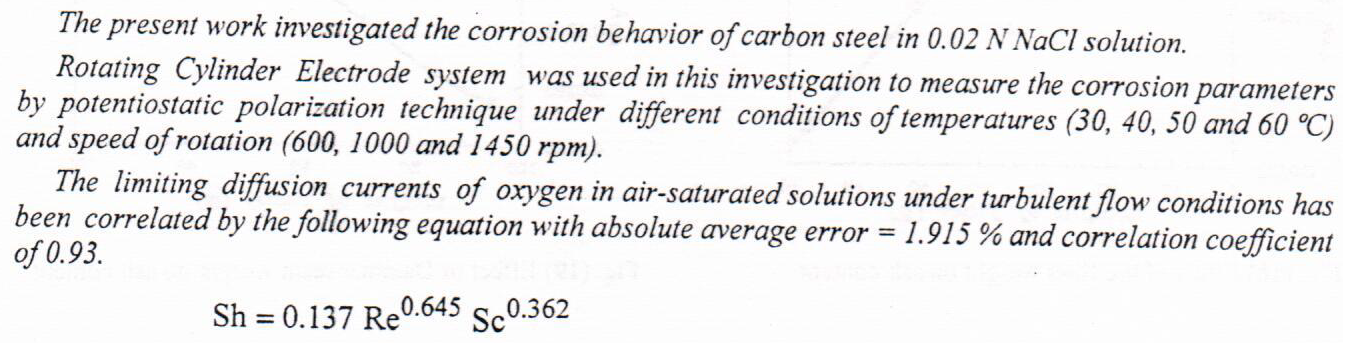

 (1)
(1)


Conjugate heat transfer has significant implications on heat transfer characteristics, particularly in thick wall applications and small diameter pipes. In this study, a three-dimensional numerical investigation was carried out using commercial CFD software “ANSYS FLUENT” to study the influence of conjugate heat transfer of laminar flow in mini channels at constant heat flux wall conditions. Two parameters were studied and analyzed: the wall thickness and thermal conductivity and their effect on heat transfer characteristics such as temperature profile and Nusselt number. Thermal conductivity of (0.25, 10, 202, and 387) W/m2C and wall thickness of (1, 5, and 50) mm were used for a channel of (1*2) mm cross
... Show More
Abstract
This work involves studying the effect of adding some selective organic component mixture on corrosion behavior of pure Al and its alloys in condensed synthetic automotive solution (CSAS) at room temperature. This mixture indicates the increasing of octane number in previous study and in this study show the increasing in corrosion resistance through the decreasing in corrosion rate values.
Electrochemical measurements were carried out by potentiostat at 3 mV/sec to estimate the corrosion parameters using Tafel extrapolation method, in addition to cyclic polarization test to know the pitting susceptibility of materials in tested medium.
The cathodic Tafel slope
... Show MoreCorrosion inhibiting admixtures are unique among other methods to protect reinforced concrete from corrosion damage. In this study, the effect of furfural on the fresh and hardened properties of concrete mixes of 35 and 45 MPa compressive strengths as well as the corrosion inhibition of furfural was evaluated. Furfural was added at different dosages (1, 2 and 3% by weight of cement) with and without superplasticizer (HRWR). Different electrochemical measurements were performed (Half-cell potential, Tafel plot and linear polarization resistance). Electrochemical measurements confirmed that furfural dramatically reduces the rate of corrosion; the inhibition efficiencies were 62.7 and 63.8 % due to 3% furfural addition to 35 and 45MPa-concr
... Show More (1)
(1)
(1)
(1)
The research aims to measure the relationship and impact of the operations of the knowledge of management of the six dimensions (diagnosis knowledge, define knowledge objectives, knowledge generation, knowledge storage, distribution of knowledge, application of knowledge) in the fiscal performance of the General Authority for taxes of the four dimensions (financial, customers (taxpayers), Operations Interior, learn and grow), the research aims also to the use of computerized programs for training and career development of the Authority that helps to add knowledge workers in the Authority, and to reach an appropriate arrangement for knowledge management processes in the Authority, as well as analysis of the reality of the Authority to get
... Show More
(21)
(19)

The degradation and mineralization of 4-chlorophenol (4-CP) by advanced oxidation processes (AOPs) was investigated in this work, using both of UV/H2O2 and photo-Fenton UV/H2O2/Fe+3 systems.The reaction was influenced by the input concentration of H2O2, the amount of the iron catalyst, the type of iron salt, the pH and the concentration of 4-CP. A colored solution of benzoquinon can be observed through the first 5 minutes of irradiation time for UV/H2O2 system when low concentration (0.01mol/L) of H2O2 was used. The colored solution of benzoquinon could also be observed through the first 5 minutes for the UV/H2O2/Fe+3 system at high
concentration (100ppm) of 4-CP. The results have shown that adding Fe+3 to the UV/H2O2 system enhanced
(1)
Lasers, with their unique characteristics in terms of excellent beam quality, especially directionality and coherency, make them the solution that is key for many processes that require high precision. Lasers have good susceptibility to integrate with automated systems, which provides high flexibility to reach difficult zones. In addition, as a processing tool, a laser can be considered as a contact-free tool of precise tip that became attractive for high precision machining at the micro and nanoscales for different materials. All of the above advantages may be not enough unless the laser technician/engineer has enough knowledge about the mechanism of interaction between the laser light with the processed material. Several sequential phenom
... Show More
(1)