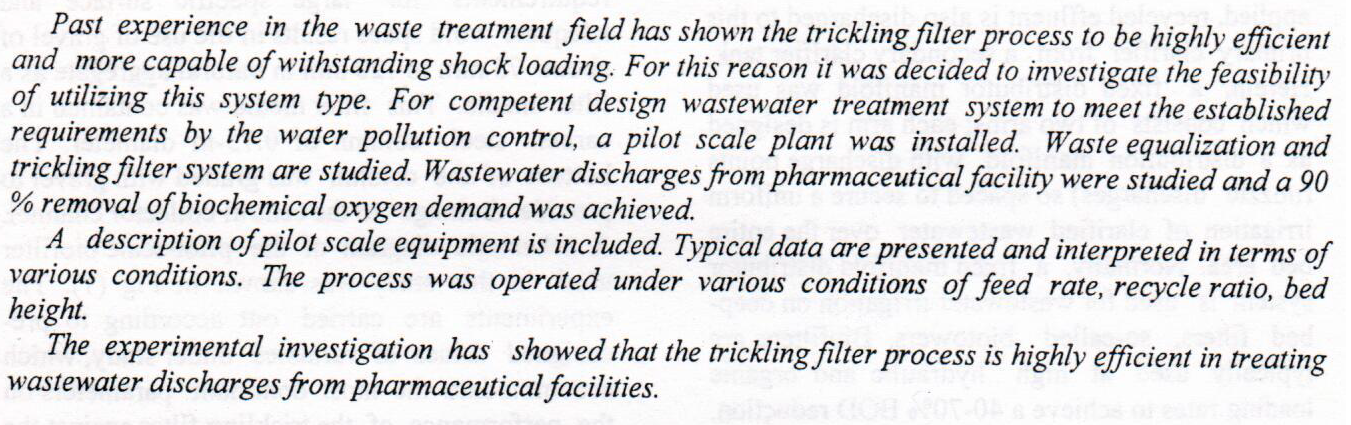
Study the Characteristic Performance of Trickling Filter for Pharmaceutical Waste Treatment

Abstract
The human mind knew the philosophy and logic in the ancient times, and the history afterwards, while the semiotics concept appeared in the modern time, and became a new knowledge field like the other knowledge fields. It deals, in its different concepts and references, with the processes that lead to and reveals the meaning through what is hidden in addition to what is disclosed. It is the result of human activity in its pragmatic and cognitive dimensions together. The semiotic token concept became a knowledge key to access all the study, research, and investigation fields, due to its ability of description, explanation, and dismantling. The paper is divided into two sections preceded by a the
... Show MoreThe research aims to prepare a preliminary feasibility study that shows the importance of preliminary feasibility study in investment decision making, carrying out of the local demand of service provided in accordance with international standards and statement of investment opportunities available to the private sector in several investment methods. In order to reach the objectives of the study was adopted as a method of partial analysis at the level of economic unity through the study demand, supply, costs, economic and social profitability.
The health sector in Iraq is one of the service sectors facing today a continuous deficiency
... Show More
Tigris River is the lifeline that supplies a great part of Iraq with water from north to south. Throughout its entire length, the river is battered by various types of pollutants such as wastewater effluents from municipal, industrial, agricultural activities, and others. Hence, the water quality assessment of the Tigris River is crucial in ensuring that appropriate and adequate measures are taken to save the river from as much pollution as possible. In this study, six water treatment plants (WTPs) situated on the two-banks of the Tigris within Baghdad City were Al Karkh; Sharq Dijla; Al Wathba; Al Karama; Al Doura, and Al Wahda from northern Baghdad to its south, that selected to determine the removal efficiency of turbidity and
... Show MoreThe current investigation examines the combined impacts of ultrasonic radiation and hydrogen donors on the viscosity of heavy crude oil. The impact of exposure time, power, duty cycle, and temperature on the viscosity of Iraqi heavy crude oil with 20.32 API was studied. Also, the viscosity of the oil samples, which were mixed with a hydrogen donor (decalin) and subjected to ultrasonic treatment under optimal conditions, was examined to evaluate the combined impact of ultrasonic radiation and hydrogen donor on the viscosity of crude oil. The viscosity experienced a decrease of 52.34% at 2 min of irradiation, 360 W ultrasonic power, 0.8 duty cycle, 35 ⁰C, and 8vol% decalin. To validate the outcomes of the experiments, asphaltene content, s
... Show More (5)
(5)
 (3)
(3)


Iron slag is a byproduct generated in huge quantities from recycled remnants of iron and steel factories; therefore, the possibility of using this waste in the removal of benzaldehyde from contaminated water offers an excellent topic in sustainability field. Results reveal that the removal efficiency was equal to 85% for the interaction of slag and water contaminated with benzaldehyde at the best operational conditions of 0.3 g/100 mL, 6, 180 min, and 250 rpm for the sorbent dosage, initial pH, agitation time, and speed, respectively with 300 mg/L initial concentration. The maximum uptake capacity of iron slag was 118.25 mg/g which was calculated by the Langmuir model. Physical sorption may be the major mechanism for the removal of
... Show More
(33)
(29)
Background: Sclerotherapy is a simple treatment modality for treatment of infantile hemangioma and slow-flow vascular malformations; Polidocanol is a mild sclerosing agent that is traditionally used in treatment of varicose veins. This study aims to evaluate the effectiveness, treatment outcome, and complications of polidocanol foam sclerotherapy for infantile hemangioma and slow-flow vascular malformations. Materials and methods: Between March 2013 and December 2014, seventeen patients with infantile hemangioma and slow-flow vascular malformations treated with polidocanol 1% foam sclerotherapy. Foam was prepared by Tessari’s method. Injection performed under general or local anesthesia, injections were repeated (if necessary) on mon
... Show More
Background: Radiation therapy has the ability to destroy healthy cells in addition to cancer cells in the area being treated. However, when radiation combines with doxorubicin, it becomes more effective on breast cancer treatment. Objective: This study aims to clarify the effect of X-ray from LINAC combined with amygdalin and doxorubicin on breast cancer treatment, and the possibility of using amygdalin with X-ray instead of doxorubicin for the breast cancer treatment. Method: Two cell lines were used in this study, the first one was MCF-7 cell line and second one was WRL- 68 normal cell line. These cells were preserved in liquid nitrogen, prepared, developed and tested in the (place). The effect of three x-ray doses combined with a
... Show More
يختبر البحث الحالي التأثيرات المشتركة للإشعاع بالموجات فوق الصوتية والمادة المانحة للهيدروجين على لزوجة النفط الخام الثقيل. تمت دراسة تأثير زمن التعرض للموجات فوق الصوتية والطاقة ودورة التشغيل ودرجة الحرارة على لزوجة النفط الخام العراقي الثقيل الذي يملك قيمة .20.32 = API كما تم فحص لزوجة عينات النفط الخام التي تم خلطها بمانح الهيدروجين (Decalin) وإخضاعها للمعالجة بالموجات فوق الصوتية في ظل الظروف المثا
... Show More
(5)
(3)