Optimizing Viscous Flow in Pipes Through Improved Flow Conditions and Chemical Injections
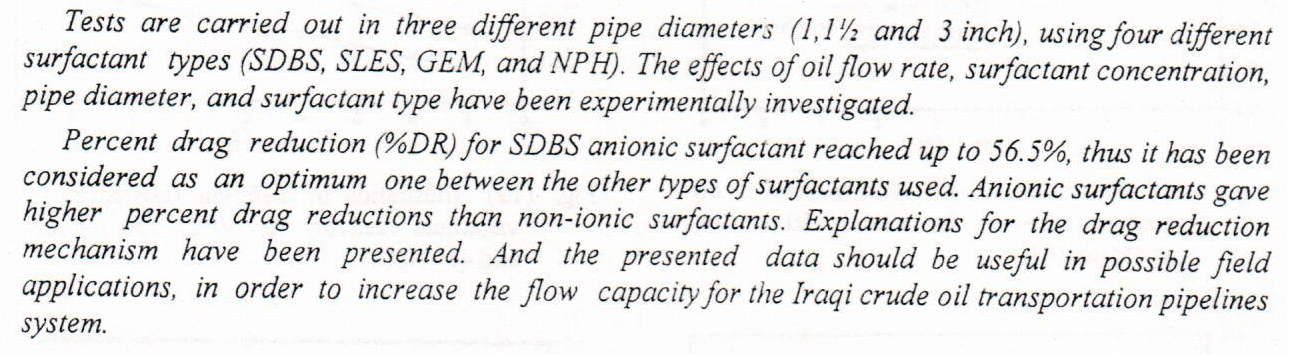

 (6)
(6)
 (3)
(3)


The risk assessment for three pipelines belonging to the Basra Oil Company (X1, X2, X3), to develop an appropriate risk mitigation plan for each pipeline to address all high risks. Corrosion risks were assessed using a 5 * 5 matrix. Now, the risk assessment for X1 showed that the POF for internal corrosion is 5, which means that its risk is high due to salinity and the presence of CO, H2S and POF for external corrosion is 1 less than the corrosion, while for Flowline X2 the probability of internal corrosion is 4 and external is 4 because there is no Cathodic protection applied due to CO2, H2S and Flowline X3 have 8 leaks due to internal corrosion so the hazard rating was very high 5 and could be due to salinity, CO2, fluid flow rate
... Show More
In this study, a simulation model inside a channel of rectangular section with high of (0.16 m) containing two rectangular obstruction plates were aligned variable heights normal to the direction of flow, use six model of the obstructions height of (0.059, 0.066, 0.073, 0.08 and 0.087 m) were compared with the flow behavior of the same duct without obstructions. To predict the velocity profile, pressure distribution, pressure coefficient and turbulence kinetic energy flow of air, the differential equations which describe the flow were approximated by the finite volumes method for two dimensional, by using commercial software package (FLUENT) with standard of k-ε model two dimensions turbulence flow.
... Show MoreAbstract
In this paper presents two dimensional turbulent flow of different nanofluids and ribs configuration in a circular tube have been numerically investigation using FLUENT 6.3.26. Two samples of CuO and, ZnO nanoparticles with 2% v/v concentration and 40 nm as nanoparticle diameter combined with trapezoidalribs with aspect ratio of p/d=5.72 in a constant tube surface heat flux were conducted for simulation. The results showed that heat flow as Nusselt number for all cases raises with Reynolds number and volume fraction of nanofluid, likewise the results also reveal that ZnO with volume fractions of 2% in trapezoidal ribs offered highest Nusselt number at Reynolds number of Re= 30000.
Key
... Show More
(1)
Conjugate heat transfer has significant implications on heat transfer characteristics, particularly in thick wall applications and small diameter pipes. In this study, a three-dimensional numerical investigation was carried out using commercial CFD software “ANSYS FLUENT” to study the influence of conjugate heat transfer of laminar flow in mini channels at constant heat flux wall conditions. Two parameters were studied and analyzed: the wall thickness and thermal conductivity and their effect on heat transfer characteristics such as temperature profile and Nusselt number. Thermal conductivity of (0.25, 10, 202, and 387) W/m2C and wall thickness of (1, 5, and 50) mm were used for a channel of (1*2) mm cross
... Show More
Abstract :- In this paper, silver nanoparticles had been prepared by chemical reduction method. Many tests had been done to it such as UV-Visible spectrophotometer, XRD, AFM&SEM test. finally an attempt had been done to get the optimum condition to control the grain size of silver Nanoparticles by variation the heating period and other parameters which has an effect in silver Nanoparticles synthesis process. in this method we can get a silver nanoparticles in the size range from 52 to 97 nm.
Background: diagnostic radiology field workers are at elevated risk level for systemic and oral diseases like periodontal diseases. This study was aimed to estimate the periodontal condition and salivary flow rate among diagnostic radiology workers. Material and method: The sample for this study consisted of a study group radiographers (forty subjects) working for 5 years at least and control group consisted of nurses and laboratory workers away from radiation (forty subjects) in Baghdad hospitals. All the 80 subjects aged 30-40 year-old and looking healthy without systemic diseases. Plaque, gingival, periodontal pocket depth and clinical attachment loss indices were used for recording the periodontal conditions. Under standardized condi
... Show More
(2)
Computational study of three-dimensional laminar and turbulent flows around electronic chip (heat source) located on a printed circuit board are presented. Computational field involves the solution of elliptic partial differential equations for conservation of mass, momentum, energy, turbulent energy, and its dissipation rate in finite volume form. The k-ε turbulent model was used with the wall function concept near the walls to treat of turbulence effects. The SIMPLE algorithm was selected in this work. The chip is cooled by an external flow of air. The goals of this investigation are to investigate the heat transfer phenomena of electronic chip located in enclosure and how we arrive to optimum level for cooling of this chip. These par
... Show More