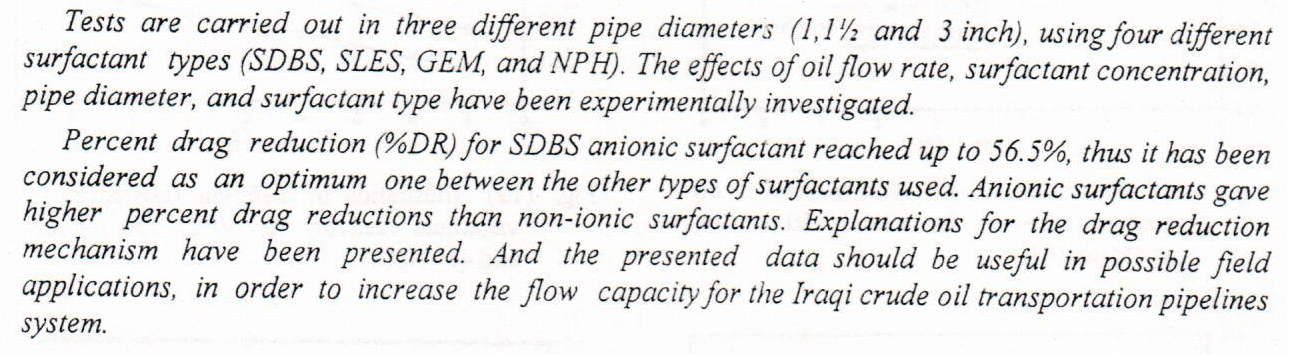
Optimizing Viscous Flow in Pipes Through Improved Flow Conditions and Chemical Injections

Within this paper, we developed a new series of organic chromophores based on triphenyleamine (TPA) (AL1, AL-2, AL-11 and AL-22) by engineering the structure of the electron donor (D) unit via replacing a phenyle ring or inserting thiophene as a π-linkage. For the sake of scrutinizing the impact of the TPA donating ability and the spacer upon the photovoltaic, absorptional, energetic, and geometrical characteristic of these sensitizers, density functional theory (DFT) and time-dependent DFT (TD-DFT) have been utilized. According to structural characteristics, incorporating the acceptor, π-bridge and TPA does not result in a perfect coplanar conformation in AL-22. We computed EHOMO, ELUMO and bandgap (Eg) energies by performing frequency a
... Show More (4)
(4)
 (4)
(4)


 (7)
(7)
Abstract The results of the effect of the type of feed showed a significant increase (P≤0.01) for palm fronds DM during the incubation period of 7, 14, 21 days, a high Mnp superiority in its incubation 14 days, and a significant superiority of Laccase in its incubation 21 days, while the effect of the enzyme concentration on DM was higher Significant at a concentration of 10% of the enzyme, and the interaction between the type of feed and the enzyme together showed a highly significant increase in the treated palm fronds Laccase and Lip in the incubation period of 7 days, and the treated palm fronds Mnp during incubation 14 days. %, 15% for the interaction between the type of coarse feed and the concentration of the enzyme
... Show More
(15)
(8)
Coagulation - flocculation are basic chemical engineering method in the treatment of metal-bearing industrial wastewater because it removes colloidal particles, some soluble compounds and very fine solid suspensions initially present in the wastewater by destabilization and formation of flocs. This research was conducted to study the feasibility of using natural coagulant such as okra and mallow and chemical coagulant such as alum for removing Cu and increase the removal efficiency and reduce the turbidity of treated water. Fourier transform Infrared (FTIR) was carried out for okra and mallow before and after coagulant to determine their type of functional groups. Carbonyl and hydroxyl functional groups on the surface of
... Show MoreEffect of [Cu/In] ratio on the optical properties of CuInS2 thin films prepared by chemical spray pyrolysis on glass slides at 300oC was studied. The optical characteristics of the prepared thin films have been investigated using UV-VIS spectrophotometer in the wavelength range (300-1100 nm). The films have a direct allow electronic transition with optical energy gap (Eg) decreased from 1.51 eV to 1.30 eV with increasing of [Cu/In] ratio and as well as we notice that films have different behavior when annealed the films in the temperature 100oC (1h,2h), 200oC (1h,2h) for [Cu/In]=1.4 . Also the extinction coefficient (k), refractive index (n) and the real and imaginary dielectric constants (ε1, ε2) have been investigated
Background: The possibility of converting the organic fraction of municipal solid waste to mature compost using the composting bin method was studied. Nine distinct treatments were created by combining municipal solid waste (MSW) with animal waste (3:1, 2:1), poultry manure (3:1, 2:1), mixed waste (2:1:1), agricultural waste (dry leaves), biocont (Trichoderm hazarium), and humic acid. Weekly monitoring of temperature, pH, EC, organic matter (OM percent), and the C/N ratio was performed, and macronutrients (N, P, K) were measured. Trace elements, including heavy metals (Cd and Pb), were tested in the first and final weeks of maturity. Results: Temperatures in the first days of composting reached the thermophilic phase in MSW compost
... Show More
(26)
(18)
Background: The possibility of converting the organic fraction of municipal solid waste to mature compost using the composting bin method was studied. Nine distinct treatments were created by combining municipal solid waste (MSW) with animal waste (3:1, 2:1), poultry manure (3:1, 2:1), mixed waste (2:1:1), agricultural waste (dry leaves), biocont (Trichoderm hazarium), and humic acid. Weekly monitoring of temperature, pH, EC, organic matter (OM percent), and the C/N ratio was performed, and macronutrients (N, P, K) were measured. Trace elements, including heavy metals (Cd and Pb), were tested in the first and final weeks of maturity. Results: Temperatures in the first days of composting reached the thermophilic phase in MSW compost
... Show More
(26)
(18)
Some of metal compounds have been synthesized of record ligand from aldehid interaction of a substance which is salicyladehyde with another material which is urea. During the analysis of the metal component, The prepared complexes were characterized by elemental analysis, IR ,UV-visible , conductivity and magnetic susceptibility measurements. this confirms the ratio[1:1] between the metal and ligand. It is found that theortical values agree with practical values All the studied complexes are suggested as an octahedral stereochemistry.