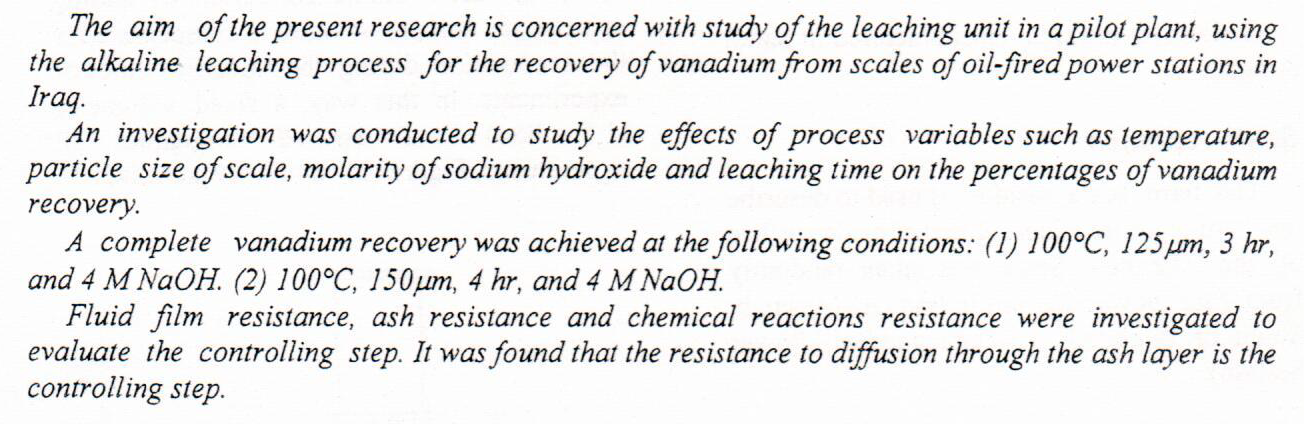
Recovery of Vanadium from Scale Residues of Oil-Fired Power Stations

A new application of a combined solvent extraction and two-phase biodegradation processes using two-liquid phase partitioning bioreactor (TLPPB) technique was proposed and developed to enhance the cleanup of high concentration of crude oil from aqueous phase using acclimated mixed culture in an anaerobic environment. Silicone oil was used as the organic extractive phase for being a water-immiscible, biocompatible and non-biodegradable. Acclimation, cell growth of mixed cultures, and biodegradation of crude oil in aqueous samples were experimentally studied at 30±2ºC. Anaerobic biodegradation of crude oil was examined at four different initial concentrations of crude oil including 500, 1000, 2000, and 5000 mg/L. Complete removal of crud
... Show More
Results of the current study demonstratedthat out of eighty-three isolatesof Pseudomonas aeruginosa,only twenty-five isolateswere resistant to five different antibiotics (of different classes) that were consequentlyconsideredmultidrug resistant isolates.These isolates developed variable susceptibility toward Eucalyptuscamaldulensisleavesoil (ECO). GC-MS analysis of ECOrevealed that the aromatic oil eugenol is the major constituent.However, the most frequent MIC was 0.39 µg/ml, while the lowest frequent MIC was 3.125 µg/ml.Moreover, this oil at ½ MIC (0.195µg/ml) increased the gene expression of exoU. Itis concluded from the outcomes of the studythat ECOmay cause severe damagewhen used to treat infections caused by P. aeruginosa.
... Show More (1)
(1)

The petroleum sector has a significant influence on the development of multiphase detection sensor techniques; to separate the crude oil from water, the crude oil tank is used. In this paper, a measuring system using a simple and low cost two parallel plate capacitance sensor is designed and implemented based on a Micro controlled embedded system plus PC to automatically identify the (gas/oil) and (oil/water) dynamic multi-interface in the crude oil tank. The Permittivity differences of two-phase liquids are used to determine the interface of them by measuring the relative changes of the sensor’s capacitance when passes through the liquid’s interface. The experiment results to determine the liquid’s interface is sa
... Show More
Drilling with casing (DWC) can be considered as a modern drilling technique in which both of drilling and casing operations done in the same time by using the casing to transfer the hydraulic and mechanical power to the bit instead of traditional drilling string. To overcome oil well control, minimizing the total cost through enhancing drilling efficiency, drilling with casing was proposed as an enabling technology.
Two surface sections (17 1/2 - and 12 1/4- inch) were drilled successfully in Rumaila oil field with casing strings which reached 655m and 1524m measured depths respectively.
By using DWC technique, the total drill/case phase time was reduced up to 20% comparing to conventional
... Show MoreIn this research, the effect of reinforcing epoxy resin composites with a filler derived from chopped agriculture waste from oil palm (OP). Epoxy/OP composites were formed by dispersing (1, 3, 5, and 10 wt%) OP filler using a high-speed mechanical stirrer utilizing a hand lay-up method. The effect of adding zinc oxide (ZnO) nanoparticles, with an average size of 10-30 nm, with different wt% (1,2,3, and 5wt%) to the epoxy/oil palm composite, on the behavior of an epoxy/oil palm composite was studied with different ratios (1,2,3, and 5wt%) and an average size of 10-30 nm. Fourier Transform Infrared (FTIR) spectrometry and mechanical properties (tensile, impact, hardness, and wear rate) were used to examine the composites. The FTIR
... Show More (7)
(7)
IMPLICATION OF GEOMECHANICAL EVALUATION ON TIGHT RESERVOIR DEVELOPMENT / SADI RESERVOIR HALFAYA OIL FIELD
Permeability is one of the essential petrophysical properties of rocks, reflecting the rock's ability to pass fluids. It is considered the basis for building any model to predict well deliverability. Yamama formation carbonate rocks are distinguished by sedimentary cycles that separate formation into reservoir units and insulating layers, a very complex porous system caused by secondary porosity due to substitute and dissolution processes. Those factors create permeability variables and vary significantly. Three ways used for permeability calculation, the firstly was the classical method, which only related the permeability to the porosity, resulting in a weak relationship. Secondly, the flow zone indicator (FZI) was divided reservoir into
... Show More
(13)
(8)
For the most reliable and reproducible results for calibration or general testing purposes of two immiscible liquids, such as water in engine oil, good emulsification is vital. This study explores the impact of emulsion quality on the Fourier transform infrared (FT-IR) spectroscopy calibration standards for measuring water contamination in used or in-service engine oil, in an attempt to strengthen the specific guidelines of ASTM International standards for sample preparation. By using different emulsification techniques and readily available laboratory equipment, this work is an attempt to establish the ideal sample preparation technique for reliability, repeatability, and reproducibility for FT-IR analysis while still considering t
... Show More
(13)
(11)
 (13)
(10)
(13)
(10)
An investigation was conducted for dewaxing of lubricating oil fraction by urea to reduce the pour point.In this study mixture of 45 % methyl ethyl ketone (MEK) and 55 % toluene was used as a solvent. The studied variables are mixing time (10-70 min), solvent to oil volume ratio (0.5:1- 2:1), urea to wax weight ratio (2- 6) and constant mixing speed 1500 rpm. By analysis of the experimental results, the best operating conditions achieved are mixing time 40 min, solvent/oil 2:1 volume ratio, and urea/wax 4:1 weight ratio. At these conditions the pour point of the lubricating oil decreases from 24 ° C to -13 °C.