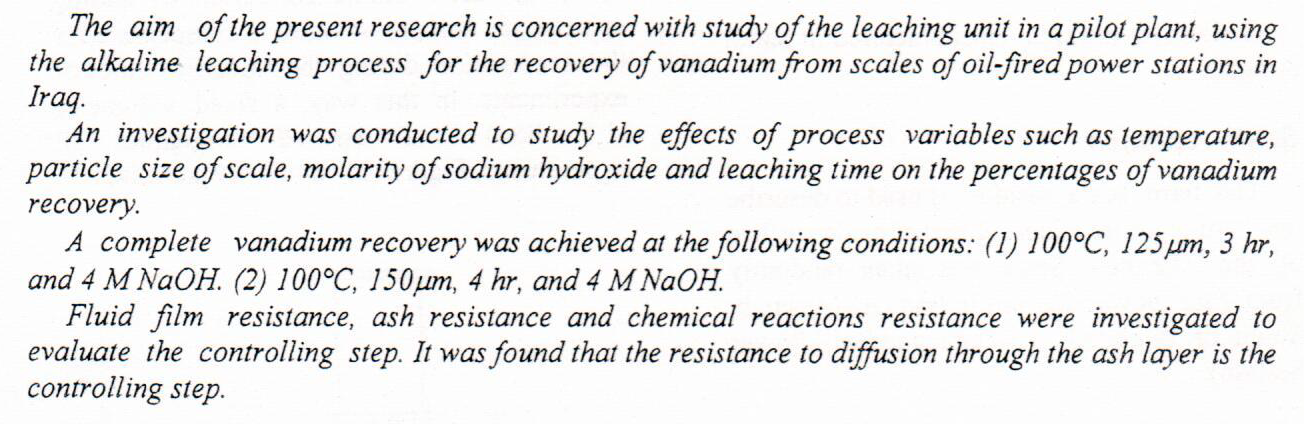
Recovery of Vanadium from Scale Residues of Oil-Fired Power Stations

 (26)
(26)
 (22)
(22)



Combining different treatment strategies successively or simultaneously has become recommended to achieve high purification standards for the treated discharged water. The current work focused on combining electrocoagulation, ion-exchange, and ultrasonication treatment approaches for the simultaneous removal of copper, nickel, and zinc ions from water. The removal of the three studied ions was significantly enhanced by increasing the power density (4–10 mA/cm2) and NaCl salt concentration (0.5–1.5 g/L) at a natural solution pH. The simultaneous removal of these metal ions at 4 mA/cm2 and 1 g NaCl/L was highly improved by introducing 1 g/L of mordenite zeolite as an ion-exchanger. A remarkable removal of heavy metals was reported
... Show More
(2)
(1)
In this study, biodiesel was prepared from chicken fat via a transesterification reaction using Mussel shells as a catalyst. Pretreatment of chicken fat was carried out using non‐catalytic esterification to reduce the free fatty acid content from 36.28 to 0.96 mg KOH/g oil using an ethanol/ fat mole ratio equal to 115:1. In the transesterification reaction, the studied variables were methanol: oil mole ratio in the range of (6:1 ‐ 30:1), catalyst loading in the range of (9‐15) wt%, reaction temperature (55‐75 °C), and reaction time (1‐7) h. The heterogeneous alkaline catalyst was greenly synthesized from waste mussel shells throughout a calcin
... Show More
(6)
(4)
The purpose of this subject is to identify what is being studied in the article, which is the involvement of human Metapneumovirus in children with respiratory illnesses. During the period November 2020 to February 2021, 100 patients with respiratory tract infections were admitted to Al Zahra Teaching Hospital and AL-Forat AL-Awsat Teaching Hospital in Najaf Governorate. Nasopharyngeal swabs were collected from patients for molecular diagnosis of human metapneumovirus using Real-Time-PCR. The patients were distributed based on age into five groups as follows (Less than one, 1-2, 2-3, 3-4, and 4-5 years), and twenty samples of healthy individuals were approved as a control group without any clinical signs of infection. the children of age gr
... Show More
Novel derivatives of 1-(´1, ´3, ´4, ´6-tetra benzoyl-β-D-fructofuranosyl)-1H- benzotriazole and 1-(´1, ´3, ´4, ´6-tetra benzoyl-β-D-fructofuranosyl)-1H- benzotriazole carrying Schiff bases moiety were synthesised and fully characterised. The protection of D- fructose using benzoyl chloride was synthesized, followed by nucleophilic addition/elimination between benzotria- zole and chloroacetyl chloride to give 1-(1- chloroacetyl)- 1H-benzotriazole. The next step was condensation reaction of protected fructose and 1-(1-chloroacetyl)-1H- benzotriazole producing a new nucleoside analogue. The novel nucleoside analogues underwent a second conden- sation reaction with different aromatic and aliphatic amines to provide new Schiff b
... Show MoreThe effects of nutrients and physical conditions on phytase production were investigated with a recently isolated strain of Aspergillus tubingensis SKA under solid state fermentation on wheat bran. The nutrient factors investigated included carbon source, nitrogen source, phosphate source and concentration, metal ions (salts) and the physical parameters investigated included inoculum size, pH, temperature and fermentation duration. Our investigations revealed that optimal productivity of phytase was achieved using wheat bran supplemented with: 1.5% glucose. 0.5% (NH4)2SO4, 0.1% sodium phytate. Additionally, optimal physical conditions were 1 × 10⁵ spore/g substrate, initial pH of 5.0, temperature of fermentation 30˚C and fermentation dura
... Show More
(8)
The study involved preparing a new compound by combining Schiff bases generated from compounds for antipyrine, including lanthanide ions (lanthanum, neodymium, erbium, gadolinium, and dysprosium). The preparation of the ligand from condensation reactions (4-antipyrinecarboxaldehyde with ethylene di-amine) at room temperature, and was characterization using spectroscopic and analytical studies ( FT-IR, UV-visible spectra, 1H-NMR, mass spectrometry, (C.H.N.O), thermogravimetric analysis (TGA), in addition to the magnetic susceptibility and conductivity measurement of the synthesis complexes, among the results we obtained from the tests, we showed that the ligand behaves with the (triple Valence) lanthanide ions, the multidentate
... Show More
(16)
(2)
(54)
(48)
Combining different treatment strategies successively or simultaneously has become recommended to achieve high purification standards for the treated discharged water. The current work focused on combining electrocoagulation, ion-exchange, and ultrasonication treatment approaches for the simultaneous removal of copper, nickel, and zinc ions from water. The removal of the three studied ions was significantly enhanced by increasing the power density (4–10 mA/cm2) and NaCl salt concentration (0.5–1.5 g/L) at a natural solution pH. The simultaneous removal of these metal ions at 4 mA/cm2 and 1 g NaCl/L was highly improved by introducing 1 g/L of mordenite zeolite as an ion-exchanger. A remarkable removal of heavy metals was reported
... Show More
(2)
(1)
This study uses an environmentally friendly and low-cost synthesis method to manufacture zinc oxide nanoparticles (ZnO NPs) by using zinc sulfate. Eucalyptus leaf extract is an effective chelating and capping agent for synthesizing ZnO NPs. The structure, morphology, thermal behavior, chemical composition, and optical properties of ZnO nanoparticles were studied utilizing FT-IR, FE-SEM, EDAX, AFM, and Zeta potential analysis. The FE-SEM pictures confirmed that the ZnO NPs with a size range of (22-37) nm were crystalline and spherical. Two methods were used to prepare ZnO NPs. The first method involved calcining the resulting ZnO NPs, while the second method did not. The prepared ZnO NPs were used as adsorbents for removing acid black 210
... Show More
(6)
(4)