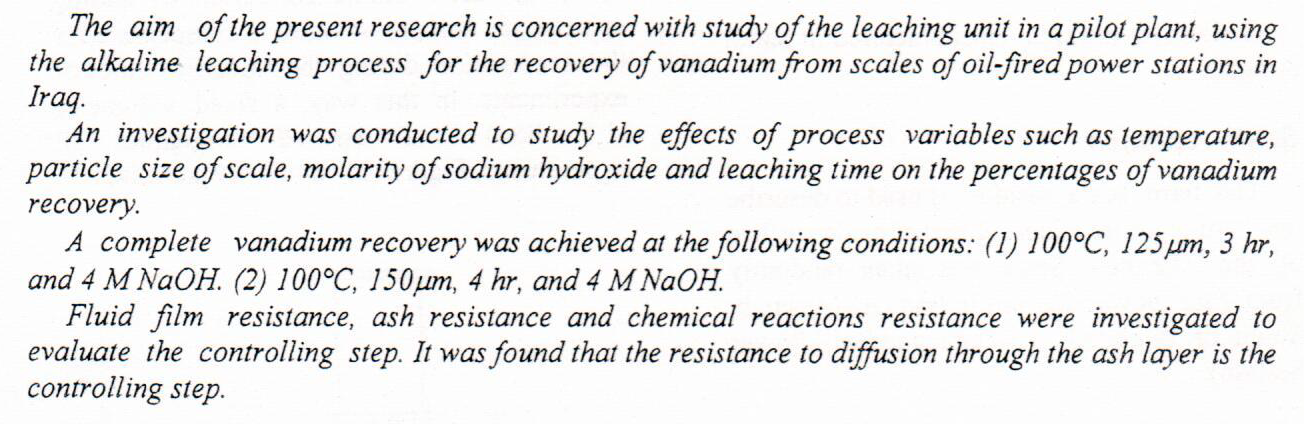
Recovery of Vanadium from Scale Residues of Oil-Fired Power Stations

Pharmaceutical-instigated pollution is a major concern, especially in relation to aquatic environments and drugs such as meropenem antibiotics. Adsorbents, such as multi-walled carbon nanotubes, offer potential as means of removing polluting meropenem antibiotics and other similar compounds from water. In order to evaluate the effectiveness of multi-walled carbon nanotubes in this capacity, various experimental parameters, including contact time, initial concentration, pH, temperature and the dose of adsorbent have been investigated. The Langmuir and the Freundlich isotherm models have been used. The data obtained using a modified Langmuir model have been consistent with the experimental ones; the best pH value has been obtained to have the
... Show More (3)
(3)

Background: Neonatal septicemia is a significant cause of morbidity and mortality worldwide especially so in developing countries. To reduce the mortality caused by neonatal septicemia, it became vital to diagnose it as soon as possible and treat with administration of appropriate antibiotics.Objective: To study the relationship between themicroorganisms isolated from septicemic neonates with place of delivery.Patients and Methods: Blood sample was obtained from 76 neonates (50 of them are born in Baghdad teaching hospital (Inborn), 26 of the babies are born at home or in Al-Elwya teaching hospital (out born) ,the laboratory diagnosis for the out born patients done in the same hospital(Al-Elwya teaching hospital .The aged of the neo
... Show More
This study was carried out to find out the effect of germination of broad beans and chickpeas seeds for different periods on the sensory properties of homus bethina and falafel. The results revealed that the studied properties were significantly different (P<0.05) in tenderness, flavor and overall acceptance as compared to control samples. While other properties such as appearance, body (texture), leavening and color did not showed significant differences.It was found that treatment B1 (100% germinated broad beans) varied significantly in tenderness in comparison with control samples.Treatment B3 (75% ordinary bread beans + 25% germinated broad beans) revealed significant differences (P<0.05) in both flavor and overall acceptance as compar
... Show MoreThe -multiple mixing ratios of γ-transitions from levels of populated in the are calculated in the present work by using the a2-ratio methods. We used the experimental coefficient (a2) for two γ-transitions from the same initial state, the statistical tensor, which is related to the a2-coefficient would be the same for the two transitions. This method was used in a previous work for pure transitions or which can be considered pure. In these cases the multiple mixing ratios for the second transition ( ) equal zero, but in our work we applied this method for mixed γ-transitions and then the multiple mixing ratio ( ) is known for one transition. Then we calculate the ( ) value and versareversa. The weight average of the -values calcu
... Show MoreBis-anthraquinones with a unique molecular backbone, (+)-2,2’-epicytoskyrin A (epi) and (+)-1,1′-bislunatin (bis), was produced by endophytic fungi Diaporthe sp GNBP-10 associated with Gambir plant (Uncaria gambier). Epi and bis possess robust antimicrobial activity toward various pathogens. This study focus on knowing the optimum condition of epi and bis production from Diaporthe sp GNBP-10. A series of culture media with various nutrient compositions was investigated in epi and bis production. The content of epi and bis was determined by measuring the area under the curve from TLC-densitometric (scanner) experiment. The linear regression analysis was then applied to obtain the results. The optimi
... Show More (1)
(1)
(1)
(1)

Klebsiella pneumoniae causes lethal nosocomial infections, mostly affecting patients with severe burns. More than 80% of its isolates have shown resistance to routinely used antibiotics in parallel with increased infection rates. The study aimed to determine the molecular typing and genetic relatedness of K. pneumoniae. Therefore, 20 multidrug resistant (MDR) K. pneumoniae already isolated from infected burned wounds in two major hospitals of Al-Kut city east Iraq were subjected to genotyping analysis. The random amplified polymorphic DNA (RAPD)-based polymerase chain reaction (PCR) technique was used along with three oligonucleotide primers (P13, OPX-04, and OPY-01). The amplicons’ patterns of the electrophoresis-gel were analyzed by the
... Show More
(1)
The present work concerns with simulating unsteady state equilibrium model for production of methyl oleate (biodiesel) from reaction of oleic acid with methanol using sulfuric acid as a catalyst in batch reactive distillation. MESHR equations of equilibrium model were solved using MATLAB (R2010a). The validity of simulation model was tested by comparing the simulation results with a data available in literature. UNIQUAC liquid phase activity coefficient model is the most appropriate model to describe the non-ideality of OLAC-MEOH-MEOL-H2O system. The chemical reactions rates results from EQ model indicating the rates are controlled by chemical kinetics. Several variables was studied such as molar ratio of methanol to oleic acid 4:1, 6:1
... Show MoreThe characteristics of sulfur nanoparticles were studied by using atomic force microscope (AFM) analysis. The atomic force microscope (AFM) measurements showed that the average size of sulfur nanoparticles synthesized using thiosulfate sodium solution through the extract of cucurbita pepo extra was 93.62 nm. Protecting galvanized steel from corrosion in salt media was achieved by using sulfur nanoparticles in different temperatures. The obtained data of thermodynamic in the presence of sulfur nanoparticles referred to high value as compares to counterpart in the absence of sulfur nanoparticles, the high inhibition efficiency (%IE) and corrosion resistance were at high temperature, the corrosion rate or weig
... Show More
(17)
(5)

The research aims to answer some of the fundamental questions posed by the contexts used and assumed for the criticism of poetry from the cultural anthropological perspective in the field of genealogy in Andalusia, as available from the remaining literature in this humanitarian field. Criticism, the varieties of its outputs, and the reasons behind it, which came in its entirety as a critical link in the critical heritage chain, did not create separation as much as we wanted to shed light on them from their sources, and from the atmosphere that resulted.