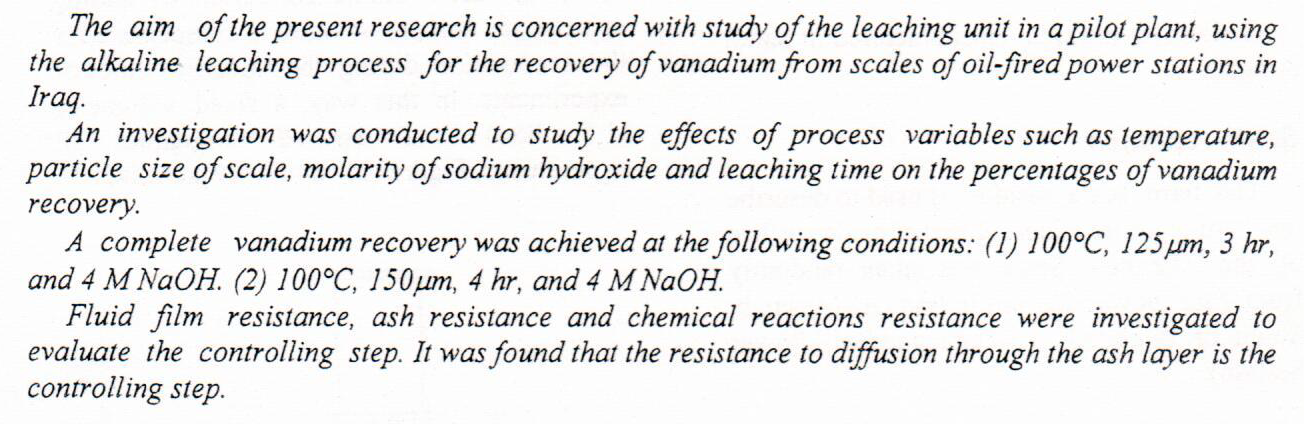
Recovery of Vanadium from Scale Residues of Oil-Fired Power Stations

 (14)
(14)
 (11)
(11)



Biodiesel is popular as an eco-friendly fossil fuel alternative. Neem oil is manufactured from Azadirachta indica seeds. Transesterifying triglycerides with alcohol in the presence of a synthesized CaO nanocatalyst is the most common biodiesel synthesis procedure—recent advances, difficulties, and prospects in laser feedstock pretreatment to boost reactivity and reduce energy use. Oil pre-treatment with a 540-nm green laser is cost-effective and environmentally friendly. This study examined neem oil with and without laser pretreatment for biodiesel synthesis. CaO nanocatalysts were synthesised using Sol–gel and characterised using XRD and SEM. According to catalyst recyclability, the CaO nanocatalyst did not lose activity after five re
... Show More
(1)
(3)
Natural gas and oil are one of the mainstays of the global economy. However, many issues surround the pipelines that transport these resources, including aging infrastructure, environmental impacts, and vulnerability to sabotage operations. Such issues can result in leakages in these pipelines, requiring significant effort to detect and pinpoint their locations. The objective of this project is to develop and implement a method for detecting oil spills caused by leaking oil pipelines using aerial images captured by a drone equipped with a Raspberry Pi 4. Using the message queuing telemetry transport Internet of Things (MQTT IoT) protocol, the acquired images and the global positioning system (GPS) coordinates of the images' acquisition are
... Show More
(16)
(9)
This work includes synthesis of sugar tetrazole derivative, D-ribose reacted with acetone in the presence of sulfuric acid H2SO4 to give 2, 3-O-isopropylidene-D-ribose (1). The Aldol condensation of (1) with formaldehyde in methanolic K2CO3 solution gave 2-hydroxymethyl (2, 3-O-isopropylidene-D-ribose)(2). Which was tosylated by Tosyl chloride in pyridine to yield compound (3), SN2 reaction of (3) with sodium cyanide in DMSO afforded compound (4). The [2+ 3] cycloaddition reaction of (4) with sodium azide gave the targeted compound (5). All prepared compounds have been characterized by: TLC, Specific rotation, Microelemental analysis and [FTIR and 1 H NMR spectroscopy]
Two specie's of terrnitls are described as new to science from Iraq Amitermes corpnlentus sp. n. and Anacanthotermes savvensis sp. n., with two figures.
single and binary competitive sorption of phenol and p-nitrophenol onto clay modified with
quaternary ammonium (Hexadecyltrimethyl ammonium ) was investigated to obtain the
adsorption isotherms constants for each solutes. The modified clay was prepared from
blending of local bentonite with quaternary ammonium . The organoclay was characterized
by cation exchange capacity. and surface area. The results show that paranitrophenol is
being adsorbed faster than phenol . The experimental data for each solute was fitted well with
the Freundlich isotherm model for single solute and with the combination of Freundlich-
Langmuier model for binary system .
(2)
Bioremoval of chromium from wastewater of tannery factory in Iraq was studied. The bacteria Proteus vulgaris 7E showed an enhanced capability in biosorping chromium when its concentration increased in the solution, reaching a maximum of 476,7 mg/ ml out of 492 mg/ ml under optimum conditions at pH 6 and 50°C at one hour contact time and biomass of 1 mg/ml. The present results showed that dead cells of P. vulgaris 7E biosorbed 87.41 mg/ml of chromium in comparison with91.18 mg/ml of chromium biosorbed by living cells, this indicates the insignificant effect of physiological state of cells. It was found that the above biosorption is physico-chemical process depends upon electrostatic attraction forces. The results has illustrated that the
... Show More
(3)