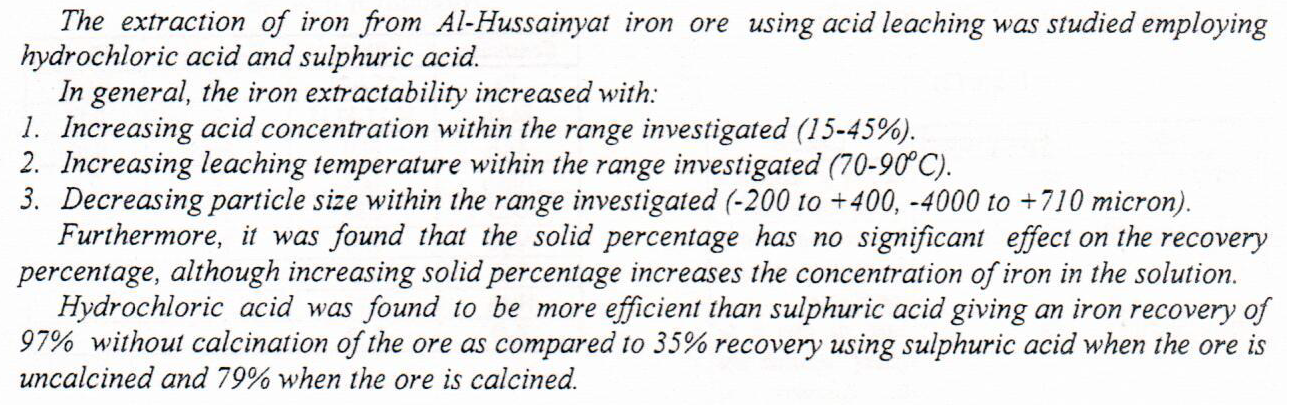
Extraction of Iron from Al-Hussainyat Iron Ore using Acid Leaching

 (50)
(50)
 (45)
(45)



Clerodendrum plant is believed to be very useful in many countries for treating various health disorders .“in this study was undertaken to assess antimicrobial activity of ethanol and aqueous extracts of clerodendrum plant”. Display my alcoholic extract higher inhibition of the aqueous extract all of the bacteria (Esherichia Coli , Pseudomonas aeruginosa, Bacillus subtilis). While the inhibition of the aqueous extract bacteria (Streptococcus, Shigelladysenteria) in higher alcoholic extract. However, the bacteria (Klebseillapneumoniae) did not shown any inhibition zone for both aqueous and alcoholic extracts. From the above results,“ it is concluded the antibacterial properties of Clerodendrum against life threatening pathogens”. So,
... Show MoreNew schiff bases series (VIII) a-e and 1,3-thiazolidin-4-one derivatives (IX) a-e containing the 1,2,4-triazole and 1,3,4-thiazazole rings were synthesized and screening their biological activities. These compounds were identified via Fourier transform infrared (FT-IR) spectra, some via Proton nuclear magnetic resonance (1H-NMR) and mass spectra. The biological results indicated that all of these compounds did not reveal antibacterial effectiveness against (Escherichia coli and Klebsiella species) (G-). Some of these compounds showed moderate antibacterial activity against (Staphylococcus aureus, and Staphylococcus epidermidis) (G+), and all compounds exhibited moderate activity against Candida albicans.
(1)
The aim of this study is to investigate the kinetics of copper removal from aqueous solutions using an electromembrane extraction (EME) system. To achieve this, a unique electrochemical cell design was adopted comprising two glass chambers, a supported liquid membrane (SLM), a graphite anode, and a stainless-steel cathode. The SLM consisted of a polypropylene flat membrane infused with 1-octanol as a solvent and bis(2-ethylhexyl) phosphate (DEHP) as a carrier. The impact of various factors on the kinetics constant rate was outlined, including the applied voltage, initial pH of the donor phase solution, and initial copper concentration. The results demonstrated a significant influence of the applied voltage on enhancing the rate of c
... Show More
(1)
The purpose of this study was to evaluate the anesthetic effectiveness of a buccal infiltration technique combined with local massage (using 2% lidocaine) in the extraction of mandibular premolars to be utilized as an alternative to the conventional inferior alveolar nerve block.
Patients eligible included any subject with a clinical indication for tooth extraction of the mandibular 1st or 2nd premolars. All patients were anesthetized buccally by local infiltration technique followed by an external pressure applied for 1 min directly over the injection area. In each case, another local
(5)
(9)
The research included four topics: the definition of Imam al-Bazzazi, his scientific life, his sheikhs, his students, his writings, his death, and selected issues of his weight in the book of prayer. The Imam al-Bazazi is the son of Muhammad ibnShihabibn Yusuf. He is known as al-Khardizi al-Khawarizmi. The author did not adopt the definitions of language and terminology, and rarely mention the legal evidence adopted by the scholars in their opinions, and only to mention the views only, and the author, may God have mercy on him in his book on the sources of m The Prophet (peace and blessings of Allaah be upon him) said: "The Prophet (peace and blessings of Allaah be upon him) And fall down the order, the third issue, which is to leave the
... Show MoreAbstract. In this research, the uranium concentration in (16) water samples collected from some agricultural areas surrounded with AlTuwitha nuclear site in Baghdad-Iraq was measured by using a CR-39 detector. The concentration of uranium in this study was from (0.6 ± 0.33mg/l) to (2.51 ± 0.49 mg/l), and the weighted average for the concentrations (1.262 ± 0.402 mg/l). The results showed it is a concentration of uranium level in water samples studied is higher than the allowed limit recommended by WHO and ICRP.
(5)
(4)
(9)
(9)
(12)
(12)
From 211 urine samples, Gram negative bacteria were isolated from only 61 urine samples with isolation percentage 28.9%. Escherichia coli were isolated percentage 70.49% while Klebsiella pneumoniae and Psendomonas aeruginosa were 8.19% and 6.55%, respectively.Proteus spp. Were isolated from 9 (14.75%), P. mirablis and P. vulgaris were isolates percentage 11.47% and 3.27%, respectively. Uroepithelial Cell Adhesin (UCA) fimbriae expression by P.mirabilis isolates was detected by the high capacity to adhesion to human uroepithetial cells, the isolate p.mirabilis U7 was adhesion to human uroepithelial cells mean no.30.2 bacteria/cell when grown on luria broth at 37C for 24h, but then grown it’s on luria agar at 37C for 24h the adhesion
... Show More