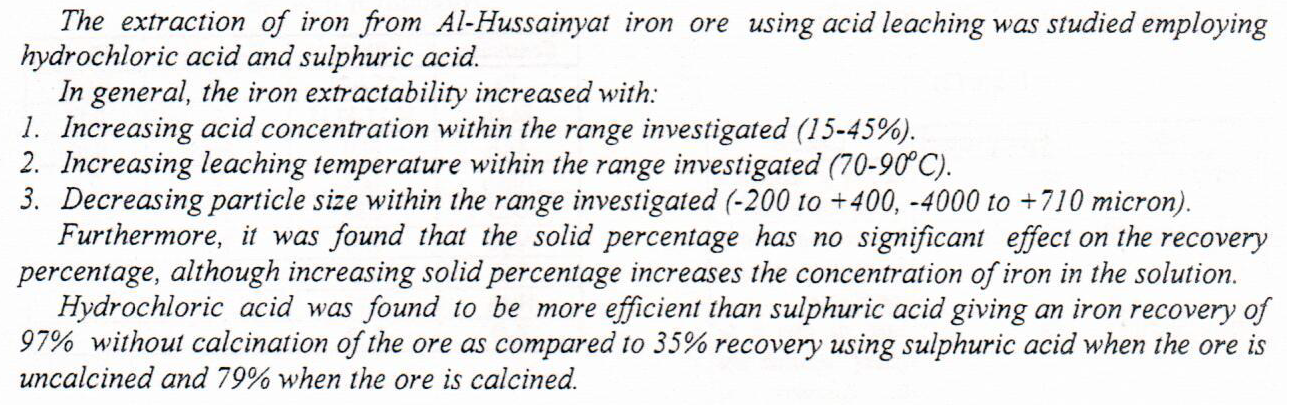
Extraction of Iron from Al-Hussainyat Iron Ore using Acid Leaching

Aqueous Two Phase System (ATPS) or liquid-liquid extraction is used in biotechnology to recover valuable compounds from raw sources. In Aqueous Two-Phase Systems, many factors influence the Partition coefficient, K, (which is the ratio of protein concentration in the top phase to that in the bottom phase) and the Recovery percentage (Rec%). In this research, two systems of ATPS were used: first, polyethylene glycol (PEG) 4000/Sodium citrate (SC), and the second, PEG8000/ Sodium phosphate (SPH), for the extraction of Bovine Serum Albumin (BSA). The behavior of Rec% and K of pure (BSA) in ATPS has been investigated throughout the study by the effects of five parameters: temperature, concentration of polyethylene glycol (P
... Show More (5)
(5)
 (4)
(4)


In this study was undertaken frish fish such as Bigeye Ilisha megaloptera, Nematalos nasus, Suboor Hilsha ilisha and Carp Cyprinus carpio. they were purchased from local marketes in Basrah, Oil was extracted by a solvent extraction method on low temperature. And the level of oil obtiened about (6.08; 10.72; 13.52 and 5.61)% for Bigeye, Jaffout, Suboor and Carp. the Crud oils were compared with vegetable oil (olive oil) and animal fat (tial fat mutton).
The extracted oil from fresh complete fishs with compared oils intraed on pharmacological system through packed in capsul with and with out garlic`s extract. this system analysis with chemical tests.
Results were analyzed statistically by using the SPSS program with using (CRD)
This study was conducted to prepare protein concentrates from AL-Zahdidate’s pits by using alkaline methods where the chemical composition of the pits were (7.30, 1.04, 5.80, 8.68 and 77.19) % for each of the moisture, ash, protein, fat and carbohydrates respectively and the chemical composition of the concentrate protein was (6.62, 4.10, 26.70, 0.93, and 58.65) % respectively. The content of protein concentrate from the metallic elements (144.07, 25.11, 15.02, 0.49, 0.59, 0.27, 0.22 and 234.6) mg/ 100 g each of potassium, magnesium, calcium, iron, manganese, copper, zinc and phosphorus respectively. The results of SDS-PAGE showed five bands with weights molecular ranged between 11000-70000 Dalton. Give the biscuit which contain protei
... Show MoreThe purpose of this research work is to synthesize conjugates of NSAIDs (ibuprofen, and naproxen) with sulfadiazine as possible mutual prodrugs to overcome the local gastric irritation of NSAIDs with free carboxyl group by formation of ester linkage that supposed to remain intact in stomach and may hydrolyze in intestine chemically or enzymatically; in addition to that attempting to target the synthesized derivative to the colon by formation of azo bond that undergo reduction only by colonic bacterial azoreductaze enzyme to liberate the parent compound to act locally (treatment of inflammation and infections in colon)
(7)
(8)
(7)
(8)

Awsaj (Lycium barbarum) is a plant belong to family Solanaceae serves as a good source of bioactive compounds like phytosterols which have many important biological activity. Literature survey available so far revealed that there was no studies about Iraqi wild Awsaj phytosterols especially B-sitosterol, there for the objective of this study was to examine the efficiency of ultrasound assisted extraction (probe and bath) as compared to the conventional (Soxhlet) extraction method for extraction of phytosterols especially B-sitosterol from fruits, leaves, stems and roots of Iraqi wild Awsaj plant. This goal was achieved by comparing the extraction mass yield, also by a quick and easy approach for identification and quantification of bioac
... Show More
(1)
2,2'-(1-(3,4-bis(carboxydichloromethoxy)-5-oxo-2,5-dihydrofuran-2-yl)ethane-1,2-diyl)bis(oxy)bis(2,2-dichloroacetic acid) a derivative of L-ascorbic acid was prepared by reaction of L-ascorbic acid with trichloroacetic acid (1:4) ratio, in the presence of potassium hydroxide. A series of new metal complexes of this ligand were prepared by a reaction with the chlorides of Cd(II), Co(II), Ni(II), Cu(II) and Zn(II). The new ligand and its complexes were identified by C.H.N., IR, UV-visible spectra, Thermogravimetric analysis (TGA), as well as 1H, 13C-NMR and Mass spectra for ligand L. The complexes were also identified by molar conductance, atomic absorption, magnetic susceptibility and X-ray diffraction for Cu (II) complex. FT-IR spectra
... Show MoreThe purpose of this research is to prepare new vanillic acid derivatives with 1,2,4-triazole-3-thiol heterocyclic ring and evaluate their antimicrobial activity in a preliminary assessment. A multistep synthesis was established for the preparation of new vanillic acid-triazole conjugates. The intermediate of 4-(4-amino-5-mercapto-4H-1,2,4-triazol-3-yl)-2-methoxyphenol (4) reacts with different heterocyclic aldehydes (thiophene-2-carboxaldehyde, pyrrole-2-carboxaldehyde, thiophene-3-carboxaldehyde, and furfural ) in ethanol containing few drops of acetic acid yielded the corresponding 4-(4-(substituted amino)-5-mercapto-4H-1,2,4-1triazol-3-yl)-2-methoxy phenol derivatives (
(4)
(2)
The purpose of this research is to prepare new vanillic acid derivatives with 1,2,4-triazole-3-thiol heterocyclic ring and evaluate their antimicrobial activity in a preliminary assessment. A multistep synthesis was established for the preparation of new vanillic acid-triazole conjugates. The intermediate of 4-(4-amino-5-mercapto-4H-1,2,4-triazol-3-yl)-2-methoxyphenol (4) reacts with different heterocyclic aldehydes (thiophene-2-carboxaldehyde, pyrrole-2-carboxaldehyde, thiophene-3-carboxaldehyde, and furfural ) in ethanol containing few drops of acetic acid yielded the corresponding 4-(4-(substituted amino)-5-mercapto-4H-1,2,4-1triazol-3-yl)-2-methoxy phenol derivatives (5-8). These compounds were characterized spectroscopically by
... Show More
(4)
(2)