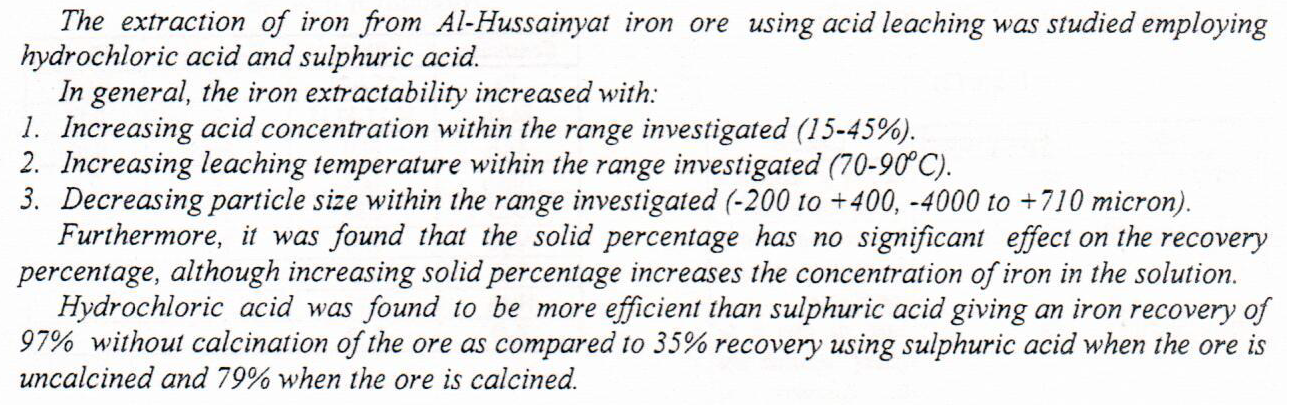
Extraction of Iron from Al-Hussainyat Iron Ore using Acid Leaching

Background: Suppression of quorum sensing (QS) that regulates many virulence factors, including antimicrobial resistance, in bacteria may subject the pathogenic microbes to the harmful consequences of the antibiotics, increasing their susceptibility to such drugs. Aim: The current study aimed to make an aqueous crude extract from the soil Proteus mirabilis isolate with the use of the gas chromatography-mass spectrometry (GC-MS) technique for its analysis, and then, study the impact of the extract on clinical isolates of Pseudomonas aeruginosa. Methods: Preparation of crude extracts from P. mirabilis (both organic and aqueous), which were then analyzed by GC-MS to detect the bioactive ingredients. Furthermore, the extract’s capability to i
... Show More (1)
(1)
 (1)
(1)



Resin-modified glass ionomer cement tends to shrink due to polymerization of the resin component. Additionally, they are more prone to syneresis and imbibition during the setting process. This
(5)
(5)
BACKGROUND: The rapidly growing knowledge regarding factors controlling tumour growth, with the new modalities of therapy acting on the biological activity of the tumours draw the attention of most cancer researches nowadays and represent a major focus for clinical oncology practice. For the detection of HER2/neu protein overexpression and gene amplification, immunohistochemistry (IHC) and in-situ hybridisation (ISH) is the recommended techniques, respectively, with high concordance between the two techniques. The current United Kingdom recommendations for HER2/neu testing are either for a two-tier system using IHC with reflex ISH testing in equivocal positive cases, or a one-tier ISH strategy. AIM: To compare the results of HER2/neu gene s
... Show More
(7)
(3)
Background: Dolutegravir sodium (DTG), used to treat HIV, faces challenges in delivering effective therapeutic concentrations to the brain due to the blood-brain barrier (BBB). Nanostructured lipid carriers (NLCs) combined with in situ gels present a promising strategy for enhancing brain drug delivery via the intranasal route. Objective: To compare brain pharmacokinetics of DTGs delivered via NLC-loaded in situ gel intranasal administration with the conventional intravenous (IV) drug solution. Methods: 80 Wistar rats, which were divided into three groups: two groups consisting of 39 animals each and a control group with 2 animals. Rats were administered with a dose of 1.0 mg/kg of DTGs IV, and DTGs NLC-loaded in situ gel were admin
... Show More
(5)
(3)
(6)
(4)
The current study was designed to evaluate the anti-inflammatory effect of GKB in the rat model of granulomatous inflammation. Thirty rats were distributed into five groups: The first group served as negative control group that received distilled water (DW) only without inducting inflammation, positive control group; treated with DW with the induction of inflammation and they were assigned to cotton pellet-induced granuloma, ginkgo biloba (GKB) treated group (200mg/kg/day), dexamethasone-treated group (1mg/kg), and Prednisolone treated group (5mg/kg). All the treatments were given orally for seven consecutive days. On day eight, the rats were anesthetized and the pellets together with granulation tissue were carefully removed
... Show More
(9)
(5)
Purpose: To identify the size of the food gap for the main agricultural products and crops in Iraq, which reflects to us the extent to which agricultural production in particular and the agricultural sector in general have declined.Theoretical framework: The theoretical side of the research dealt with the definition of self-sufficiency and the food gap, as well as identifying the reality of agricultural production in Iraq during the study period, as well as the reality of the food gap for the most important agricultural, plant and animal products.Design/methodology/approach: In reviewing the research problem, the researcher adopted the method of deductive and descriptive analysis based on the presentation and detail of official data
... Show More
(2)
(38)
(42)
Laboratory studies were conducted at the biological control unit, college of Agriculture, University of Baghdad to evaluate some biological aspects of the predator Chilocorus bipustulatus (Coleoptera: Coccinellidae), which is considered one of the most important predators on many insect pests, especially the scale insect, Parlatoria blanchardi, (Homoptera: Diaspididae) on date palms. The results showed that biological parameters of the predator were varied according to different degree of temperature. Egg incubation period was significantly different and reached to 7.5 and 5.44 day at 25 and 30°C respectively, Fertility was the same 100% at both temperature degrees. Larval growth periods were 17.41 and 16.12 day as well as the mortality
... Show More