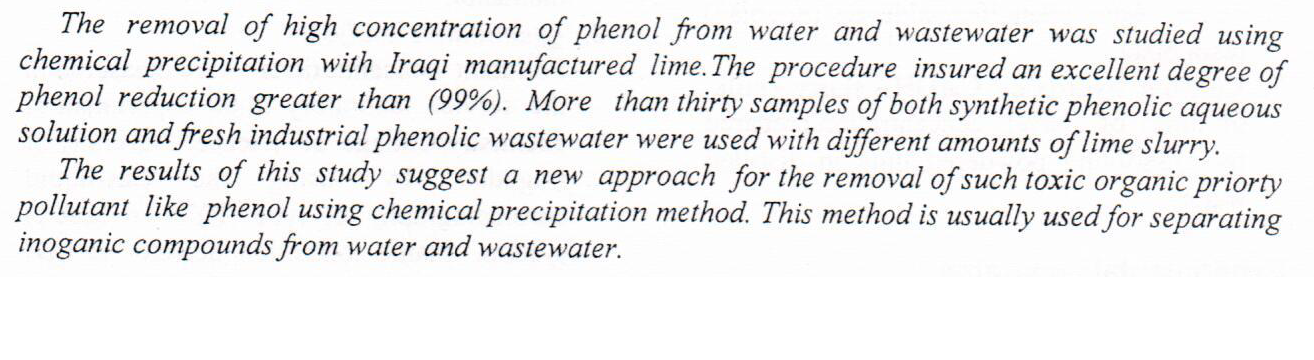
Removal of Phenol from Water and Wastewater by Chemical Precipitation with Lime

This research was aimed to study the exposure of Razzazah Lake to major hydrological changes in recent years as a result of natural climatic changes and drought, high evaporation in lake due to stop discharge from Habbaniyah Lake by Al- majera channel. During 2019, we collected surface water samples at three locations, and three samples from groundwater, in addition one samples from each location Imam Ali Drop and Sewage water of Karbala. The Results show that the heavy isotopes in lake and groundwater well are enriched during the warm period, and depleted during the cold period. Chemically, The dominant cations and anions in Al-Razzaza lake water are mainly of in Order Ca > Na > Mg and Cl>SO4 and the water
... Show More
This work focuses on the preparation of pure nanocrystalline SnO2 and SnO2:Cu thin films on cleaned glass substrates utilizing a sol-gel spin coating and chemical bath deposition (CBD) procedures. The primary aim of this study is to investigate the possible use of these thin films in the context of gas sensor applications. The films underwent annealing in an air environment at a temperature of 500 ◦C for duration of 60 minutes. The thickness of the film that was deposited may be estimated to be around 300 nm. The investigation included an examination of the structural, optical, electrical, and sensing characteristics, which were explored across various preparation circumstances, specifically focusing on varied
... Show More (7)
(7)
 (6)
(6)


To test the effect of 4 levels of nitrogen (i.e. 0, 45, 90 and 135 Kg N ha-1) as urea (46% N) and 3 levels of phosphorus (i.e. 0, 17.5 and 35 Kg P ha-1) as triple superphosphate (21.8% P) on yield and concentration of dill (Anethum graveolens L. local cultivar) seed oil this experiment was carried out during winter season of 1999 - 2000 at the experimental field of Agriculture College, Abu-Ghraib.
Both fertilizers were applied in two equal splits, first at seeds sowing and the second was added one month after emergence. Dried and ground seed samples were subjected to water distillation for extraction of volatile oils
Result indicated that fertilization of dill plants with 90 Kg N
... Show More
This paper experimentally investigates the heating process of a hot water supply using a neural network implementation of a self-tuning PID controller on a microcontroller system. The Particle Swarm Optimization (PSO) algorithm employed in system tuning proved very effective, as it is simple and fast optimization algorithm. The PSO method for the PID parameters is executed on the Matlab platform in order to put these parameters in the real-time digital PID controller, which was experimented with in a pilot study on a microcontroller platform. Instead of the traditional phase angle power control (PAPC) method, the Cycle by Cycle Power Control (CBCPC) method is implemented because it yields better power factor and eliminates harmonics
... Show More
In this paper waste natural material (date seed) and polymer particles(UF) were used for investigation of removal dye of the potassium permanganate. Also study effect some variables such as pH, dye concentration and adsorbent concentration on dye removal. 15 experimental runs were done using the itemized conditions designed established on the Box-Wilson design employed to optimize dye removal. The optimum conditions for the dye removal were found: (pH) 12, (dye con.) 2.38 ppm, (adsorbant con.) 0.0816 gm for date seed with 95.22% removal and for UF (pH) 12, (dye con.) 18 ppm, (adsorbant con.) 0.2235 gm with 91.43%. The value of R-square was 85.47% for Date seed and (88.77%) for UF.
... Show More
This study includes applying chemical tests on cow, sheep and chicken bones including both hallow and flat. The results of chemical tests on bones mentioned the moisture percentage which was between 4.95-7.32 %, and it was noticed the difference in protein percentage among different kinds of bones, The highest protien percentage was 39.62 % in hallow chicken bones and the lowest was in hallow sheep bones 20.31%, at the same time, the highest Ash percentage was in hallow sheep bones48.11% , whereas the highest percentage of fat was in hallow cow bones 30%. The chemical and physical tests were conducted for extracted fat from hallow and flat bones for cows, sheeps and chicken. It was found that peroxide values (PV), and free fatty acids (F
... Show MoreIn this study, a review of variety of processes that are used in the treatment produced water prior to reuse or to responsible disposal are presented with their environmental issues and economical benefits. Samples of produced water from five locations in Rumaila oilfield/in south of Iraq were taken and analyzed for their contents of brine, some heavy metals, total suspended solids and oil and grease. Moreover, two samples of water were treated using reverse osmosis technique which showed its ability to treat such contaminated water. The results showed that the environmental impact of produced water arises from its chemical composition; i.e., its salt content, its heavy metals, and hydrocarbon contents.
Abstract : A research was conducted to study the process parameters affecting hexavalent chromium Cr (VI) (carcinogenic compound) the removal percentage from the electrical industries company waste water that contain 88 mg/l of Cr (VI) concentration by adsorption onto tea wastes. Synthetic water with 88 mg/l Cr (VI) concentration was used. Several operation parameters affecting Cr (VI) removal efficiency were investigated, such as pH, initial Cr (VI) concentration, stirring time and tea wastes dose. The experimental results reveal that maximum Cr (VI) removal reached up to 94.26% at pH of 2, stirring time of 180 minute, tea wastes do
... Show More
Formation of Au–Ag–Cu ternary alloy nanoparticles (NPs) is of particular interest because this trimetallic system have miscible (Au–Ag and Au–Cu) and immiscible (Ag– Cu) system. So there is a possibility of phase segregation in this ternary system. At this challenge it was present attempts synthetic technique to generate such trimetallic alloy nanoparticles by exploding wire technique. The importance of preparing nanoparticles alloys in distilled water and in this technique makes the possibility of obtaining nanoparticles free of any additional chemical substance and makes it possible to be used in the treatment of cancer or diseases resulting from bacterial or virus with least toxic. In this work, three metals alloys Au-Ag-Cu
... Show More
(2)
Two field experiments were conducted at two different texture sites. The first site of the fields of AlMed-hateya Agriculture Division / Babil Governorate. The second site of the fields of Al-Nouriah Research Station / Ministry of Agriculture, the factors of the study in the two sites included several factors. The first factor includes two irrigation systems: sprinkler irrigation and surface irrigation. The second factor is the method of cultivation which includes the method of cultivation with basin and furrowing. The third factor is the type of the cultivated crop which includes a local variety (Fajr 3) and a hybrid variety (Drakma). The actual water consumption for the sprinkler irrigation system reached (587.13 and 637.62) mm season-1 f
... Show More