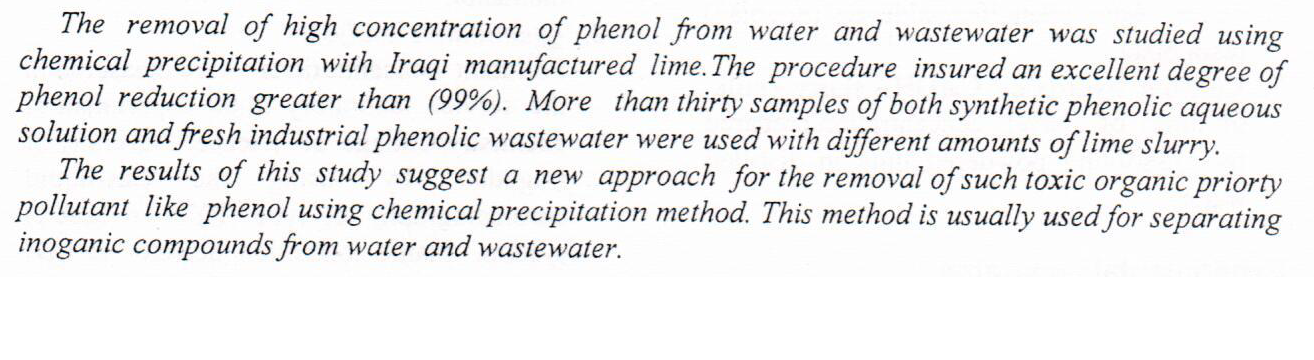
Removal of Phenol from Water and Wastewater by Chemical Precipitation with Lime

Polyethersulfone (PES) ultrafiltration membrane blending NaX zeolite crystals as a hydrophilic additive was examined for zinc (II) and lead ions Pb (II) removal from aqueous solutions. The effect of NaX zeolite content on the permeation flux and removal efficiency was studied. The results showed that adding zeolite to the polymer matrix enhanced the permeation flux. The permeation flux of all the zeolite/PES matrix membranes was higher than the pristine membrane. No significant improvement was observed in the removal of Zn (II) ions using all prepared membranes as the removal percentage did not raise above 29.2%. However, the removal percentage of Pb (II) ions was enhanced to 97% using a membrane containing 0.9%wt. zeolite. Also, it was
... Show More (7)
(7)

Fatty Acid Methyl Ester (FAME) produced from biomass offers several advantages such as renewability and sustainability. The typical production process of FAME is accompanied by various impurities such as alcohol, soap, glycerol, and the spent catalyst. Therefore, the most challenging part of the FAME production is the purification process. In this work, a novel application of bulk liquid membrane (BLM) developed from conventional solvent extraction methods was investigated for the removal of glycerol from FAME. The extraction and stripping processes are combined into a single system, allowing for simultaneous solvent recovery whereby low-cost quaternary ammonium salt-glycerol-based deep eutectic solvent (DES) is used as the membrane phase.
... Show More (11)
(10)
(11)
(10)


This study has been performed for knowing the nutritional and chemical content of one kind chamomile tea for infant and children available in the pharmacy. The results have been showed that the percentage of essential compounds which represented with moisture, protein, fat, carbohydrate, ash and calories as 7.09%,0.01%,0.01%,92,81%, 0.08% and 371,37 Kal./100g, respectively of dry weight. Also the results have been showed that the percentage of chamomile plant extract that added to the tea as 5.74%. And the result of chemical test for effective materials in alcoholic extract showed consist Tannis, Glycosides, Flavonoids, Alkialoids,and Resins.
The purpose of this research was to evaluate rice husk functionalized with Mg-Fe-layered double hydroxide (RH-Mg/Fe-LDH) as an adsorbent for the removal of meropenem antibiotic (MA) from an aqueous solution. Several batch experiments were undertaken using various conditions. Based on the results, the optimal Mg/Fe-LDH adsorbent with a pH of 9 and an M2+/M3+ ratio of 0.5 was associated with the lowest particle size (specifically. 11.1 nm). The Langmuir and Freundlich models were consistent with the experimental isotherm data (R2 was 0.984 and 0.993, respectively), and MA’s highest equilibrium adsorption capacity was 43.3 mg/g. Additionally, the second-order model was consistent with the adsorption kinetic results.
(14)
A numerical investigation has been performed to examine the effect of fluorine concentration on the chain reaction mechanisms and parameters of hydrogen fluoride (HF) chemical laser. The practical difficulties associated with this type of lasers impose that an alternative route might be quite useful. Thus, particular attention was paid to develop a computer program to investigate various processes. The results of this computer simulation program proved their credibility when compared with the little published data. This computer program is called Reaction Rate Simulation Model (RRSM). An entirely new approach to emulate the reaction mechanisms has been followed. The effectiveness of reaction rates in the processes of HF lase
... Show More
The wide use of pesticides in recent years leads to rapid distribution of these pollutants in the environment (air, water and soil).They were transported by means of air or water to biological ecosystems. They become more toxic through the processes of biological magnification while some of them persist for along period.The aim of this work is to show the negative effect that chemical pesticides causes, and in the same to show their side effect on the environment and health in Iraq. We could conclude that the bad use of these chemicals could cause an urgent impact now or in the future. Governmental offices dealing with these materials should take the right measures to minimize the danger and the misuse of these chemicals by seeking alternat
... Show MoreThe compounding of polyvinyl chloride (PVC) with two types of fillers and some additives were studied for the manufacturing of acid resistant tile. Various concentrations of two types of fillers namely; calcium carbonate and recycled glass powder were used along with different additives generally categorized as plasticizers, stabilizers, and lubricants were mixed in the standard concentration unit parts per hundred resins (phr) with the PVC as base polymer. The effects of filler materials on acid resistant towered different acids like sulphuric, nitric and hydrochloric at different concentration were studied. Samples which passed the test were further checked for dielectric strength and mechanical properties. It was found that the recycl
... Show More
In this work a hybrid composite materials were prepared containing matrix of polymer (polyethylene PE) reinforced by different reinforcing materials (Alumina powder + Carbon black powder CB + Silica powder). The hybrid composite materials prepared are: • H1 = PE + Al2O3 + CB • H2 = PE + CB + SiO2 • H3 = PE + Al2O3 + CB + SiO2 All samples related to electrical tests were prepared by injection molding process. Mechanical tests include compression with different temperatures and different chemical solutions at different immersion times The mechanical experimentations results were in favour of the samples (H3) with an obvious weakness of the samples (H1) and a decrease of these properties with a rise in temperature and the increasing
... Show More
An investigation was conducted for the improvement of viscosity index of light lubricating oil fraction (40 stock)
obtained from vacuum distillation unit of lube oil plant of Daura Refinery, using solvent extraction process.
In this study furfural solvent was used to extract the undesirable materials which reduce the viscosity index of raw
lubricating oil fraction.
The studied effecting variables of extraction were extraction temperature range from 70 to 110°C, and solvent to oil
ratio range from 1:1 to 4:1 (wt/wt).
The n-d-M method was used for calculation of carbon distribution and structural group analysis of the raffinate
produced from furfural extraction.
Also the three component phase diagram for a mixed-ba
(1)
(1)