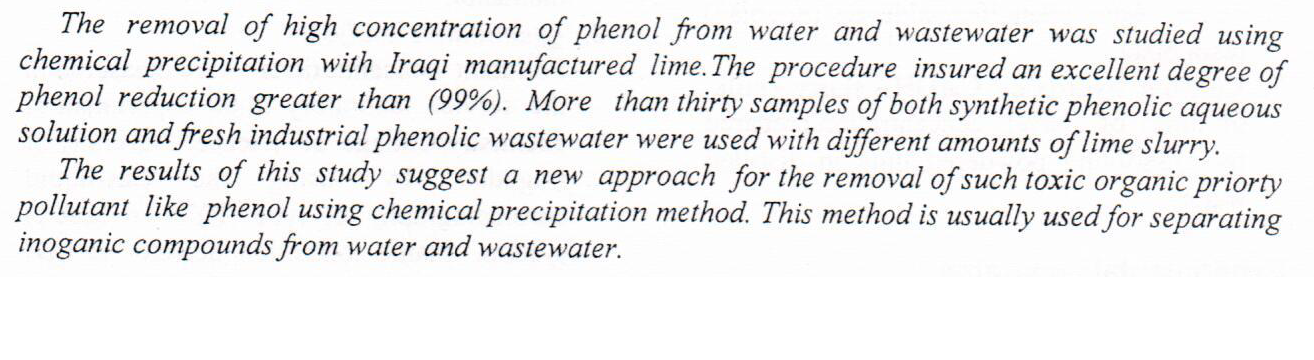
Removal of Phenol from Water and Wastewater by Chemical Precipitation with Lime

Wheat straw was modified with malonic acid in order to get low cost adsorbent have a good ability to remove copper and ferric ions from aqueous solutions, chemical modification temperature was 120°C and the time was 12 h. Parameters that affect the adsorption experiments were studied and found the optimum pH were 6 and 5 for copper and iron respectively and the time interval was 120 min and the adsorbent mass was 0.1 g. The values for adsorption isotherms parameters were determined according to Langmuir [qmax were 54.64 and 61.7 mg/g while b values were 0.234 and 0.22 mg/l] , Freundlich [Kf were 16.07 and 18.89 mg/g and n were 2.77 and 3.16], Temkin [B were 0.063 and 0.074 j/mol and At were 0.143 and 1.658 l/g] and for Dubinin-Radushkev
... Show MoreSlag of aluminum is a residue which results during the melting process of primary and secondary aluminum production. Salt slag of aluminum is hazardous solid waste according to the European Catalogue for Hazardous Wastes. Hence, recovery of aluminum not only saves the environment, but also has advantages of financial and economic returns. In this research, aluminum was recovered and purified from the industrial wastes generated as waste from both of State Company for Electrical and Electronic Industries (Baghdad/AlWaziriya) and General Company for Mechanical Industries (Babylon/-Al-Escandria). It was found that these wastes contain tiny proportions of other elements such as iron, copper, nickel, titanium, lead, and potassium. Wastes were
... Show More (3)
(3)

Crystalline silicon (c-Si) has low optical absorption due to its high surface reflection of incident light. Nanotexturing of c-Si which produces black silicon (b-Si) offers a promising solution. In this work, effect of H2O2 concentrations towards surface morphological and optical properties of b-Si fabricated by two-step silver-assisted wet chemical etching (Ag-based two-step MACE) for potential photovoltaic (PV) applications is presented. The method involves a 30 s deposition of silver nanoparticles (Ag NPs) in an aqueous solution of AgNO3:HF (5:6) and an optimized etching in HF:H2O2:DI H2O solution under 0.62 M, 1.85 M, 2.47 M, and 3.7 M concentrations of H2O<
... Show More
(4)
A modified chemical method was used to prepare titanium dioxide nanoparticles (TiO2 NPs), which were diagnosed by several techniques: X-ray diffraction, Fourier transform infrared, field emission scaning electron microscopy, energy disperse X-ray, and UV-visible spectroscopy, which proved the success of the preparation process at the nanoscale level. Where the titanium oxide particles have an average particle size equal to 6.8 nm, titanium dioxide particles were used in the process of adsorption of Congo red dye from its aqueous solutions using a batch system. The titanium oxide particles gave an adsorption efficiency of Congo red dye up to more than 79 %. The experimental data of the adsorption process were analyzed with kinetic models and
... Show More (1)
(1)

Air stripping for removal of Trichloroethylene (TCE), Chloroform (CF) and Dichloromethane (DCM) from water were studied in a bubble column (0.073 m inside dia. and 1.08 m height with several sampling ports). The contaminated water was prepared from deionized water and VOCs. The presence of VOCs in feed solution was single, binary or ternary components. They were diluted to the concentrations ranged between 50 mg/l to 250 mg/l. The experiments were carried out in batch experiments which regard the bubble column as stirred tank and only gas was bubbled through stationary liquid. In this case transient measurements of VOC concentration in the liquid phase and the measured concentra
... Show More
(50)
(50)

A new benzylidene derivative, namely N-benzylidene-5-phenyl-1,3,4-thiadiazol-2-amine (BPTA), has been synthesized and instrumentally confirmed with Elemental Analysis (CHN), Nuclear Magnetic Resonance (NMR), and Fourier Transform Infrared Spectroscopy (FT-IR). Titanium Dioxide (TiO2) nanoparticles (NPs) were synthesized and characterized by X-ray. The mutualistic complementary dependence of BPTA with TiO2 nanoparticles as anti-corrosive inhibitor on mild steel (MS) in 1.0 M hydrochloric acid has been tested at various concentrations and various temperatures. The methodological work was achieved by gravimetric measurement methods complemented with surface analysis. The synthesized inhibitor concentrations were 0.1 mM to 0.5 mM and the temper
... Show More
(77)
This work includes the synthesis and identification of ligand {3-((4-acetylphenyl)amino)-5,5-dimethylcyclohex2-en-1-one} (HL* ) by the treatment of 5,5-dimethylcyclohexane-1,3-dione with 4-aminoacetophenone under reflux. The ligand (HL* ) was identified via FTIR, Mass spectrum, elemental analysis (C.H.N.), 1H and 13C-NMR spectra, UV-Vis spectroscopy, TGA and melting point. The complexes were synthesized from ligand (HL* ) mixed with 3-aminophenol (A) and metal ion M(II), where M(II) = (Mn, Co, Ni, Cu, Zn and Cd) at alkaline medium to produce complexes of general formula [M(L* )(A)] with (1:1:1) molar ratio. These complexes were detected via FT-IR spectra, UV-Vis spectroscopy as well as elemental analysis (A.A) and melting point, conductivit
... Show MoreThis work includes the synthesis and identification of ligand {3-((4-acetylphenyl)amino)-5,5-dimethylcyclohex2-en-1-one} (HL* ) by the treatment of 5,5-dimethylcyclohexane-1,3-dione with 4-aminoacetophenone under reflux. The ligand (HL* ) was identified via FTIR, Mass spectrum, elemental analysis (C.H.N.), 1H and 13C-NMR spectra, UV-Vis spectroscopy, TGA and melting point. The complexes were synthesized from ligand (HL* ) mixed with 3-aminophenol (A) and metal ion M(II), where M(II) = (Mn, Co, Ni, Cu, Zn and Cd) at alkaline medium to produce complexes of general formula [M(L* )(A)] with (1:1:1) molar ratio. These complexes were detected via FT-IR spectra, UV-Vis spectroscopy as well as elemental analysis (A.A) and melting point, conductivit
... Show More