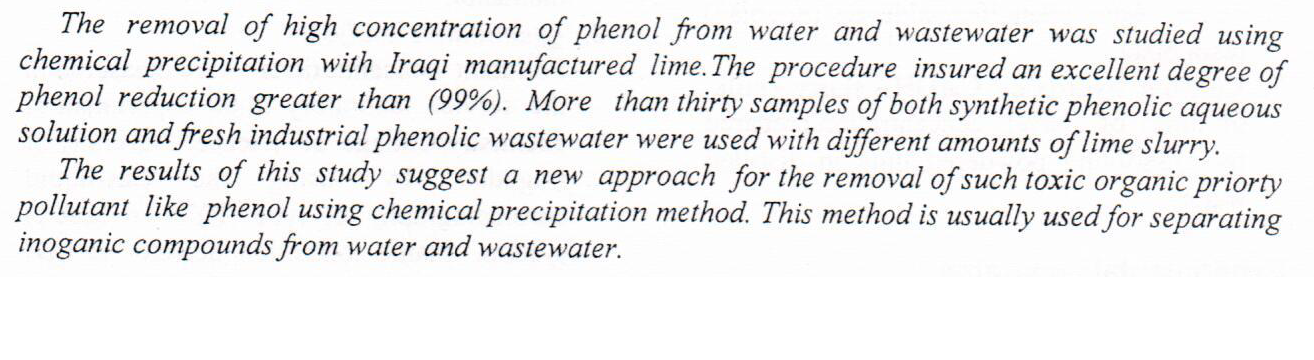
Removal of Phenol from Water and Wastewater by Chemical Precipitation with Lime

The purpose of this study was to find out the connection between the water parameters that were examined in the laboratory and the water index acquired from the examination of the satellite image of the study area. This was accomplished by analysing the Landsat-8 satellite picture results as well as the geographic information system (GIS). The primary goal of this study is to develop a model for the chemical and physical characteristics of the Al-Abbasia River in Al-Najaf Al-Ashraf Governorate. The water parameters employed in this investigation are as follows: (PH, EC, TDS, TSS, Na, Mg, K, SO4, Cl, and NO3). To collect the samples, ten sampling locations were identified, and the satellite image was obtained on the
... Show More (1)
(1)

 (12)
(6)
(12)
(6)


A simple, rapid, accurate and sensitive spectrophotometric method has been developed for the determing carbamate pesticides in both pure and water samples. The method is appropriate for the determination of carbofuran in the presence of other ingredients that are usually available in dosage forms. The effect of organic solvents on the spectrophotometric properties of the azo dye and the structure of the resulting product have also been worked out and it is found to be 1:1 benzidine :carbofuran. The method can be successfully applied to determination of carbofuran in water samples. The method is based on diazotization of Benzidine (4, 4 – diamino biphenyl) with sodium nitrite and hydrochloric acid followed by coupling with carbofuran
... Show More
(1)
The aim of this study was the discrimination of Salmonella isolated from chicken and their feed and drinking water for the epidemiological control of salmonellosis. Totally, 289 samples, including 217 chicken cloaca swabs, 46 water, and 26 feed samples were collected from five different farms in Karbala governorate, Iraq. Conventional bacteriology tests, API 20E, Vitek 2, and serology were used for bacterial identification. Random amplified polymorphic DNA (RAPD)-polymerase chain reaction (PCR) was applied to analyze the genetic relationships among Salmonella isolates. The isolation rate of Salmonella spp. was 21.1% (61/289). While the water samples constituted the highest rate (30.4%), a rate of
... Show More
(6)
(3)
Slag of aluminum is a residue which results during the melting process of primary and secondary aluminum production. Salt slag of aluminum is hazardous solid waste according to the European Catalogue for Hazardous Wastes. Hence, recovery of aluminum not only saves the environment, but also has advantages of financial and economic returns. In this research, aluminum was recovered and purified from the industrial wastes generated as waste from both of State Company for Electrical and Electronic Industries (Baghdad/AlWaziriya) and General Company for Mechanical Industries (Babylon/-Al-Escandria). It was found that these wastes contain tiny proportions of other elements such as iron, copper, nickel, titanium, lead, and potassium. Wastes were
... Show More
(3)
Wheat straw was modified with malonic acid in order to get low cost adsorbent have a good ability to remove copper and ferric ions from aqueous solutions, chemical modification temperature was 120°C and the time was 12 h. Parameters that affect the adsorption experiments were studied and found the optimum pH were 6 and 5 for copper and iron respectively and the time interval was 120 min and the adsorbent mass was 0.1 g. The values for adsorption isotherms parameters were determined according to Langmuir [qmax were 54.64 and 61.7 mg/g while b values were 0.234 and 0.22 mg/l] , Freundlich [Kf were 16.07 and 18.89 mg/g and n were 2.77 and 3.16], Temkin [B were 0.063 and 0.074 j/mol and At were 0.143 and 1.658 l/g] and for Dubinin-Radushkev
... Show MoreThis study was carried out in order to determine the toxic, mutagenic and antimutagenic effects for Mallow (Malva parviflora) in comparison to its mutagenic effect of Ultraviolet (UV) because it is consider physical mutagen by using parameters for the extract pri , with , post UV exposure by using bacterial system (G-system). The used system consisted of three isolates G3 Bacillus spp., G12 Arthrobacter spp. and G27 Brevibacterium spp.. The study depended on recording survival fraction (Sx) for studying the effects and induction of Streptomycin and Refampicin resistance mutants as a genetic markers.Water Extract was prepared from fresh and dry mallow leaves, stems, flowers and roots, in optimum concentration equal to (125µg/ml) which is
... Show More
(2)
(4)
(1)
n this study, Cr−Mo−N thin films with different Mo contents were synthesised via closed field unbalanced magnetron sputtering ion plating. The effects of Mo content on the microstructure, chemical bonding state, and optical properties of the prepared films were investigated by X-ray diffraction spectroscopy (XRD), X-ray photoelectron spectroscopy (XPS), field emission scanning electron microscopy, and ultraviolet-visible spectrophotometry. XRD results determined the face centered cubic (fcc) structure of pure CrN film. The incorporation of molybdenum (Mo) in the CrN matrix was confirmed by both XRD and XPS analyses. The CrMoN coatings demonstrate various polycrystalline phases including CrN, γ-Mo2N, Cr with oxides layers of MoO3, CrO3,
... Show More