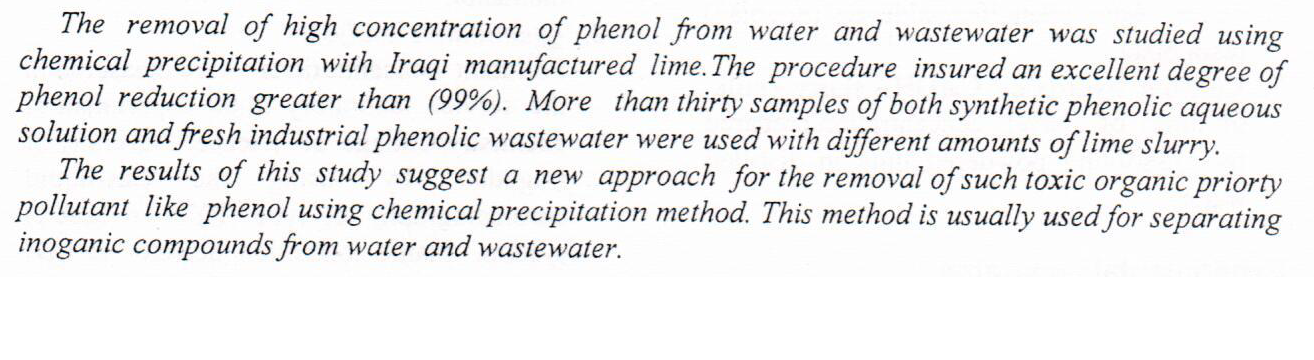
Removal of Phenol from Water and Wastewater by Chemical Precipitation with Lime

Abstract This study investigated the treatment of textile wastewater contaminated with Acid Black 210 dye (AB210) using zinc oxide nanoparticles (ZnO NPs) through adsorption and photocatalytic techniques. ZnO NPs were synthesized using a green synthesis process involving eucalyptus leaves as reducing and capping agents. The synthesized ZnO NPs were characterized using UV-Vis spectroscopy, SEM, EDAX, XRD, BET, Zeta potential, and FTIR techniques. The BET analysis revealed a specific surface area and total pore volume of 26.318 m2/g. SEM images confirmed the crystalline and spherical nature of the particles, with a particle size of 73.4 nm. A photoreactor was designed to facilitate the photo-degradation process. The study investigated the inf
... Show More (11)
(11)
 (3)
(3)

 (1)
(1)
One technique used to prepare nanoparticles material is Pulsed Laser Ablation in Liquid (PLAL), Silver Oxide nanoparticles (AgO) were prepared by using this technique, where silver target was submerged in ultra-pure water (UPW) at room temperature after that Nd:Yag laser which characteristics by 1064 nm wavelength, Q-switched, and 6ns pulse duration was used to irradiated silver target. This preparation method was used to study the effects of laser irradiation on Nanoparticles synthesized by used varying laser pulse energy 1000 mJ, 500 mJ, and 100 mJ, with 500 pulses each time on the particle size. Nanoparticles are characterized using XRD, SEM, AFM, and UV-Visible spectroscopy. All the structural peaks determined by the XRD
... Show More
(4)
(2)
The effects of the permeation cement grout with fly ash on the sandy soil skeleton were studied in the present work in two phase; first phase the shear strength parameters, and the second phase effect of these grouted materials on volume grouted zone by injection (51) cm³ of slurry in sandy soil placed in steel cylinder model with dimension 15 cm in diameter and 30 cm in height. The soil sample was obtained from Karbala city and it is classified as poorly graded sand (SP) according to USCS. The soil samples were improved by cement grout with three percentages weight of water cement ratio (w:c); (0.1w:0.9c, 0.8w:0.2c, and 0.7w:0.3c), while the soil samples were dehydrated for one day
... Show MoreThe study's primary purpose is to explore an appropriate way of monitoring and assessing water depths using the satellite remote sensing technique of the Al Habbaniyah Lake in Iraq. This research studied the experience-conditions (thresholds) of different bands for multi-temporal satellite image data with different satellite image sensors (Landsat 5-TM, and EO1-ALI) for the same region, to recognize regions of water depths. The threshold values are taken that to separate the Al Habbaniyah Lake to the required depths (shallow, deep, and very deep), as a supervised method. A three-dimension feature space plot had used to represent these regions. The relationship of the mean values of the three separated water regions with all TM and A
... Show More
(1)
The present study refers to a ready-made three components epoxy based paint made by the Modern Paints Industries Company (Al-Za'farania, Baghdad) subjected to several tests in order to improve its specifications by optimizing the application conditions. The paint components are under the trade names: Resin (D-5547), Hardener (H-1457) and Thinner (P-851). The paint is used for painting drinking water reservoirs from inside.
Background: One of the most prevalent procedures in oral surgery is the removal of impacted mandibular third molars, typically accompanied by trismus, edema, and pain. Several methods and biomaterials were implemented to mitigate or avoid these surgical problems. Objectives: To evaluate the efficiency of chlorhexidine gel (WISDOM®) in minimizing postoperative sequelae associated with the impacted mandibular third molar that will be surgically extracted and its role in promoting early soft tissue closure of the surgical site. Methods: The study design was a double-masked and randomized, controlled clinical study that included healthy patients needing the removal of a mandibular third molar through surgery. The participants were rand
... Show More
The assessment of a river water’ quality is an essential procedure of monitor programs and is used to collect basic environmental data. The management of integrated water resources in a sustainable method is also necessary to allow future generations to meet their water needs. The main objective of this research is to assess the effect of the Diyala River on Tigris River water quality using Geographic Information System (GIS) technique. Water samples have been collected monthly from November 2017 to April 2018 from four selected locations in Tigris and Diyala Rivers using the grab sampling method. Fourteen parameters were studied which are Turbidity, pH, Dissolved Oxygen, Biological Oxygen Demand, Electrical Conductivi
... Show More
(2)
The assessment of a river water’ quality is an essential procedure of monitor programs and isused to collect basic environmental data. The management of integrated water resources in asustainable method is also necessary to allow future generations to meet their water needs. Themain objective of this research is to assess the effect of the Diyala River on Tigris River waterquality using Geographic Information System (GIS) technique. Water samples have beencollected monthly from November 2017 to April 2018 from four selected locations in Tigris andDiyala Rivers using the grab sampling method. Fourteen parameters were studied which areTurbidity, pH, Dissolved Oxygen, Biological Oxygen Demand, Electrical Conductivity, TotalDissolved Solids,
... Show MoreThe current study aimed to isolate and diagnose Candida spp yeasts that cause candidiasis with a PCR device from patients reviewed for some hospitals in Baghdad city and by 190 samples, the study recorded 123 isolates and the total percentage of infection was 64.7% .Samples were taken from different clinical cases of the vagina, blood and mouth and the Candida spp were (70.37%, 41.26%, 86.95%) respectively. Five types of yeasts were isolated and diagnosed, namely C. albicans, C. tropicalis, C. parapsilosis, C. krusei and C.glabarta. They were confirmed by PCR device and the most notable were yeast C. albicans, where 91 isolates were found, 73.98%, while the lowest infection was recorded. C.glabartawith 3 isolates, at 2.43%, significant diff
... Show More