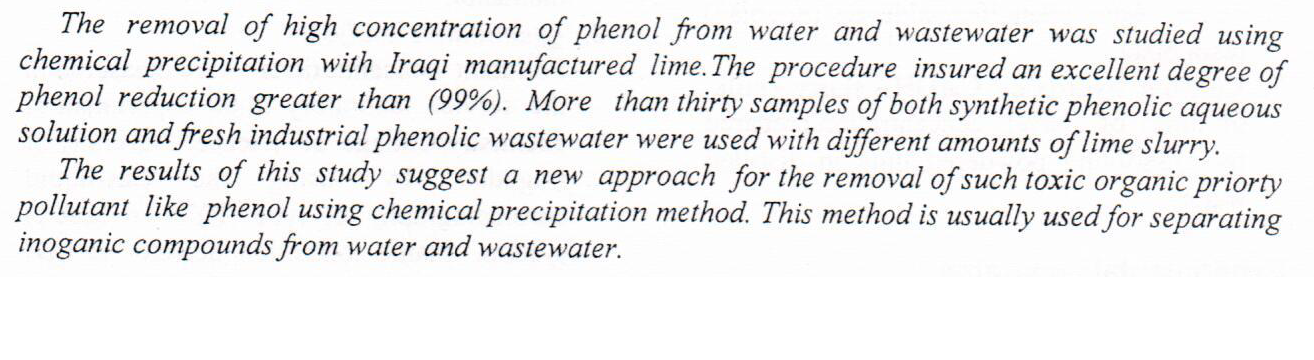
Removal of Phenol from Water and Wastewater by Chemical Precipitation with Lime



In order to evaluate the effect of seed size, plant growth regulators and some chemical materials on seed vigour and seedling growth of rice (Oryza sativa L.) an experiment was conducted in 2015 at Laboratories of Agriculture and Marshes College, University of Thi-Qar. Factorial experiment in CRD was used with four replications in two factors. The first factor included three seed sizes (4.6-5.1, 5.2-5.7 and 5.8-6.3 mm). The second factor was seeds soaking treatments (KNO3 6 gl-1, CaCl2 20 gl-1, salicylic acid 20 mg l-1, cytokinin 40 mg l-1, gibberllic acid 400 mg l-1, ascorbic acid 40 mg l-1 and seeds soaked in distilled water). The results showed that the largest seed size influenced significantly and gave the higher averages of germinatio
... Show MoreAbstract. In this research, the uranium concentration in (16) water samples collected from some agricultural areas surrounded with AlTuwitha nuclear site in Baghdad-Iraq was measured by using a CR-39 detector. The concentration of uranium in this study was from (0.6 ± 0.33mg/l) to (2.51 ± 0.49 mg/l), and the weighted average for the concentrations (1.262 ± 0.402 mg/l). The results showed it is a concentration of uranium level in water samples studied is higher than the allowed limit recommended by WHO and ICRP.
 (2)
(2)
 (2)
(2)
 (9)
(9)
In this study, pure Co3O4 nano structure and doping with 4 %, and
6 % of Yttrium is successfully synthesized by hydrothermal method.
The XRD examination, optical, electrical and photo sensing
properties have been studied for pure and doped Co3O4 thin films.
The X-ray diffraction (XRD) analysis shows that all films are
polycrystalline in nature, having cubic structure.
The optical properties indication that the optical energy gap follows
allowed direct electronic transition calculated using Tauc equation
and it increases for doped Co3O4. The photo sensing properties of
thin films are studied as a function of time at different wavelengths to
find the sensitivity for these lights.
High photo sensitivity dope
(8)
A novel series of mixed-ligand complexes of the type, [ML 1 (L 2 ) 3 ]Cl x [M = Cr(III), Fe(III), Co(II),Ni(II), Cu(II), Cd(II) and Hg(II), n = 2, 3], was synthesized using Schiffbase (HL 1 ) as main ligand, nicotinamide (L 2 ) as secondary ligand, and the corresponding metal ions in 1:3:1 molar ratio. The main ligand, HL 1 was prepared by the interaction of ampicillin drug and 4-chlorobenzophenone. The synthesized mixed ligand complexes were characterized by elemental analysis, UV-Vis, FT-IR, 1 H-NMR, 13 C-NMR and TG/DTG studies. In the mixed-ligand complexes, the Schiffbase ligand, HL 1 showed coordination to the central metal ion in tridentate manner via azomethine nitrogen, β-lactam ring oxygen and deprotonated carboxylic oxy- gen atom
... Show MoreBackground: Fracture of different types of acrylic denture base is a common problem associated with dental prosthesis. Studies suggested that the repair strength may be improved by several means including surface treatment with chemical agents. The aim of the study was to evaluate the effect of surface treatment with acrybond-bonding agent and monomer on fractured denture base in respect to transverse, tensile and shear bond strength and evaluation of the mode of failure by light microscope. Materials and methods: Two hundred seventy specimens were prepared and divided into 3 groups according to the material used (regular conventional, rapid simplified and high impact) heat cure acrylic. The specimen in each groups were prepared specificall
... Show MoreA Raman spectroscopy method was optimised to examine the chemical changes of aspirin tablets after interaction with helium temperatures. Several aspirin tablets were exposed to plasma-assisted desorption ionisation flame for different times (10, 30, 50, 60, 180 and 300s) and then analysed by Raman spectroscopy using optimal conditions. The changes in chemistry between exposed and fresh (without exposure to plasma) tablets were compared. The vibrational peaks of the aspirin molecule in the Raman spectrum were identified by checking the peak position. The results showed clear spectra with increases in intensity of vibrational peaks until 30s, whereas no spectra were measured for the exposed tablets to plasma flame after 50s. It can, the
... Show More
(10)