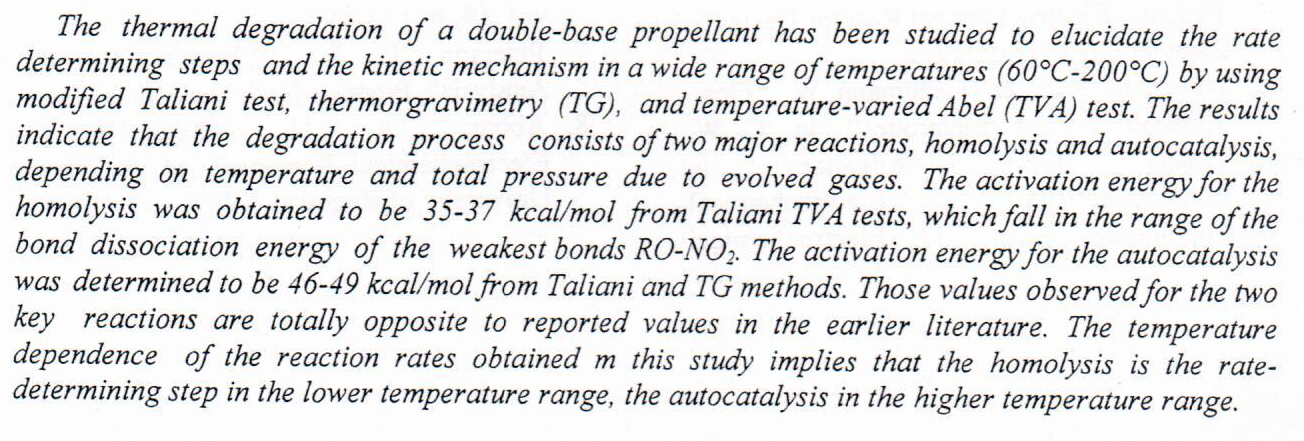
Kinetic Mechanism on Thermal Degradation of a Nitrate Ester Propellant

Protein arginine methyltransferases (PRMTs) play important roles in transcription, splicing, DNA damage repair, RNA biology, and cellular metabolism. Thus, PRMTs have been attractive targets for various diseases. In this study, we reported the design and synthesis of a potent pan-inhibitor for PRMTs that tethers a thioadenosine and various substituted guanidino groups through a propyl linker. Compound II757 exhibits a half-maximal inhibition concentration (IC50) value of 5 to 555 nM for eight tested PRMTs, with the highest inhibition for PRMT4 (IC50 = 5 nM). The kinetic study demonstrated that II757 competitively binds at the SAM binding site of PRMT1. Notably, II757 is selective for PRMTs over a panel of other methyltransferases, w
... Show More (22)
(22)
 (25)
(25)


 (4)
(2)
(4)
(2)
This review is concluded of 8-Hydroxyquinline (8HQ) compound and derivatives which has a very significant interests with a strong fluorescence , furthermore the relationship between divalent metal ions and characteristic of chelating . In the same way coordinated features have increase of its organic action and inorganic behavior by giving many samples of compounds which are a good chelating agents ligands with more capable of forming very stable complexes.Therefore, the role of (8HQ) is not limited on complexes only but its applications in different fields so this review will focus on demonstration preparation methods and properties of (8HQ) derivatives with their complexes and applications, hopefully that we will cover a part of scientifi
... Show MoreMorphological and phonological studies of fungal pathogen infecting alfalfa weevil Hypera postica (Gyllenhal) indicating that infection has been shown to develop along two distinct physiological lines, each culminating in the production of either conidial or resting spores, in host cadavers which are morphologically distinct. The percent of infection and epizootic development appeared to be dependent on host density. Farther evidence to entail proper correlation between conidia and resting spores suggest that these two forms of spores are stages in the development of one pathogen.
At the beginning of the twentieth century distorting handling totalitarian phenomena of art, which can be called the stage of the test, transition from the theory of ideal theory and other realistic is not cushy, since it requires vision and reading and other concepts, and in light of this dialectic manifested research problem by asking the following Is affected by the design idealism and realism. Through the above mentioned questions, the researcher found rationale for addressing this problem, the study through his research, which is marked (idealism and realism in a comparative study design). And demonstrated the importance of research in the identification of the concept and the effectiveness of the two theories idealism and realism a
... Show More
Many academics have concentrated on applying machine learning to retrieve information from databases to enable researchers to perform better. A difficult issue in prediction models is the selection of practical strategies that yield satisfactory forecast accuracy. Traditional software testing techniques have been extended to testing machine learning systems; however, they are insufficient for the latter because of the diversity of problems that machine learning systems create. Hence, the proposed methodologies were used to predict flight prices. A variety of artificial intelligence algorithms are used to attain the required, such as Bayesian modeling techniques such as Stochastic Gradient Descent (SGD), Adaptive boosting (ADA), Deci
... Show More
(17)
(5)
(1)
This study investigates asset returns within the Iraq Stock Exchange by employing both the Fama-MacBeth regression model and the Fama-French three-factor model. The research involves the estimation of cross-sectional regressions wherein model parameters are subject to temporal variation, and the independent variables function as proxies. The dataset comprises information from the first quarter of 2010 to the first quarter of 2024, encompassing 22 publicly listed companies across six industrial sectors. The study explores methodological advancements through the application of the Single Index Model (SIM) and Kernel Weighted Regression (KWR) in both time series and cross-sectional analyses. The SIM outperformed the K
... Show More
(1)
Most of the water pollutants with dyes are leftovers from industries, including textiles, wool and others. There are many ways to remove dyes such as sorption, oxidation, coagulation, filtration, and biodegradation, Chlorination, ozonation, chemical precipitation, adsorption, electrochemical processes, membrane approaches, and biological treatment are among the most widely used technologies for removing colors from wastewater. Dyes are divided into two types: natural dyes and synthetic dyes.
(5)
(66)
(59)