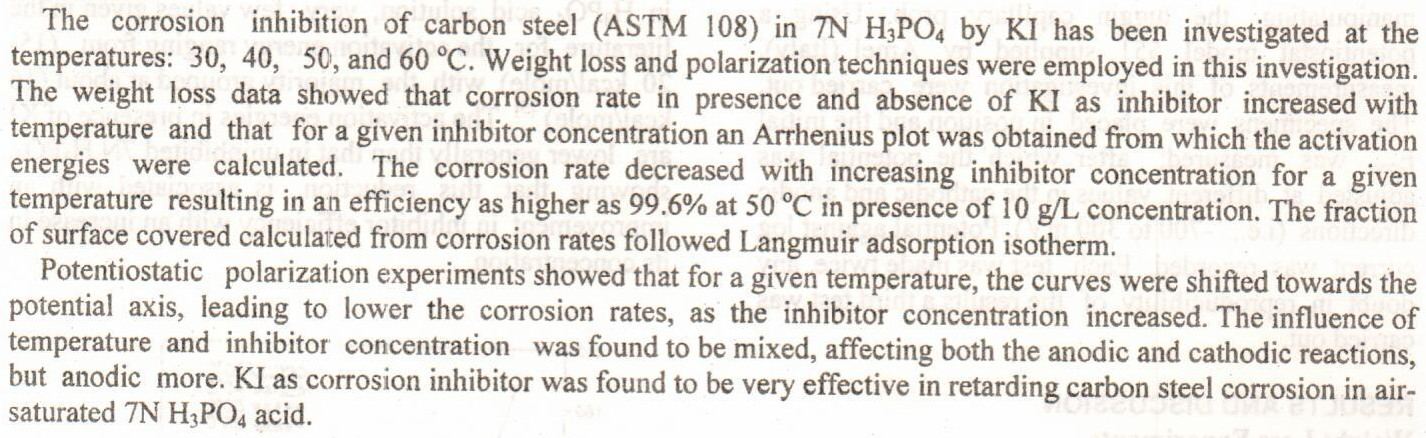
The Influence of Temperature on Corrosion Inhibition of Carbon Steel in Air-Saturated 7NH3PO4 by Potassium Iodide

These days, the world is facing a global environmental and sustainability problem due to the increasing generation of large amounts of waste through construction and demolition work, which causes a serious problem for the environment. Therefore, this research was conducted to get rid of the waste disposal problems, including old glass and concrete, which were used as recycled fine aggregates. Seven different mixtures were prepared. The first mixture was with the used sand, which is glass sand, and it was adopted as a reference mixture (ORPC), and three mixtures were prepared for each of the recycled materials (waste concrete and glass) and partially replaced by glass sand in different proportions (25, 50, and 75) %. Some
... Show More (1)
(1)
 (1)
(1)


The slurry infiltrated fiber concrete (SIFCON) is nowadays considered a special type of high fiber content concrete; it is high strength and high performance material. This paper investigates the effect of spread steel fiber into the slurry mortar on some properties of SIFCON. According to fiber distribution, two sets were used in this investigation. The first set consisted of randomly distributing fibers inside the slurry. The second set was by placing the fibers in an orderly manner inside the slurry. Crimped steel fibers with an aspect ratio of (60) were used. Two different volume fractions percentage of (7% and 9%) by volume of mold were used in both sets for this study. Also, a w/c ratio of (0.35) and superplasticiz
... Show More
(11)
(10)
(4)
(4)

Three-dimensional nonlinear thermal numerical simulations are conducted for the friction stir welding (FSW) of AA 7020-T53. Three welding cases with tool (rotational and travel) speeds of 900rpm-40mm/min, 1400rpm-16mm/min and 1400rpm-40mm/in are analyzed. The objective is to study the variation of transient temperature in a friction stir welded plate of 5mm workpiece thickness. Based on the experimental records of transient temperature at several specific locations during the friction stir welding process for the AA 7020-T53, thermal numerical simulation is developed. The numerical results show that the temperature field in the FSW process is symmetrically distributed with respect to the welding line, increasing travel speed decreasing tran
... Show More
(44)
Incremental Sheet Metal Forming (ISMF) is a modern sheet metal forming technology which offers the possibility of manufacturing 3D complex parts of thin sheet metals using the CNC milling machine. The surface quality is a very important aspect in any manufacturing process. Therefore, this study focuses on the resultant residual stresses by forming parameters, namely; (tool shape, step over, feed rate, and slope angle) using Taguchi method for the products formed by single point incremental forming process (SPIF). For evaluating the surface quality, practical experiments to produce pyramid like shape have been implemented on aluminum sheets (AA1050) for thickness (0.9) mm. Three types of tool shape used in this work, the spherical tool ga
... Show More
(4)
Nanofluid treatment of oil reservoirs is being developed to enhance oil recovery and increase residual trapping capacities of CO2 at the reservoir scale. Recent studies have demonstrated good potential for silica nanoparticles for enhanced oil recovery (EOR) at ambient conditions. Nanofluid composition and exposure time have shown significant effects on the efficiency of EOR. However, there is a serious lack of information regarding the influence of temperature on nanofluid performance; thus the effects of temperature, exposure time and particle size on wettability alteration of oil-wet calcite surface were comprehensively investigated; moreover, the stability of the nanofluids was examined. We found that nanofluid treatment is more efficie
... Show More
(173)
(163)
The main objective of this study is to determine whether the use of He-Ne Laser (632.8 nm wavelength and power 0.5 mW) is an eligible and effective tool to kill or reduce the cell viability of Candida albicans isolated from complete upper dentures. Twenty one swabs were taken from the complete upper dentures. Only six swabs showed positive cultures for C. albicans. The isolate was divided into two groups, group I was not irradiated (control), and group II was irradiated by He-Ne Laser for different periods (10, 15, 20, and 30) min. After irradiation, the results showed a significant reduction in the viable cell count and colonies diameters especially at exposure periods 10 and 15 min. Although the low power He-Ne Laser was not eradicating t
... Show More