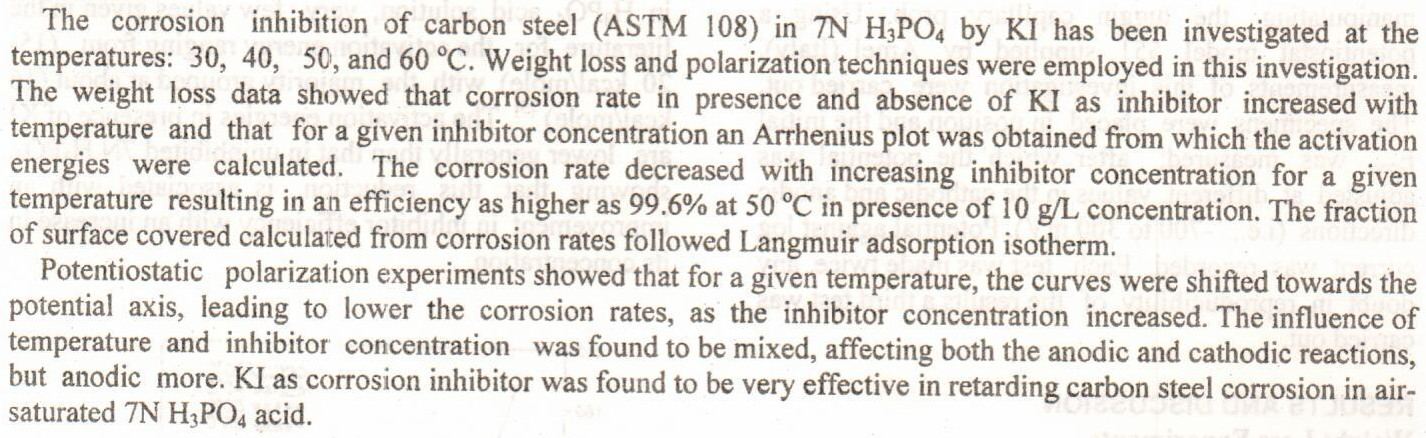
The Influence of Temperature on Corrosion Inhibition of Carbon Steel in Air-Saturated 7NH3PO4 by Potassium Iodide

Brucella melitensis isolates were obtained from human infections , and milk which obtained from aborted sheep at Mosul city vicinity . One isolate from each source was used in carrying out this study. Brucella liquid culture was added to sheep milk at 2.5 % for treatments . To first treatment 2 % of yoghurt starter ( Lactobacillus delbrueckii subsp. bulgaricus and Streptococcus salivarius subsp. thermophilus ( 1: 1 ) ) . Second treatment was carried out without addition of yoghurt starter but the pH was lowered using lactic acid in pattern similar to first treatment . Third treatment was similar to the first treatment but contained buffer to alleviate the reduction in pH , which reduced to 6.1 in comparison to 4.9 of the first treatment .
... Show More
The plant Zizyphus spina-christa grows wildly in the middle and southern of Iraq locally named Nabag. In this study the antibacterial activity of several different plant extract (alcoholic hot and cold extract 80%, aqueous hot and cold extract) was tested against some gram negative bacteria that related to Enterobacteriacea as follow; Pseudomonas aeruginosa, Escherchia coli Proteus mirabilis, Serratia mercesence,. Aeromonas sp, Klebsiella pneumoniae ,Shigella sp, Salmonella enteritidis (134), S. typhi(97), S. typhimurium (300) , S. typhi, . The results showed that efficient method of extract was alcoholic hot extract from other extract methods that are used in this study. The detection of active compound in crude extracts of the leaves show
... Show More
 (2)
(2)

The effect of three ionic liquids viz., 1-hexyl-3-methylimidazolium tetrafluoroborate (ILE), 1-hexyl-3-metylimidazolium hexafluorophosphate (ILF) and 1-octyl-3-methylimidazolium tetrafluoroborate (ILG) when used as surfactants on the performance of dissolved air floatation (DAF) was investigated.
Experiments were conducted at a temperature of 30-35 ºC, 10ppm ferric chloride as coagulant, 50% recycle ratio, pH 8, and 10 minutes treatment time to find oil and grease (OG) and turbidity removal efficiencies at saturation pressure (2-6) bar.
ILs were used at concentration of 50 µl/liter of treated water in two positions in DAF system; the saturation vessel and the treatment tank. The performance using ILs
... Show More
(1)
 (1)
(1)
In an attempt to disposal from nuclear waste which threats our health and environments. Therefore we have to find appropriate method to immobilize nuclear waste. So, in this research the nuclear waste (Strontium hydroxide) was immobilized by Carbon nanotubes (CNTs). The Nd-YAG laser with wave length 1064 nm, energy 750 mJ and 100 pulses used to prepare CNTs. After that adding Sr(HO)2 powder to the CNTs colloidal in calculated rate to get homogenous mixing of CNTs-Sr(OH)2. The Sr(HO)2 absorbs carbon dioxide from the air to form strontium carbonate so, the new solution is CNTs-SrCO3. To dry solution putting three drops from the new solution on the glass slides. To investigate the radi
... Show More
(3)
Drilling solutions can be considered as an intricate mixture comprising of number of chemical additives which aid specific needs such as controlling the rheological properties and reducing corrosion. Inhibitors are substances that are added in small concentrations to corrosive environment to decrease the corrosion. Their applications can be found in drilling equipments. The effect of adding Zinc Sulphate and Carboxymethyl Cellulose to study their influence on the corrosion of carbon steel in Bentonite mud has been evaluated using Weight Loss Technique. This study focuses on determining rheological properties and corrosion characteristics. Results show CMC and ZnSO4 work as inhibitors when added to the Bentonite with inhibition
... Show More
(3)
Hydrocarbon displacement at the pore scale is mainly controlled by the wetness properties of the porous media. Consequently, several techniques including nanofluid flooding were implemented to manipulate the wetting behavior of the pore space in oil reservoirs. This study thus focuses on monitoring the displacement of oil from artificial glass porous media, as a representative for sandstone reservoirs, before and after nanofluid flooding. Experiments were conducted at various temperatures (25 – 50° C), nanoparticles concentrations (0.001 – 0.05 wt% SiO2 NPs), salinity (0.1 – 2 wt% NaCl), and flooding time. Images were taken via a high-resolution microscopic camera and analyzed to investigate the displacement of the oil
... Show More
(4)
Hydrocarbon displacement at the pore scale is mainly controlled by the wetness properties of the porous media. Consequently, several techniques including nanofluid flooding were implemented to manipulate the wetting behavior of the pore space in oil reservoirs. This study thus focuses on monitoring the displacement of oil from artificial glass porous media, as a representative for sandstone reservoirs, before and after nanofluid flooding. Experiments were conducted at various temperatures (25 – 50° C), nanoparticles concentrations (0.001 – 0.05 wt% SiO2 NPs), salinity (0.1 – 2 wt% NaCl), and flooding time. Images were taken via a high-resolution microscopic camera and analyzed to investigate the displacement of the oil at dif
... Show More
(4)
Oyster mushroom (Pleurotus ostreatus (Jacq. ex Fr.) P. Kumm.) is involved in the destruction of dead wood which is the main place of settlement of several living organisms. After humification, dead wood also becomes an important component of forest soils.
The purpose of the research is to study temperature and moisture conditions of extensive cultivation of oyster mushrooms on various wood substrates. To accomplish this goal, the following tasks were set: to determine the amount of effective stress temperatures and moisture content of substrates and their influence on the appearance of fruiting bodies of the oyster mushroom; to study the features of the extensive culti
... Show More
(1)
(3)