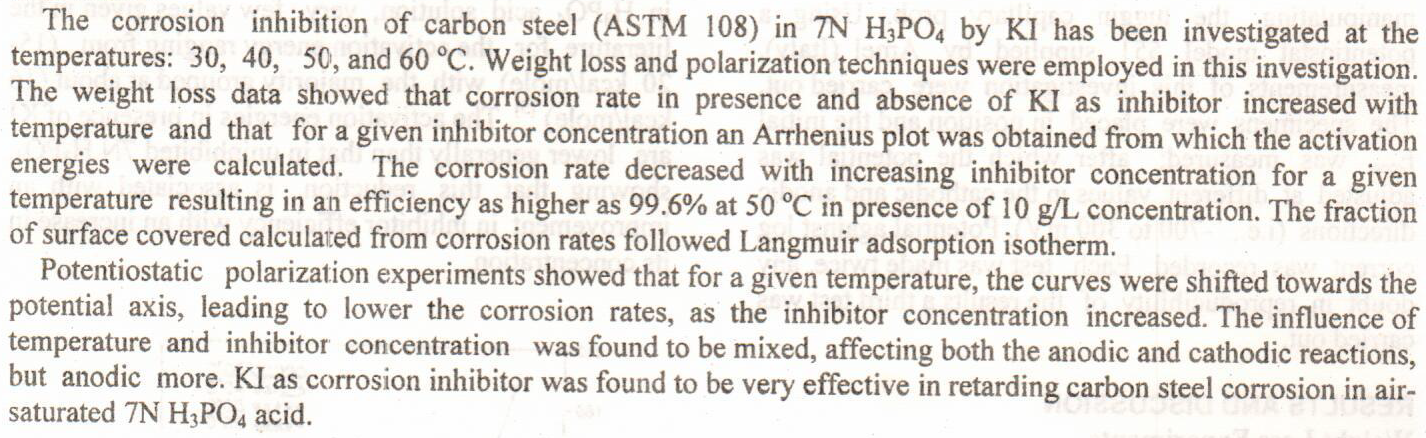
The Influence of Temperature on Corrosion Inhibition of Carbon Steel in Air-Saturated 7NH3PO4 by Potassium Iodide

In the present work, the efficiency of Tri-octyl Methyl Ammonium Chloride (TOMAC) ionic liquid was investigated as new and green demulsifier for three types of Iraqi crude oil emulsions (Nafut Khana (NK), Kirkuk and Basrah). The separation efficiency was studied at room temperature and by using microwave heating technique. Several batch experiments were done to specify the suitable conditions for the emulsification and demulsification which were specified as 45 minutes and 3000 rpm for crude oil emulsification while the ionic liquid doses were (500,300,150,50) ppm and the conditions of microwave heating were 1000 watt and 50 second as irradiation time. The results were very encouraging especially for NK and Kirkuk crude oil emulsions whe
... Show MoreThis study examines the removal of ciprofloxacin in an aqueous solution using green tea silver nanoparticles (Ag-NPs). The synthesized Ag-NPs have been classified by the different techniques of SEM, AFM, BET, FTIR, and Zeta potential. Spherical nanoparticles with average sizes of 32 nm and a surface area of 1.2387m2/g are found to be silver nanoparticles. The results showed that the ciprofloxacin removal efficiency depends on the initial pH (2.5-10), CIP (2-15 mg/L), temperature (20-50°C), time (0-180 min), and Ag-NPs dosage (0.1-1g/L). Batch experiments revealed that the removal rate with ratio (1:1) (w/w) were 52%, and 79.8% of the 10 mg/L of CIP at 60, and 180 minutes, respectively with optimal pH=4. Kinetic models for adsorpti
... Show More (1)

This paper concerns is the preparation and characterization of a bidentate ligand [4-(5,5- dimethyl-3-oxocyclohex-1-enylamino)-N-(5-methylisoxazol-3-yl) benzene sulfonamide]. The ligand was prepared from fusing of sulfamethoxazole and dimedone at (140) ºC for half hour. The complex was prepared by refluxing the ligand with a bivalent cobalt ion using ethanol as a solvent. The prepared ligand and complex were identified using Spectroscopic methods. The proposed tetrahedral geometry around the metal ions studied were concluded from these measurements. Both molar ratio and continuous variation method were studied to determine metal to ligand ratio (M:L). The M to L ratio was found to be (1:1). The adsorption of cobalt complex was carried out
... Show MoreMassive multiple-input multiple-output (massive-MIMO) is considered as the key technology to meet the huge demands of data rates in the future wireless communications networks. However, for massive-MIMO systems to realize their maximum potential gain, sufficiently accurate downlink (DL) channel state information (CSI) with low overhead to meet the short coherence time (CT) is required. Therefore, this article aims to overcome the technical challenge of DL CSI estimation in a frequency-division-duplex (FDD) massive-MIMO with short CT considering five different physical correlation models. To this end, the statistical structure of the massive-MIMO channel, which is captured by the physical correlation is exploited to find sufficiently
... Show More (5)
(5)


Heat exchanger is an important device in the industry for cooling or heating process. To increase the efficiency of heat exchanger, nanofluids are used to enhance the convective heat . transfer relative to the base fluid. - Al2O3/water nanofluid is used as cold stream in the shell and double concentric tube heat exchanger counter current to the hot stream basis oil. These nanoparticles were of particle size of 40 nm and it was mixed with a base fluid (water) at volume
concentrations of 0.002% and 0.004%. The results showed that each of Nusselt number and overall heat transfer coefficient increased as nanofluid concentrations increased. The pressure drop of nanofluid increased slightly than the base fluid because
The work presented in this research deals with the synthesis and physico-chemical characterization of Schiff base ligand (HL) created from vanillin with p-aminoazobenzene containing (N, O) as donor atoms. The synthesis ligand (HL) was characterized by the CHN, (FT-IR), (UV-Vis), (1H,13C-NMR) and mass spectroscopy, in addition the melting point were used to charac-terize the Schiff base. A series of mixed metal ligands complexes were formed by using Schiff base ligand (HL) as primary ligand and Paracetamol (PAR) as a secondary ligand with five divalent metal ions; Ni, Cu, Zn, Cd(II) and Hg. The formed complexes were characterized by using some analytical and standard spectroscopic methods; molar conductivity, magnetic susceptibil-ity, FT-IR,
... Show Moreالصيغة العامة للمعقدات الجديدة [M2(BDS)Cl4] الناتجة من تفاعل الليكاند الجديد] ن1,ن4-ثنائي(1أ –بنزو]د[ اميدازول-2-يل)-ن1,ن4-ثنائي(4-ثنائي مثيل امينو) بنزيل) سكسنمايد[ (BDS) مع الايونات الفلزية الكادميوم, الكوبلت, الزئبق, النحاس والنيكل. تم اشتقاق هذا الليكاند من تفاعل المواد الثلاث 4-(ثنائي ميثيل أمينو) بنزالدهيد، 2-أمينو بنزيميدازول، وكلوريد السكسينيل. تم تشخيص المركبات باستخدام مطيافية طيف الاشعة تحت الحمراء وطيف الرن
... Show More
(2)
(1)
(8)
Periodontitis is a dysbiosis-driven inflammatory disease in which a pathogenic subgingival biofilm disrupts the host–microbe equilibrium and promotes progressive loss of tooth-supporting tissues. While periodontal destruction has traditionally been explained mainly through the host immune response, increasing experimental and clinical evidence suggests that epithelial–mesenchymal transition (EMT)-like changes in the gingival epithelium may contribute to barrier failure and tissue remodeling during disease progression. EMT is characterized by reduced epithelial adhesion and polarity, alongside a shift toward a mesenchymal-like phenotype with enhanced motility and impaired epithelial barrier function. This narrative review focuses
... Show More
(5)
(6)
Concrete columns with hollow-core sections find widespread application owing to their excellent structural efficiency and efficient material utilization. However, corrosion poses a challenge in concrete buildings with steel reinforcement. This paper explores the possibility of using glass fiber-reinforced polymer (GFRP) reinforcement as a non-corrosive and economically viable substitute for steel reinforcement in short square hollow concrete columns. Twelve hollow short columns were meticulously prepared in the laboratory experiments and subjected to pure axial compressive loads until failure. All columns featured a hollow square section with exterior dimensions of (180 × 180) mm and 900 mm height. The columns were categorized into
... Show More
(16)
(20)