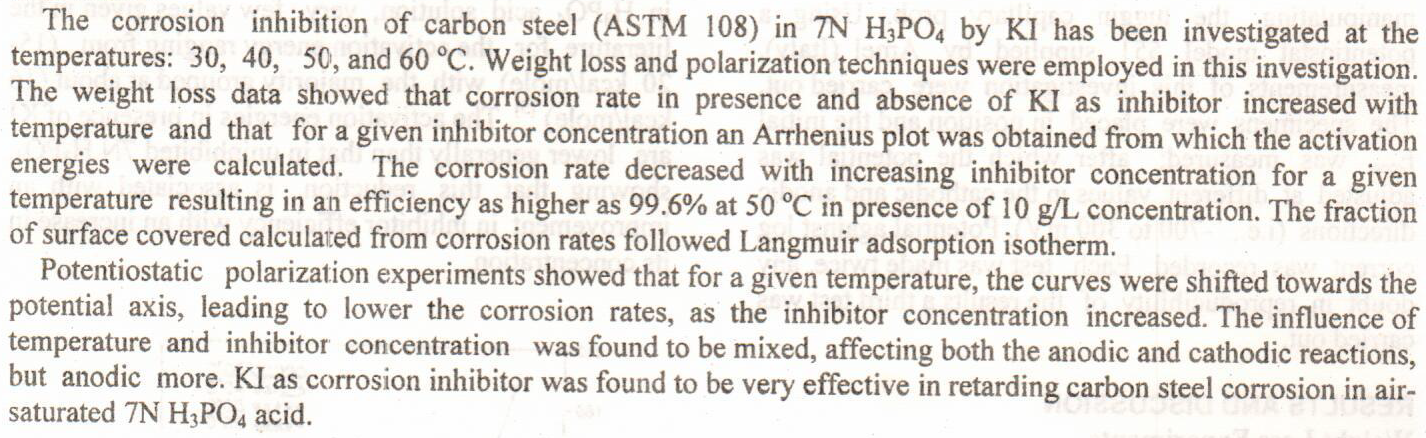
The Influence of Temperature on Corrosion Inhibition of Carbon Steel in Air-Saturated 7NH3PO4 by Potassium Iodide

 (12)
 (11)


A Schiff base ligand (L) was used as primary ligand and potassium anthranilate (Anth) was used as the secondary ligand in the molar ratio M: L:2Anth to synthesize a new platinum(IV) mixed-ligand complex [Pt(L)(Anth)₂]Cl₂. The Schiff base ligand was synthesized by the condensation of 4-Aminoantipyrine with 4-Hydroxybenzaldehyde and was verified as a bidentate ligand. The UV-visible, FT-IR, 1 H NMR, 13 C NMR, CHN elemental analysis, molar conductance, chloride ion determination and melting point measurements were used to characterize the ligand and the complex. The results of the molar conductance showed that the electrolytic behavior was 1:2, where the two chloride ions were present outside the coordination sphere, while the spectroscopi
... Show More
(12)
(11)
 (148)
(149)
(59)
(51)
A Schiff base ligand (L) was synthesized via condensation of N-( 1-naphthyl) ethylenediamine dihydrochloride with phthalaldehyde. The ligand was characterized by FT-IR, UV–Vis, 1H NMR, mass spectrometry, and elemental analysis (C, H, N). Five metal complexes (Co(II), Ni(II), Cu(II), Zn(II), and Cd(II)) were prepared with the ligand in a 1:1 (M:L) ratio using an aqueous ethanol solution. The complexes were characterized by FT-IR, UV–Vis, mass spectrometry, and elemental analysis (C, H, N). Additionally, 1H NMR spectroscopy was employed for Cd(II) complex. Antimicrobial activity of the ligand and its metal complexes against pathogenic bacteria (K. pneumoniae, E. coli, S. aureus, and S. epidermidis) and fungus (C. albicans) were evaluated
... Show More
(24)
(18)
(47)
(42)
(10)
(8)
(9)
(3)