Preferred Language
Articles
/
ijcpe-529
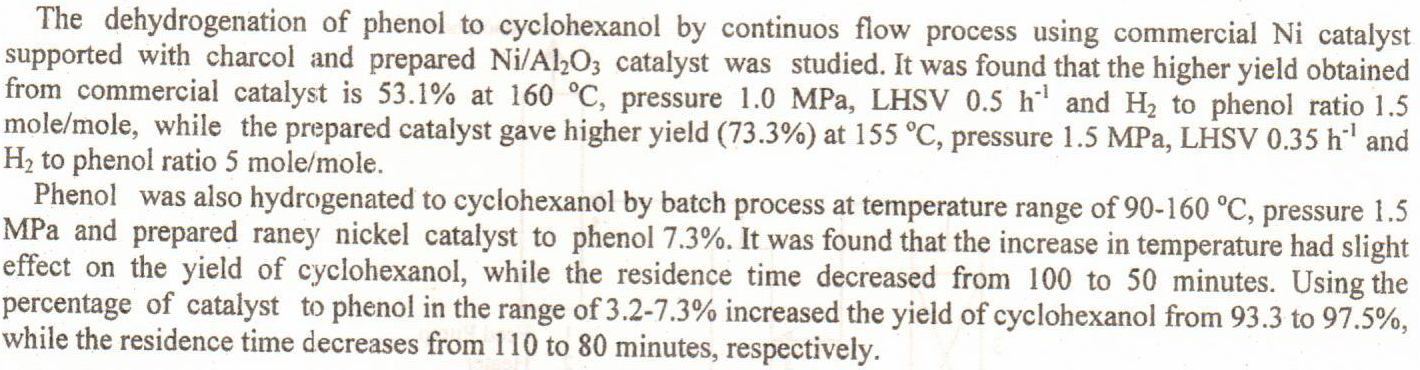
Batch and Continuous Process of Cyclohexanol Production
...Show More Authors

View Publication Preview PDF
Quick Preview PDF
Publication Date
Thu Sep 01 2016
Journal Name
Journal Of Engineering
Demulsification of Remaining Waste (Water In Oil Emulsions) After Removal Of Phenol In Emulsion Liquid Membrane Process
...Show More Authors

The aim of present work is to study the removal of phenol present in aqueous feed solution by the emulsion liquid membrane technique using kerosene as a diluent, sodium hydroxide as a stripping agent, and sorbitan monooleate (Span 80) as a surfactant. The parameters studied were: surfactant concentration, volume ratio of membrane phase to internal phase, and stirring speed. It was found that more than 98% of phenol can be removed at the conditions were surfactant concentration 2% (v/v), volume ratio of membrane phase to internal phase 5:1 and stirring speed 400 rpm. Maximum phenol extraction efficiency at 7 minutes of process time was observed. It was found that there was a good agreement between the standard kerosene an

... Show More
View Publication Preview PDF
Publication Date
Thu Mar 29 2018
Journal Name
Construction Research Congress 2018
Consideration of Worker Safety in the Design Process: A Statistical-Based Approach Using Analysis of Variance (ANOVA)
...Show More Authors

View Publication
Scopus (2)
Crossref (3)
Scopus Crossref
Publication Date
Wed Apr 12 2017
Journal Name
Journal Of Engineering
Cultivation of Chlorella Vulgaris Using Airlift Photobioreactor Sparged with 5%CO2-Air as a Biofixing Process
...Show More Authors

The present paper addresses cultivation of Chlorella vulgaris microalgae using airlift photobioreactor that sparged with 5% CO2/air. The experimental data were compared with that obtained from bioreactor aerated with air and unsparged bioreactor. The results showed that the concentration of biomass is 0.36 g l-1 in sparged bioreactor with CO2/air, while, the concentration of biomass reached to 0.069 g l-1 in the unsparged bioreactor. They showed also that aerated bioreactor with CO2/air gives more biomass production even the bioreactor was aerated with air. This study proved that application of sparging system for cultivation of Chlorella vulgaris microalgae using either CO2/air mixture or air has a significant growth rate, since the biorea

... Show More
Publication Date
Thu Sep 15 2022
Journal Name
Journal Of Baghdad College Of Dentistry
Immunohistochemical evaluation for integrin binding sialoprotein on healing process of intrabony defect treated by bone sialoprotein
...Show More Authors

Background: Bone defect healing is a multidimensional procedure with an overlapping timeline that involves the regeneration of bone tissue. Due to bone's ability to regenerate, the vast majority of bone abnormalities can be restored intuitively under the right physiological conditions. The goal of this study is to examine the immunohistochemistry of bone sialoprotein in order to determine the effect of local application of bone sialoprotein on the healing of a rat tibia generated bone defect. Materials and Methods: In this experiment, 48 albino male rats weighing 300-400 grams and aged 6-8 months will be employed under controlled temperature, drinking, and food consumption settings. The animals will be subjected to a surgical procedure o

... Show More
View Publication Preview PDF
Scopus (1)
Crossref (1)
Scopus Crossref
Publication Date
Sun Jan 01 2023
Journal Name
Aip Conference Proceedings
Recovery of methyl orange from aqueous solutions by bulk liquid membrane process facilitated with anionic carrier
...Show More Authors

Dyes are extensively water-soluble and toxic chemicals. The disposing of wastewater rich with such chemicals has severely impacted surface water quality (rivers and lakes). In the current study, an anionic dye, methyl orange, were extracted from wastewater fluids using bulk liquid membranes supplemented with an anionic carrier (Aliquat 336 (QCI)). Parameters including solvent type (carbon tetrachloride and chloroform), membrane stirring speed (100-250 rpm), mixing speed of both phases (50-100 rpm), The feed pH (2-12) and implemented temperature (35-60 °C) were thoroughly analyzed to determine the effect of such variables on extraction effectiveness. Furthermore, the effect of methyl orange (10-50 ppm) in the feed stage and NaOH (0

... Show More
View Publication
Scopus (8)
Crossref (1)
Scopus Crossref
Publication Date
Sat Dec 01 2018
Journal Name
Journal Of Economics And Administrative Sciences
Measuring The Level of Complexity In The Process University – Case Study At The Southern Technical University.
...Show More Authors

    Complexity is the inherent characteristic of contemporary organizations. It is characterized by the intertwining and expansion of its relations, by the severe disorder and rapid change in its environment, which makes it suffer from a state of uncertainty in determining the direction of its future or the assessment of the rules governing its paths. All organizations tend to evolve with increasing sophistication, And to take measures that contribute to the simplification of the system as it moves towards complexity, allowing the administration to easily control its movement and directions, and the problem of complexity in the university is based on the entanglement and overlap in the goals and processes betwe

... Show More
View Publication Preview PDF
Crossref
Publication Date
Sun Jan 01 2023
Journal Name
Journal Of Ecological Engineering
Chromium Ions Removal by Capacitive Deionization Process – Optimization of the Operating Parameters with Response Surface Methodology
...Show More Authors

An innovative desalination method called electrosorption or capacitive deionization (CDI) has significant benefits for wastewater treatment. This process is performed by using a carbon fiber electrode as a working electrode to remove hexavalent chromium ions from an aqueous solution. The pH, NaCl concentration, and cell voltage were optimized using the Box-Behnken experimental design (BDD) in response surface methodology (RSM) to study the effects and interactions of selected variables. To attain the relationship between the process variables and chromium removal, the experimental data were subjected to an analysis of variance and fitted with a quadratic model. The optimum conditions to remove Cr(VI) ions were: pH of 2, a cell voltage of 4.

... Show More
View Publication Preview PDF
Scopus (10)
Crossref (9)
Scopus Clarivate Crossref
Publication Date
Fri Sep 15 2023
Journal Name
Journal Of Baghdad University College Of Dentistry
Immunohistochemical evaluation for integrin binding sialoprotein on healing process of intrabony defect treated by bone sialoprotein
...Show More Authors

Preview PDF
Scopus (1)
Crossref (1)
Scopus Crossref
Publication Date
Mon Jun 05 2023
Journal Name
Al-khwarizmi Engineering Journal
Treatment of Petroleum Refinery Wastewater by Sono Fenton Process Utilizing the in-Situ Generated Hydrogen Peroxide
...Show More Authors

Combining ultrasonic irradiation and the Fenton process as a sono-Fenton process, the chemical oxygen demand (COD) in refinery wastewater was successfully eliminated using response surface methodology (RSM) with central composite design (CCD). The impact of two main influential operational parameters (iron dosage and reaction time) on the COD removal from wastewater generated by an Iraqi petroleum refinery facility was explored. Removal of 85.81% was attained under the optimal conditions of 21 minutes and 0.289 mM of  concentration. Additionally, the results revealed that the concentration of has the highest effect on the COD elimination, followed by reaction time. The high R2 value (96.40%) validated the strong fit of the mo

... Show More
View Publication Preview PDF
Scopus (10)
Crossref (10)
Scopus Crossref
Publication Date
Fri Sep 30 2022
Journal Name
Journal Of Economics And Administrative Sciences
Estimation of Reliability through the Wiener Degradation Process Based on the Genetic Algorithm to Estimating Parameters
...Show More Authors

      In this paper, the researcher suggested using the Genetic algorithm method to estimate the parameters of the Wiener degradation process,  where it is based on the Wiener process in order to estimate the reliability of high-efficiency products, due to the difficulty of estimating the reliability of them using traditional techniques that depend only on the failure times of products. Monte Carlo simulation has been applied for the purpose of proving the efficiency of the proposed method in estimating parameters; it was compared with the method of the maximum likelihood estimation. The results were that the Genetic algorithm method is the best based on the AMSE comparison criterion, then the reliab

... Show More
View Publication Preview PDF
Crossref


