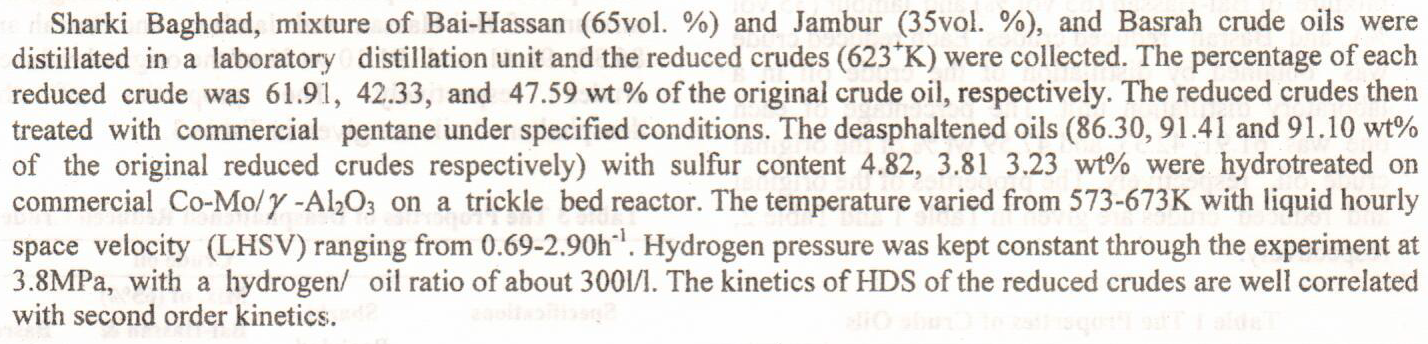
Production of Low Sulfur Fuel Oil from Different Iraqi Residues Crudes

This work was conducted to study the extraction of eucalyptus oil from natural plants (Eucalyptus camaldulensis leaves) using water distillation method by Clevenger apparatus. The effects of main operating parameters were studied: time to reach equilibrium, temperature (70 to100°C), solvent to solid ratio (4:1 to 8:1 (v/w)), agitation speed (0 to 900 rpm), and particle size (0.5 to 2.5 cm) of the fresh leaves, to find the best processing conditions for achieving maximum oil yield. The results showed that the agitation speed of 900 rpm, temperature 100° C, with solvent to solid ratio 5:1 (v/w) of particle size 0.5 cm for 160 minute give the highest percentage of oil (46.25 wt.%). The extracted oil was examined by HPLC.
This study aimed to extraction of essential oil from peppermint leaves by using hydro distillation methods. In the peppermint oil extraction with hydro distillation method is studied the effect of the extraction temperature to the yield of peppermint oil. Besides it also studied the kinetics during the extraction process. Then, 2nd -order mechanism was adopted in the model of hydro distillation for estimation many parameters such as the initial extraction rate, capacity of extraction and the constant rat of extraction with various temperature. The same model was also used to estimate the activation energy. The results showed a spontaneous process, since the Gibbs free energy had a value negative sign.
 (8)
(8)

In this paper, the topic of forecasting the changes in the value of Iraqi crude oil exports for the period from 2019 to 2025, using the Markov transitional series based on the data of the time series for the period from January 2011 to November 2018, is real data obtained from the published data of the Central Agency Of the Iraqi statistics and the Iraqi Ministry of Oil that the results reached indicate stability in the value of crude oil exports according to the data analyzed and listed in the annex to the research.
Keywords: Using Markov chains
Asphaltene is a component class that may precipitate from petroleum as a highly viscous and sticky material that is likely to cause deposition problems in a reservoir, in production well, transportation, and in process plants. It is more important to locate the asphaltene precipitation conditions (precipitation pressure and temperature) before the occurring problem of asphaltene deposition to prevent it and eliminate the burden of high treatment costs of this problem if it happens. There are different models which are used in this flow assurance problem (asphaltene precipitation and deposition problem) and these models depend on experimental testing of asphaltene properties. In this study, the used model was equation of
... Show More
(5)
The analysis and efficiency of phenol extraction from the industrial water using different solvents, were investigated. To our knowledge, the experimental information available in the literature for liquid-liquid equilibria of ternary mixtures containing the pair phenol-water is limited. Therefore the purpose of the present investigation is to generate the data for the water-phenol with different solvents to aid the correlation of liquid-liquid equilibria, including phase diagrams, distribution coefficients of phenol, tie-lines data and selectivity of the solvents for the aqueous phenol system.
The ternary equilibrium diagrams and tie-lines
... Show MoreSoil samples were tested for Calcite and Dolomite using XRD analysis. some Iraqi soils have low levels in Calcite that might approaches to zero, and that does not mean it has zero level of Carbonate because the decrease in a major compound of this group (carbonate) will be on the expense of the other compound. Besides, dolomitization is no less importance than Calcification in Iraqi soils where it was in recent or paleo occurrence of these minerals. There was a highly significant Pearson correlation between Calcite and Dolomite contents in soils (significant at 0.01 level) that shows that the increase of one component will be on the expense of the other component, and here is an evidence for the occurring of Dolomitization process i
... Show More (1)
(1)
 (6)
(6)
(6)
(6)

The effect of some environment faetor (different temperature and relative humidity) on the biology of the old world- screw worm, were studied under laboratory condition, the result showed that non of the eggs hatched at 15°c and under dried eondition which relative humidity between 20-40%, also result showed that the mature larvae needs one days to become pupa since it leaves the larval died at the temperature ranged between 25-40°C at different humidity rates. While it needs 3 days under lower temperature and different humidity to become pu^, on the other hand the results showed that either low temperature and dried condition or high temperature at different humidity rates cause non of pupa became adult. While low temperature (15-20) °c
... Show MoreBackground: Prophylaxis methods are used to mechanically remove plaque and stain from tooth surfaces; such methods give rise to loss of superficial structure and roughen the surface of composites as a result of their abrasive action. This study was done to assess the effect of three polishing systems on surface texture of new anterior composites after storage in artificial saliva. Materials and methods: A total of 40 Giomer and Tetric®N-Ceram composite discs of 12 mm internal diameter and 3mm height were prepared using a specially designed cylindrical mold and were stored in artificial saliva for one month and then samples were divided into four groups according to surface treatment: Group A (control group):10 specimens received no surfa
... Show More
(153)
(141)