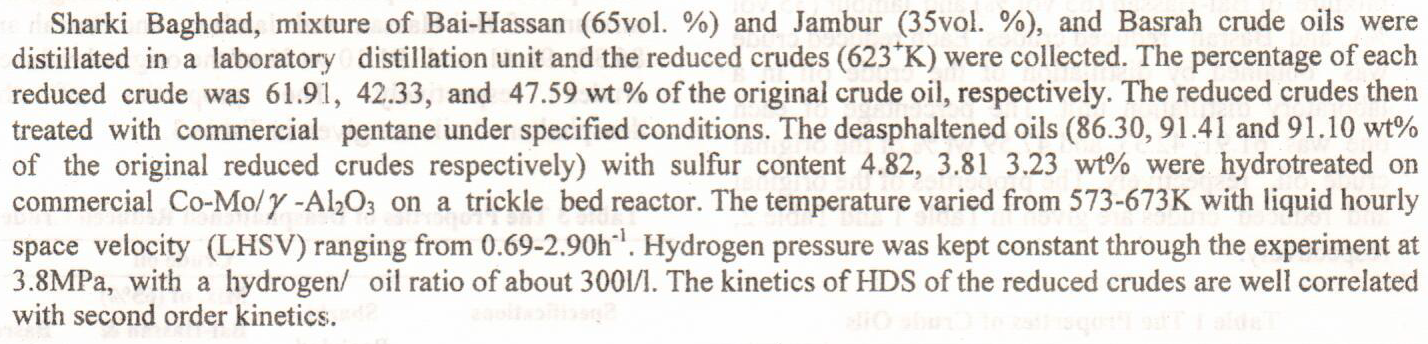
Production of Low Sulfur Fuel Oil from Different Iraqi Residues Crudes

In the present study, activated carbon supported metal oxides was prepared for thiophene removal from model fuel (Thiophene in n-hexane) using adsorptive desulfurization technique. Commercial activated carbon was loaded individually with copper oxide in the form of Cu2O/AC. A comparison of the kinetic and isotherm models of the sorption of thiophene from model fuel was made at different operating conditions including adsorbent dose, initial thiophene concentration and contact time. Various adsorption rate constants and isotherm parameters were calculated. Results indicated that the desulfurization was enhanced when copper was loaded onto activated carbon surface. The highest desulfurization percent for Cu2O/AC and o
... Show MoreMicroorganisms have an active role in biotechnology for example yeasts, especially in some genus like Saccharomyces, Pichia, and Candida. C.tropicalis one of the most important species of Candida and despite it is one of the causative agents of candidiasis but it has a major role in the production of many chemical compounds. C.tropicalis in the previous study was isolated from sheep dung and morphologically and molecularly classified the result of sequencing was elucidate 100% similarity between the studied isolate and other isolates inserted in DNA Data Bank of Japan DDBJ, physiologically this isolate tolerated 6% ethanol concentration in broth media with the ability to the pro
... Show More
There is a growing imperative to extract oil not only through primary and secondary means but also via tertiary recovery methods to meet the escalating global energy demands. Consequently, Enhanced Oil Recovery (EOR) is slated to increase significance in the oil industry in the coming years. The amalgamation of low salinity water (LSW) with chemicals to augment oil recovery has gained substantial traction in recent years owing to its demonstrated effectiveness. In this study, a systematic investigation utilizing contact angle measurements to elucidate the underlying mechanisms was undertaken. The results reveal that the contact angle (CA) demonstrated the effectiveness of the combined fluid in altering the wettability from oil-
... Show More (2)
(2)
In this research work, a new type of concrete based on sulfur-melamine modification was introduced, and its various properties were studied. This new type of concrete was prepared based on the sulfur-melamine modification and various ingredients. The new sulfur-melamine modifier was fabricated, and its fabrication was confirmed by IR spectroscopy and TG analysis. The surface morphology resulted from this modifier was studied by SEM and EDS analysis. The components ratios in concrete, chemical and physical characteristics resulted from sulfur-melamine modifier, chemical and corrosion resistance of concrete, stability of concrete against water adsorption, stability of concrete against freezing, physical and mechanical properties and durabi
... Show More (5)
(3)
(5)
(3)

Empirical equation has been presented to predict the optimum hydrodynamic
pressure gradient with optimum mud flow rate (one equation) of five Iraqi oil wells
to obtain the optimum carrying capacity of the drilling fluid ( optimum transport
cuttings from the hole to the surface through the annulus).
This equation is a function of mud flow rate, mud density and penetration
rate without using any charts or graphs.
The correlation coefficient accuracy is more than 0.9999.
Efficient cuttings transport and hole cleaning are very important factors for obtaining an effective drilling operation. In an inclined and horizontal drilling, hole cleaning issue is a common and complex problem.
The scope of this research is to study the drilling parameters which affect hole cleaning in Iraqi directional wells through studying and analyzing some drilled wells ( vertical , directional (30 degree) , directional (60 degree) and horizontal ).An excel sheet is prepared to calculate carrying capacity index which represents an indicator for good hole cleaning in different sections. The study indicated through the field investigations, practical experiences and theoretical calculations tha
... Show MoreResults showed that the optimum conditions for production of inulunase from isolate Kluyveromyces marxianus AY2 by submerged culture could be achieved by using inulin as carbon source at a concentration of 2% with mixture of yeast extract and ammonium sulphate in a ratio of 1:1 in a concentration of 1% at initial pH 5.5 after incubation for 42 hours at 30ºC.
The corrosion inhibition of low carbon steel in1N HCl solution in the presence of peach juice at temperature (30,40,50,and 60)°C at concentration ( 5, 10, 20, 30, 40and 50 cm3/L)were studied using weight loss and polarization techniques. Results show that the inhibition efficiency was increased with the increase of inhibitor concentration and increased with the increase of temperature up to 50ºC ,above 50ºC (i.e. at 60 ºC) the values of efficiency decreases. Activation parameters of the corrosion process such as activation energies, Ea, activation enthalpies, ΔH, and activation entropies, ΔS, were calculated. The adsorption of inhibitor follows Langmuir isotherm. Maximum inhibition efficiency obtained was a bout 91% at 50ºC in the
... Show MoreDifferent solvents (light naphtha, n-heptane, and n-hexane) are used to treat Iraqi Atmospheric oil residue by the deasphalting process. Oil residue from Al-Dura refinery with specific gravity 0.9705, API 14.9, and 0.5 wt. % sulfur content was used. Deasphalting oil (DAO) was examined on a laboratory scale by using solvents with different operation conditions (temperature, concentration of solvent, solvent to oil ratio, and duration time). This study investigates the effects of these parameters on asphaltene yield. The results show that an increase in temperature for all solvents increases the extraction of asphaltene yield. The higher reduction in asphaltene content is obtained with hexane solvent at operating conditions of (90 °C
... Show More
(3)
Different solvents (light naphtha, n-heptane, and n-hexane) are used to treat Iraqi Atmospheric oil residue by the deasphalting process. Oil residue from Al-Dura refinery with specific gravity 0.9705, API 14.9, and 0.5 wt. % sulfur content was used. Deasphalting oil (DAO) was examined on a laboratory scale by using solvents with different operation conditions (temperature, concentration of solvent, solvent to oil ratio, and duration time). This study investigates the effects of these parameters on asphaltene yield. The results show that an increase in temperature for all solvents increases the extraction of asphaltene yield. The higher reduction in asphaltene content is obtained with hexane solvent at operating conditions of (90 °C, 4/1
... Show More
(3)