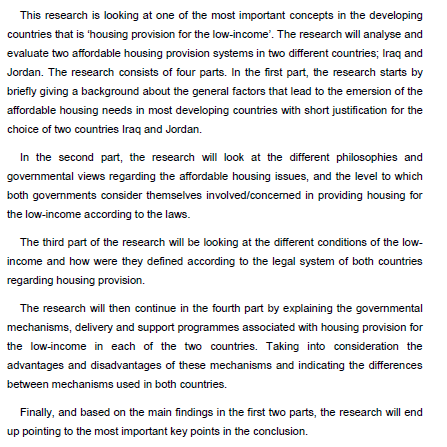
Affordable Housing Policies in Iraq and Jordan
الاسكان الاقتصادي

The Logic of Freezers and Animals in the Holy Quran
The Arab heritage is considered one of the treasures of the noble human civilizations, as it is a deep-rooted heritage, when the dawn of Islam dawned on the Arabian Peninsula, and when its conquests spanned,

تحتل الرقابة المالية والإدارية أهمية كبيرة في عمل المؤسسات وتمثل المرحلة الإشرافية فيها وتُعد من أهم عناصر العملية الإدارية، ويأتي دور الأجهزة الرقابية لضمان تقديم الخدمات للمواطنين، بأسرع وقت، وبأقل جهد وتكلفة. واعتمدت الدولة العراقية منذ تأسيسها على جهاز رقابي خارجي واحد هو ديوان مراقب الحسابات العام المؤسس بالقانون رقم (17) لعام 1927 الذي كان يمارس أعمال الرقابة والتدقيق المالي والحسابي للمصروفات والإير
... Show MoreIn this research, the researchers attempted to reveal the non-verbal language in the Holy Qur'an through the hurt of the eye, its communicative effect, and its psychological significance in order to demonstrate the importance of this language. Fold the search ..
Xanthomonas axonopodis pv glycines (Xag) is a pathogen that causes pustule disease in soybeans. Many
techniques for controlling this disease have been widely developed, one of which is the use of biological agents.
Bacillus sp. from the soybean phyllosphere is a biological agent that has the potential to suppress the
development of pustule disease. One of the biological control mechanisms is through biochemical induction
of plant resistance which includes the accumulation of phenols, salicylic acid compounds, and peroxidase
enzymes. Bacillus subtilis JB12 and Bacillus velezensis ST32 are two bacteria isolated from the soybean
phyllosphere which have previously been known to suppress Xag through an anti
 (3)
(3)
 (2)
(2)

Salmonellosis in poultry is one of the most significant bacterial infections causing mortality, reduced production, and serious economic losses. This study aimed to study the molecular diversity among Salmonella isolates and investigate the epidemiological spread of these bacteria in broiler and layer chicken flocks in five different farms in Karbala, Iraq, using random amplified polymorphic DNA (RAPD) polymerase chain reaction (PCR). In total, 217 cloac a swabs were collected from the farms, out of which 129 and 88 swabs were taken from broiler and layer chickens. The samples were screened by PCR for S. enterica subsp. enterica using primers specific for the invA gene. Afterward, RAPD-PCR with uniplex or multiplex octamer primers was appli
... Show More
(4)
In the Rumaila oilfields in southern Iraq, the Zubair Formation was deposited in a shallow environment as three main facies, delta plain, backshore, and delta front depositional conditions indicating a transition from delta front and delta plain to a highstand level due to the finning upward mode. The facies of the Zubair clasts show well-sorted quartz arenite sandstone, poorly sorted quartz arenite sandstone, clayey sandstone that has not been properly sorted, sandy shale, and shale lithofacies. The minor lithofacies were identified using well-logging methods (gamma ray, spontaneous potential and sonic logs) and petrography. The Zubair clasts are of transition environment that appears to be transported from freshwater and deposited
... Show More
(2)
A total of 13 samples of domestic cat Felis cattus (Linnaeus, 1758 ) and 9 samples of wild cat Felis chaus furax (de Winton, 1898) of the Felidae Family were trapped and examined to detect the hard ticks. The areas of the collection were: Baghdad, Al-Rashidiya, Tharthar, Nahrawan, AL-Mahmoudiya (middle of Iraq) and AL-Haretha (south of Iraq), Mosul (north of Iraq). The results of the current study revealed that four species belong to two genera of hard ticks: Haemaphysalis sp. (Koch, 1844), Rhipicephalus turanicus (Morel, 1969), Rhipicephalus sanguineus (Neumann, 1904) and Rhipicephalus appendiculatus (Santos, 1955). The rates and the density of infestation were discussed. The current study aimed to clarify the infestation differe
... Show More
(1)
A total of sixty raw milk samples were collected from (street vendors and shops) from Baghdad city, Iraq. The samples were inoculated into peptone water and, then, subcultured onto MacConkey agar and Blood agar. Identification of isolates was confirmed by microscopic examination, cultural characteristic, biochemical tests, Vitek (VITEK®2 system), and Biolog GN substrate reactions followed by 16S rRNA and specific genes sequencing. Of 60 raw cow’s milk samples, Providencia spp. were identified only in 4 samples (6.67%) and P. rettgeri was the most common, 2/4 (50%), followed by P. stuartii and P. vermicola, 1/4 (25%). Antimicrobial susceptibility tests were conducted against ten antibiotics by the disc diffusion method. All Provid
... Show More
(8)
(7)
