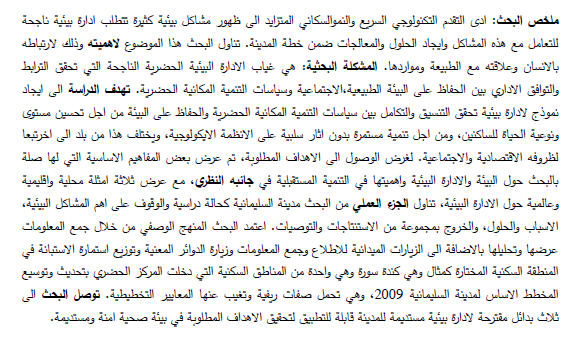
The problem of the research is that some companies lack the mechanisms and policies that to enhance the loyalty of these valuable resources, which led to difficulties in generating knowledge, producing, storing, investing and investing information to achieve a sustainable competitive advantage. In addition, companies are still working with the traditional wage system (monthly salaries), which makes people not think about adding value to work. The research aims to determine the level of variables for researchers to clarify the impact of the organizational innovation climate on sustainable competitive advantage. The Qualitative approach is used based on research. The research was applied
... Show MoreThe issue of peace, renunciation of violence, and acceptance of the other is one of the vital issues that rose to the top of the list of priorities at the end of the last century and the beginning of the new millennium of the conscience of the Iraqi people by spreading the culture of peace. In this context, we seek during this research to identify the concept of the culture of peace and its impact on sustainable development, and to draw a set of results and suggestions to consolidate this culture in our Iraqi society as an obligation of sustainable development.
Heritage is considered as the civilization and cultural wealth accumulated over the . centuries, whereas architectural heritage is the physical witness of that civilization. Despite the fact that architectural heritage is the most important effort for economic development of any communit,، it suffers from deterioration and neglection especially in the Arab communities. Recently awareness has increased about the importance of investing on architectural heritage generally and sustainable investment particularly. The goal of investment process in heritage areas is to revive economic activity in addition to attempt to revive the heritage and community values. Research aims to examine the relationship between sustainable investment and
... Show MoreIn recent years, the steady stream of artificial intelligence into economic systems has become a torrent. It is changing how we generate wealth and grow anew. Manufacturing, finance, health care energy, agriculture and education are just a few of the areas where AI may result in dramatic increases in productivity as well as innovation and sustainability. Predictive analytics, AI, robotics and natural language processing have significantly contributed in the improvement of resource allocation mechanisms and decision making as well as reaching SDGs. The concept of Artificial Humanity is also introduced in the paper. It shows how AI could become a global cognitive network to foster knowledge. By comparison and references of the literature, thi
... Show MoreThe use of the plastic waste material to stabilize soil is step in the right direction making the construction industry a suitable candidate with its high consumption capacity. The method would be a reliable alternative to traditional ground improvement technique. It would be cost effective, sustainable and environmentally friendly. In this review paper, the behaviour of reinforced soil with plastic waste would be discussed including its suitability for pavement and road construction. The previous literature highlighted by authors will be reviewed in focus on type of treated soil, nature, shape, geometry, and amount of the added plastic waste. The aim of this review is to investigate the effect of granules and fibre plastic waste materials
... Show MoreNowadays, many new technologies developed in a lot of countries. These technologies are promising in many areas such as environmental monitoring, precision agriculture as well as in animal production. The purpose of this study was to define a better understanding of how new and advanced technologies affect the agriculture and livestock sector alike. Although agriculture and animal husbandry are among the most important sectors, advanced equipment and information technology cannot be used adequately. This situation leads to low production efficiency. It is also known that there can be a significant difference in temperature between the position of the climate control sensor (room temperature) and the area occupied by the animal. This study e
... Show MoreIn this article, the types of renewable energies and the environmental effects of consuming these energies are studied. Energy is one of the things necessary for economic and social development and improving the quality of life, and the presence of continuous and sustainable economic energy is essential for any economic development and growth. Humankind has been aware of renewable energies such as biomass and geothermal energy for a long time and has used these energies as heat sources for shelter. With the beginning of the extraction of fossil fuels such as oil and coal and unlimited access to these products, the use of renewable energy sources, except in remote places and forest areas, has become limited and forgotten. Currently in Iraq,
... Show MoreThe phytoremediation technique has become very efficient for treating soil contaminated with heavy metals. In this study, a pot experiment was conducted where the Dodonaea plant (known as hops) was grown, and soil previously contaminated with metals (Zn, Ni, Cd) was added at concentrations 100, 50, 0 mg·kg-1 for Ni and Zn, and at concentrations of 0, 5, 10 mg·kg-1 for cadmium. Irrigation was done within the limits of the field capacity of the soil. Cadmium, nickel and zinc was estimated in the soil to find out the capacity of plants to the absorption of heavy and contaminated metals by using bioconcentration factors (BCFs), bioaccumulation coefficient (BAC) and translocation factor (TF). Additionally, BCF values of both Ni and Zn were l
... Show MoreBiodiversity is one of the important biological factors in determining water quality and maintaining the
ecological balance. In this study, there are 223 species of phytoplankton were identified, and they are as
follows: 88 species of Bacillariophyta and were at 44%,70 species of Chlorophyta and they were at 29 %, 39
species of Cyanophyta and they were at 16 %, 12 species of Euglenozoa and they were at 4 %, four species of
Miozoa and they were at 3 %, and, Phylum Charophyta and Ochrophyta were only eight and two species,
respectively and both of them were at 2%. The common phytoplankton recorded in the sites studied
include Nitzschia palea, Scenedesmus quadricauda, Oscillatoria princeps, and Peridinium
Fish are regarded as a crucial indicator of alterations in the aquatic environment due to their position at the apex of the food chain. Monitoring these alterations is crucial for identifying modifications in the aquatic ecosystem. The principal elements influencing fish health are temperature, pH, dissolved oxygen, salinity, pesticide contamination, microplastics, and algal presence. These elements substantially influence fish health regarding development, reproduction, respiration, oxygen stress, and the internal enzymes associated with digesting and other metabolic functions. Alterations in global environmental conditions and anthropogenic pollutants result in modifications to fish populations, their lives, and their behavior and
... Show More