Preferred Language
Articles
/
joe-9
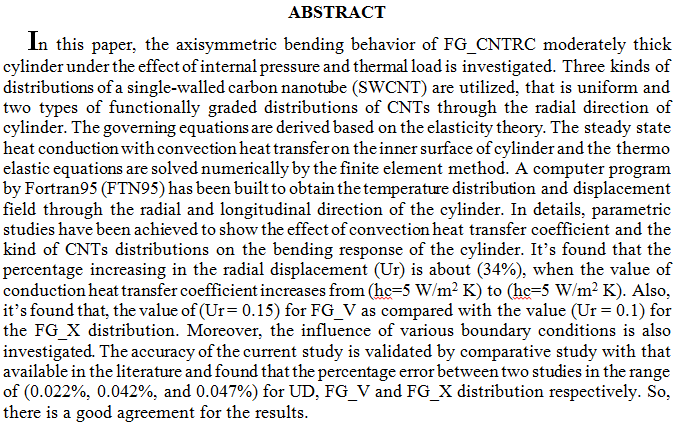
Thermo Elastic Analysis of Carbon Nanotube-Reinforced Composite Cylinder Utilizing Finite Element Method with the Theory of Elasticity
...Show More Authors


View Publication Preview PDF
Quick Preview PDF
Publication Date
Wed Jul 01 2020
Journal Name
Journal Of Engineering
Using Adaptive Neuro Fuzzy Inference System to Predict Rate of Penetration from Dynamic Elastic Properties
...Show More Authors

Rate of penetration plays a vital role in field development process because the drilling operation is expensive and include the cost of equipment and materials used during the penetration of rock and efforts of the crew in order to complete the well without major problems. It’s important to finish the well as soon as possible to reduce the expenditures. So, knowing the rate of penetration in the area that is going to be drilled will help in speculation of the cost and that will lead to optimize drilling outgoings. In this research, an intelligent model was built using artificial intelligence to achieve this goal.  The model was built using adaptive neuro fuzzy inference system to predict the rate of penetration in

... Show More
View Publication Preview PDF
Crossref
Publication Date
Tue Dec 01 2020
Journal Name
Baghdad Science Journal
Effect of Electrolyte Composition on Structural and Photoelectrochemical Properties of Titanium Dioxide Nanotube Arrays Synthesized by Anodization Technique
...Show More Authors

The present work involves studying the effect of electrolyte composition [@1= 0.5 wt.%  NH4F / 5% H2O / 5% Glycerol (GLY)/ 90%  Ethylene Glycol (EG)] and [ @2= 0.5 wt. % NH4F / 5% H2O / 95%  Ethylene Glycol (EG)]  on the structural and photoelectrochemical properties of titania nanotubes arrays (TNTAs). TNTAs substrates were successfully carried out via anodization technique and were carried out in 40 V for one hour in different electrolytes (@1, and @2). The properties of physicochemical of TNTAs were distinguished via an X-ray Diffractometer (XRD), Field Emission Scanning Electron Microscope (FESEM), an Energy Dispersive X-ray (EDX), and UV–visible diffuse reflectance. The photoelectrochemical response of TNTAs was evaluated

... Show More
View Publication
Scopus (19)
Crossref (12)
Scopus Clarivate Crossref
Publication Date
Tue Dec 01 2020
Journal Name
Baghdad Science Journal
Effect of Electrolyte Composition on Structural and Photoelectrochemical Properties of Titanium Dioxide Nanotube Arrays Synthesized by Anodization Technique
...Show More Authors

The present work involves studying the effect of electrolyte composition [@1= 0.5 wt.%  NH4F / 5% H2O / 5% Glycerol (GLY)/ 90%  Ethylene Glycol (EG)] and [ @2= 0.5 wt. % NH4F / 5% H2O / 95%  Ethylene Glycol (EG)]  on the structural and photoelectrochemical properties of titania nanotubes arrays (TNTAs). TNTAs substrates were successfully carried out via anodization technique and were carried out in 40 V for one hour in different electrolytes (@1, and @2). The properties of physicochemical of TNTAs were distinguished via an X-ray Diffractometer (XRD), Field Emission Scanning Electron Microscope (FESEM), an Energy Dispersive X-ray (EDX), and UV–visible diffuse reflectance. T

... Show More
View Publication Preview PDF
Scopus (19)
Crossref (12)
Scopus Clarivate Crossref
Publication Date
Mon Jan 01 2024
Journal Name
Iraqi Journal Of Applied Physics
Decoration of Zinc Oxide Nanoparticles with Aluminum Nanoparticles by Explosive Strips Method
...Show More Authors

In this study, aluminum nanoparticles (Al NPs) were prepared using explosive strips method in double-distilled deionized water (DDDW), where the effect of five different currents (25, 50, 75, 100 and 125 A) on particle size and distribution was studied. Also, the explosive strips method was used to decorate zinc oxide particles with Al particles, where Al particles were prepared in suspended from zinc oxide with DDDW. Transmission electron microscopy (TEM), UV-visible absorption spectroscopy, and x-ray diffraction are used to characterize the nanoparticles. XRD pattern were examined for three samples of aluminum particles and DDDW prepared with three current values (25, 75 and 125 A) and three samples prepared with the same currents for zin

... Show More
Scopus
Publication Date
Sat Aug 31 2019
Journal Name
Iraqi Journal Of Physics
Characterization of Zinc oxide Nanostructures prepared by hydrothermal method with Antibacterial property
...Show More Authors

        In this study, Zinc oxide nanostructures were synthesized via a hydrothermal method by using zinc nitrate hexahydrate and sodium hydroxide as a precursor. Three different annealing temperatures were used to study their effect on ZnO NSs properties. The synthesized nanostructure was characterized by X-ray diffraction (XRD), field emission scanning electron microscopy (FESEM), Atomic force microscope (AFM), and Fourier Transform Infrared Spectroscopy (FTIR). Their optical properties were studied by using UV -visible spectroscopy. The XRD analysis confirms that all ZnO nanostructures have the hexagonal wurtzite structure with average crystallite size within the range of (30.59 - 34

... Show More
View Publication Preview PDF
Crossref (1)
Crossref
Publication Date
Thu May 30 2024
Journal Name
Journal Of Interdisciplinary Mathematics
Analytical approximate solutions of random integro differential equations with laplace decomposition method
...Show More Authors

An efficient combination of Adomian Decomposition iterative technique coupled with Laplace transformation to solve non-linear Random Integro differential equation (NRIDE) is introduced in a novel way to get an accurate analytical solution. This technique is an elegant combination of theLaplace transform, and the Adomian polynomial. The suggested method will convert differential equations into iterative algebraic equations, thus reducing processing and analytical work. The technique solves the problem of calculating the Adomian polynomials. The method’s efficiency was investigated using some numerical instances, and the findings demonstrate that it is easier to use than many other numerical procedures. It has also been established that (LT

... Show More
Scopus (6)
Scopus
Publication Date
Wed Oct 14 2026
Journal Name
Journal Of Baghdad College Of Dentistry
The effect of thermocycling and different pH of artificial saliva on the impact and transverse strength of heat cure resin reinforced with silanated ZrO2 nano-fillers.
...Show More Authors

Background: The aim of this study was to evaluate the effect of thermo cycling and different pH of artificial saliva (neutral, acidic, basic) on impact and transverse strength of heat cure acrylic resin reinforced of with 5% silanated ZrO2 nano fillers. Materials and methods: 120 samples were prepared, 60 samples for impact strength test and another 60 samples for transverse strength test, for each test, samples were divided into two major groups (before and after thermo cycling), then each of these major groups were further subdivided into 3 subgroups according to the pH of prepared artificial saliva (neutral, acidic, basic). Charpy impact device was used for impact strength test and Flexural device was used for transverse strength test. R

... Show More
View Publication Preview PDF
Publication Date
Mon Mar 01 2021
Journal Name
Iop Conference Series: Materials Science And Engineering
Structural Design According to Constructal Theory in Architecture
...Show More Authors
Abstract<p>Constructal theory plays a major role in the conceptual design stage of the structural system in architecture. It provides a conceptual framework for predicting the form depending on natural systems to model those systems geometrically according to the constructal law that works in two directions: the first is towards predicting the general form of the structural system, and the second is the physical application of the law in the process of detailed design of the parts of the system. The aim of this paper is to determine the mechanism adopted in the structural design according to the constructal theory, assuming that the structural design according to the constructal theory achieves </p> ... Show More
View Publication Preview PDF
Crossref (3)
Crossref
Publication Date
Fri Jan 17 2025
Journal Name
African Journal Of Biomedical Research
Digital Evaluation of Cuspal Deflection of Endodontically Treated Teeth Restored with Resin Composite and Different Fiber Formulations
...Show More Authors

Background: This study evaluated the influence of different fiber formulations incorporation in resin composite on cuspal deflection (CD) of endodontically-treated teeth with mesio-occluso-distal (MOD) cavities. Materials and Methods: Thirty-two freshly extracted maxillary premolar teeth received MOD cavity preparation followed by endodontic treatment using single cone obturation technique, and divided into: Group I: direct composite resin only using a centripetal technique, Group II: direct composite resin with short fiber-reinforced composite (everX Flow), Group III: direct composite resin with leno wave ultra-high molecular weight polyethylene (LWUHMWPE) fibers placed on the cavity floor, and Group IV: direct composite resin with LWUHMWP

... Show More
Preview PDF
Publication Date
Thu Dec 10 2009
Journal Name
Iraqi Journal Of Laser
Diagnosis and Treatment of Cervical Intraepithelial Neoplasia with Carbon Dioxide Laser Therapy in Selected Patients
...Show More Authors

Female infection with HPV (human papilla virus) has been established as an essential cause of CIN (cervical intraepithelial neoplasia). The danger of transformation from CIN to frank malignancy should be considered. Objective: The goal of this study is to evaluate the effectiveness of CO2 laser vaporization of ectocervical lesion high grade squamous intraepithelial lesion (HGSIL). Patients and Methods: Four Female out of 150 affected with HGSIL lesions were submitted to CO2 laser vaporization and followed up in 4 months later, and 10 women with HGSIL lesion submitted to electrocautery diathermy for the comparison. Results: Among women treated by CO2 laser vaporization, 3 women had negative results (clear cervix), at 4 months follow up; o

... Show More
View Publication Preview PDF