Preferred Language
Articles
/
joe-9
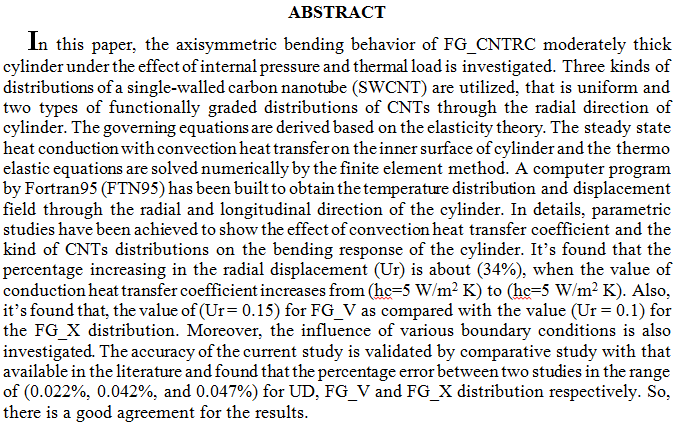
Thermo Elastic Analysis of Carbon Nanotube-Reinforced Composite Cylinder Utilizing Finite Element Method with the Theory of Elasticity
...Show More Authors


View Publication Preview PDF
Quick Preview PDF
Publication Date
Sat Nov 27 2021
Journal Name
International Conference On Fibre-reinforced Polymer (frp) Composites In Civil Engineering
Hybrid Anchors in Reinforced Concrete Slabs Strengthened with FRP Sheets
...Show More Authors

Reinforced concrete (RC) slabs strengthened with carbon fibre reinforced polymer (CFRP) and subjected to flexural actions may experience many types of failure, including FRP debonding, FRP rupture and concrete crushing. Of these different types of failure modes, FRP debonding stands out as the most predominant type of failure because of its dependence on the relatively weak bond interface between the soffit of the RC member and the FRP sheet attached to it. Many anchorage systems have been developed to enhance the performance of strengthened systems, one of which is the hybrid anchor, which combines the effects of patch anchors and spike anchors. Hybrid anchors have shown significant enhancement when used with RC members subjected to shear

... Show More
View Publication
Crossref
Publication Date
Wed Dec 30 2009
Journal Name
Iraqi Journal Of Physics
The Effect of PVC Powder content on the Elastic Moduli and Acoustic Impedance of Epoxy Composites
...Show More Authors

The primary purpose of the present research was to study the effect of polyvinyl chloride (PVC) powder content on ultrasonic wave velocity in PVC/Epoxy composites. The second part is concerned with the relations of dynamic elastic moduli with the ultrasonic wave velocities, to determine how ultrasonic waves can affect them.
Experimental data have been obtained using the sonic viewer (model -5217 A) device to generate two types of waves, longitudinal waves of frequency 63 kHz and transverse waves of frequency 33 kHz and to measure the transit time required for those waves to travel through individual sample.
The experimental results have shown that the propagation of the ultrasonic velocity increases directly with PVC content in the

... Show More
View Publication Preview PDF
Publication Date
Fri Dec 01 2023
Journal Name
Iranian Journal Of Physics Research
Formation of self-organized TiO2 nanotube arrays and its photoelectrochemical response
...Show More Authors

View Publication
Scopus (1)
Crossref (1)
Scopus Crossref
Publication Date
Wed Apr 30 2025
Journal Name
Iraqi Journal Of Science
Electrochemical Synthesis of Fe-doped TiO2 Nanotube for Gas Sensor Application
...Show More Authors

Titanium dioxide (TiO2) nanotubes have gained particular interest as a material for gas sensors because of their vertical arrays, prepared by the anodization procedure. The presence of several oxygen vacancies in these nanotubes facilitates gas diffusion and provides additional active sites. This study examined the impact of voltages on the process of depositing iron nanoparticles onto arrays of TiO2 nanotubes (TNTs) for use as a gas sensor. The TNTs are manufactured using a straightforward and economical electrochemical anodization technique, specifically for gas sensor applications. By varying the deposition voltage (2-6 volts), ordered Fe-TNTs were efficiently manufactured using a simple two-step electrochemical process. It utili

... Show More
View Publication
Scopus Crossref
Publication Date
Tue Dec 01 2020
Journal Name
Baghdad Science Journal
In Vitro Cytotoxicity Study of Pt Nanoparticles Decorated TiO2 Nanotube Array
...Show More Authors

Titanium dioxide nanotubes were synthesized by anodizing Ti sheets in the ethylene glycol solution and were covered in Pt nanoparticles onto the surface of TiO2NTs using electrodeposition method from using five derivatives of Mannich base Pt complexes which have been used as precursor of platinum. The mean size, shape, elemental composition of the titanium dioxide nanotubes and platinum deposited on the template were evaluated by different techniques such as field emission scanning electron microscope (FE-SEM), transmission electron microscopy (TEM), X-ray diffraction pattern (XRD), and energy dispersive X-ray (EDX) technique. From all these analyses, the TiO2NTs prepared and Ptnanoparticles deposited on it were ide

... Show More
View Publication Preview PDF
Scopus (9)
Crossref (3)
Scopus Clarivate Crossref
Publication Date
Tue Dec 01 2020
Journal Name
Baghdad Science Journal
In Vitro Cytotoxicity Study of Pt Nanoparticles Decorated TiO2 Nanotube Array
...Show More Authors

Titanium dioxide nanotubes were synthesized by anodizing Ti sheets in the ethylene glycol solution and were covered in Pt nanoparticles onto the surface of TiO2NTs using electrodeposition method from using five derivatives of Mannich base Pt complexes which have been used as precursor of platinum. The mean size, shape, elemental composition of the titanium dioxide nanotubes and platinum deposited on the template were evaluated by different techniques such as field emission scanning electron microscope (FE-SEM), transmission electron microscopy (TEM), X-ray diffraction pattern (XRD), and energy dispersive X-ray (EDX) technique. From all these analyses, the TiO2NTs prepared and Ptnanoparticles deposited on it were identified. The diagnoses pr

... Show More
View Publication
Scopus (9)
Crossref (3)
Scopus Crossref
Publication Date
Mon Feb 25 2019
Journal Name
Iraqi Journal Of Physics
Nuclear level density with proton resonance using Gaussian orthogonal ensemble theory
...Show More Authors

The Gaussian orthogonal ensemble (GOE) version of the random matrix theory (RMT) has been used to study the level density following up the proton interaction with 44Ca, 48Ti and 56Fe.

A promising analysis method has been implemented based on the available data of the resonance spacing, where widths are associated with Porter Thomas distribution. The calculated level density for the compound nuclei 45Sc,49Vand 57Co shows a parity and spin dependence, where for Sc a discrepancy in level density distinguished from this analysis probably due to the spin  misassignment .The present results show an acceptable agreement with the combinatorial method of level density.

... Show More
View Publication Preview PDF
Crossref
Publication Date
Wed Feb 01 2023
Journal Name
Chemical Engineering Research And Design
Nickel removal from simulated wastewater using a novel bio-electrochemical cell with packed bed rotating cylinder cathode
...Show More Authors

View Publication
Scopus (8)
Crossref (8)
Scopus Clarivate Crossref
Publication Date
Sun Mar 01 2020
Journal Name
Iraqi Journal Of Physics
THE DIFFERENCE IN THE CHARGE DENSITY DISTRIBUTION OF 90Zr and 92Mo NUCLEI FROM ELASTIC ELECTRON SCATTERING
...Show More Authors

The calculation. of the nuclear. charge. density. distributions. ρ(r) and root. mean. square. radius.( RMS ) by elastic. electron. scattering. of medium. mass. nuclei. such. as (90Zr, 92Mo) based. on the model. of the modified. shell. and the use of the probability. of occupation. on the surface. orbits. of level 2p, 2s eroding. shells. and 1g gaining. shells. The occupation probabilities of these states differ noticeably from the predictions of the SSM. We have found. an improvement. in the determination. of ground. charge. density. and this improvement. allow. more precise. identification. of (CDD) between. (92Mo- 90Zr) to illustrate the influence of the extra

... Show More
View Publication Preview PDF
Crossref
Publication Date
Thu Jan 07 2021
Journal Name
Indian Journal Of Forensic Medicine & Toxicology
Effect of Dentifrices with Different Abrasives on the Surface Roughness of a Nano Composite Resins materials
...Show More Authors

Background: to evaluate the effect of different dentifrices on the surface roughness of two composite resins (nanofilled-based and nanoceramic – based composite resins). Materials and methods: Forty specimens (diameter 12 mm and height of 2mm) prepared from different composite resin materials: Z350 (nanofilled composite, and Ceram-X (nanoceramic) .they were subjected to brushing simulation equivalent to the period of 1 year. The groups assessed were a control group brushed with distilled water (G1), Opalescence whitening toothpasteR (G2), Colgate sensitive pro-relief (G3) and Biomed Charcoal Toothpaste (G4). The initial and final roughness of each group was tested by surface roughness tester. The results were statistically analyzed using

... Show More
View Publication
Scopus (1)
Scopus Crossref