Preferred Language
Articles
/
joe-9
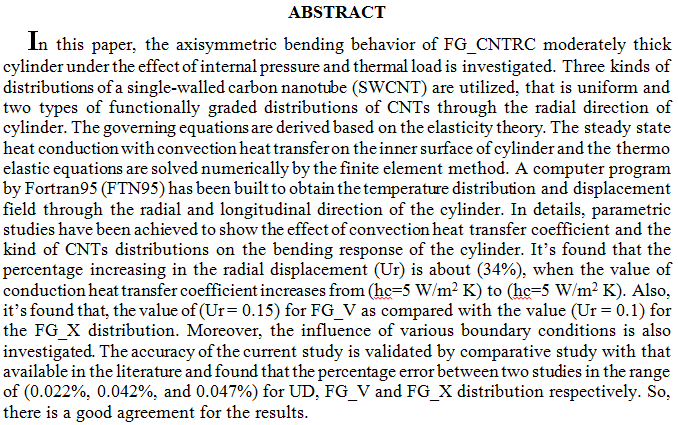
Thermo Elastic Analysis of Carbon Nanotube-Reinforced Composite Cylinder Utilizing Finite Element Method with the Theory of Elasticity
...Show More Authors


View Publication Preview PDF
Quick Preview PDF
Publication Date
Fri Jun 11 2021
Journal Name
Journal Of Baghdad College Of Dentistry
The effect of composite bonding spot size and location on the performance of poly-ether-ether-ketone (PEEK) retainer wires
...Show More Authors

Background: Poly-ether-ether-ketone(PEEK) has been introduced to many dental fields. Recently it was tested as a retainer wire‎ following orthodontic treatment. This study aimed to investigate the effect of changing the bonding spot size and location on the performance of PEEK retainer wires. Methods: A biomechanical study involving four three-dimensional finite element models was performed. The basic model was with a 0.8 mm cylindrical cross-section PEEK wire, bonded at the center of the lingual surface of the mandibular incisors with 4 mm in diameter composite spots. Two other models were designed with 3 mm and 5 mm composite sizes. The last model was created with the composite bonding spot of the canine away from the center

... Show More
Scopus (17)
Crossref (14)
Scopus Crossref
Publication Date
Fri Jun 11 2021
Journal Name
Journal Of Baghdad College Of Dentistry
The effect of composite bonding spot size and location on the performance of poly-ether-ether-ketone (PEEK) retainer wires
...Show More Authors

Background: Poly-ether-ether-ketone(PEEK) has been introduced to many dental fields. Recently it was tested as a retainer wire‎ following orthodontic treatment. This study aimed to investigate the effect of changing the bonding spot size and location on the performance of PEEK retainer wires. Methods: A biomechanical study involving four three-dimensional finite element models was performed. The basic model was with a 0.8 mm cylindrical cross-section PEEK wire, bonded at the center of the lingual surface of the mandibular incisors with 4 mm in diameter composite spots. Two other models were designed with 3 mm and 5 mm composite sizes. The last model was created with the composite bonding spot of the canine away from the center of t

... Show More
View Publication Preview PDF
Scopus (17)
Crossref (14)
Scopus Crossref
Publication Date
Wed Jan 01 2025
Journal Name
Journal Of Nanostructures
The Effects of Different Camphorquinone Concentrations on the Water Sorption and Solubility of an Experimental Green-Based Flowable Resin Composite
...Show More Authors

Water sorption (WS) and solubility (S) of the experimental flowable composites (EFCs), made from silica filler of rice husk are important to explore the reaction of EFCs against different oral environments. To investigate the effects of different camphorquinone concentrations on the WS and S of the EFCs. EFCs were fabricated from nanohybrid silica and involved different weights of camphorquinone (CQ) (0.03 g, 0.05 g and 0.075 g) and other materials. 3 groups of 7 disk-like samples of each of the three EFCs and Revolution Formula 2 (RF2) were tested. Before immersion, the volumes were recorded and the mass of each sample was recorded, as m1. During the immersion phase in three different media for 7 days, the weight was recorded as m2. During

... Show More
View Publication
Scopus (1)
Scopus
Publication Date
Tue Sep 01 2020
Journal Name
Baghdad Science Journal
Reconstruction of Three-Dimensional Object from Two-Dimensional Images by Utilizing Distance Regularized Level Algorithm and Mesh Object Generation
...Show More Authors

Three-dimensional (3D) reconstruction from images is a most beneficial method of object regeneration by using a photo-realistic way that can be used in many fields. For industrial fields, it can be used to visualize the cracks within alloys or walls. In medical fields, it has been used as 3D scanner to reconstruct some human organs such as internal nose for plastic surgery or to reconstruct ear canal for fabricating a hearing aid device, and others. These applications need high accuracy details and measurement that represent the main issue which should be taken in consideration, also the other issues are cost, movability, and ease of use which should be taken into consideration. This work has presented an approach for design and construc

... Show More
View Publication Preview PDF
Scopus (4)
Crossref (1)
Scopus Clarivate Crossref
Publication Date
Thu May 06 2010
Journal Name
Journal Of Engineering
A PROPOSED PROCEDURE FOR ANALYSING REINFORCED EMBANKMENTS
...Show More Authors

Publication Date
Thu Oct 29 2026
Journal Name
Journal Of Baghdad College Of Dentistry
A Clinical Method for Prediction of Alveolar Bone Mineral Density in the Area between the Second Premolar and First Molar in Iraqi Adults with Class I Occlusion
...Show More Authors

Background: Orthodontic mini-implants are increasingly used in orthodontics and the bone density is a very important factor in stabilization and success of mini-implant. The aim of this study was to observe the relationship among maximum bite force (MBF); body mass index (BMI); face width, height and type; and bone density in an attempt to predict bone density from these variables to eliminate the need for CT scan which have a highly hazard on patient. Materials and Methods: Computed tomographic (CT) images were obtained for 70 patients (24 males and 46 females) with age range 18-30 years. The maxillary and mandibular buccal cortical and cancellous bone densities were measured between 2nd premolar and 1st molar at two levels from the alveol

... Show More
View Publication Preview PDF
Publication Date
Sat Jan 01 2022
Journal Name
Dental Hypotheses
Comparison of Microleakage of Composite and Glass Ionomer Restorations in Primary Molars Pretreated with Silver Diamine Fluoride at Two Time Intervals: An In Vitro study
...Show More Authors

View Publication
Scopus (6)
Crossref (4)
Scopus Clarivate Crossref
Publication Date
Sat Apr 04 2015
Journal Name
International Journal Of Advanced Technology In Engineering And Science
SYNTHESIS OF ZNO QUANTUM DOT BY SELF ASSEMBLY METHOD AND ZNO NANOROD BY HYDROTHERMAL METHOD
...Show More Authors

In this work, ZnO quantum dots (Q.dots) and nanorods were prepared. ZnO quantum dots were prepared by self-assembly method of zinc acetate solution with KOH solution, while ZnO nanorods were prepared by hydrothermal method of zinc nitrate hexahydrate Zn (NO3)2.6H2O with hexamethy lenetetramin (HMT) C6H12N4. The optical , structural and spectroscopic properties of the product quantum dot were studied. The results show the dependence of the optical properties on the crystal dimension and the formation of the trap states in the energy band gap. The deep levels emission was studied for n-ZnO and p-ZnO. The preparation ZnO nanorods show semiconductor behavior of p-type, which is a difficult process by doping because native defects.

Publication Date
Sun Jul 31 2022
Journal Name
International Review Of Civil Engineering (irece)
Bearing Capacity Factor of Shallow Foundation on Reinforced Sloped Clayey Soil
...Show More Authors

The placement of buildings and structures on/or adjacent to slopes is possible, but this poses a danger to the structure due to failures that occur in slopes. Therefore, a solution or improvement should be determined for these issues of the collapse of the structure as a result of the failure of the slopes. A laboratory model has been built to test the impact of some variables on the bearing capacity factor. The variables include the magnitude of static axial load applied at the center of footing, the depth of embedment, the spacing between geogrid reinforcement layer and the numbering of the geogrid sheet under the footing, the inclination angle of slope clayey soil (β), the spacing between the footing's edge and the slope's end (b/H). Th

... Show More
View Publication
Crossref
Publication Date
Fri Jun 30 2006
Journal Name
Tikrit Journal Of Engineering Sciences
Curvature Ductility of Reinforced Concrete Column Sections Under Different strain Rates
...Show More Authors

This paper presents theoretical parametric study of the curvature ductility capacity for reinforced concrete column sections. The study considers the behavior of concrete and reinforcing steel under different strain rates. A computer program has been written to compute the curvature ductility taking into account the spalling in concrete cover. Strain rate sensitive constitutive models of steel and concrete were used for predicting the moment-curvature relationship of reinforced concrete columns at different rate of straining. The study parameters are the yield strength of main reinforcement, yield strength of transverse reinforcement, compressive strength of concrete, spacing of ties and the axial load. The results indicated that hi

... Show More
View Publication Preview PDF
Crossref (1)
Crossref