Preferred Language
Articles
/
joe-7
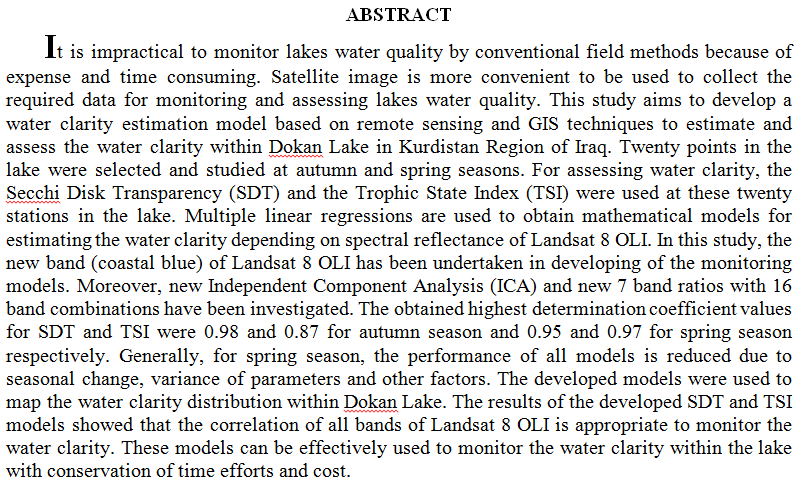
Assessment of Water Clarity within Dokan Lake Using Remote Sensing Techniques
...Show More Authors

View Publication Preview PDF
Quick Preview PDF
Publication Date
Mon Mar 12 2018
Journal Name
Arabian Journal For Science And Engineering
Estimate Level of Radon Concentration for Drinking Water in Some Regions of Baghdad City
...Show More Authors

View Publication
Scopus (10)
Crossref (9)
Scopus Clarivate Crossref
Publication Date
Sun Jan 01 2017
Journal Name
Euphrates Journal Of Agriculture Science
EFFECT OF ERRIGATION WATER SALINITY ON OAT SEEDS OF SOME CULTIVAR (Avena sativa L.)
...Show More Authors

The study was conducted to investigate the effect of salinity of irrigation water on seeds quality and seedling growth characters for three oat cultivars (Shifaa, Hamel and Pimula) . It was carried oat in seed technology laboratory, field crops department, College of Agriculture, Baghdad University of Aljadiriya for period of tow years. Seeds of three oat cultivars (Shifaa, Hamel and Pimula) taken from a field experiment conducted during 2014-2015 and 2015-2016 irrigated with three salinity water levels (3, 6 and 9 dS.m-1 ) in addition to river water with salinity level of 1.164 dS.m-1 as control. Seeds were tested in laboratory experiments to estimate their quality, and completely randomized design with three replicates was used. Statistic

... Show More
Publication Date
Tue Dec 30 2014
Journal Name
Iraqi Journal Of Chemical And Petroleum Engineering
Influences of Operating Variables on Hydrodynamic Performance of Plunging Water Jet Downflow Bubble Column
...Show More Authors

The hydrodynamics of a co-current down flow bubble column has been investigated with air – water system. A Perspex bubble column of 5cm in diameter and 1.5m height is used as a test contactor using nozzles of 7, 8 and 9 mm diameter for air-water distributing. The column is provided with three electro-resistivity needle probes for bubble detection.
Experimental work is carried out with air flow rates from 0.09 to 0.45 m3/hr and liquid flow rates from 0.65 to 1.1m3/hr in order to study the effects of superficial gas velocity, nozzle diameter and liquid flow rate on the characteristics of hydrodynamic interactions viz. gas hold up, bubble diameter and bubble velocity by using two technical methods, direct height measurements for air-wa

... Show More
View Publication Preview PDF
Publication Date
Sun Mar 13 2011
Journal Name
Baghdad Science Journal
Environmental Study of Some Water Characteristics at Um-Al-Naaj Marsh, South of Iraq.
...Show More Authors

Um-Al-Naaj region in Al-Hawiezah Marsh, Southern Iraq was chosen to study the environmental variations of some water characteristics during 2008, seasonally. The results showed clear seasonal changes in values of some environmental variables (temperature, depth, light penetration, turbidity, total suspended solids, pH, dissolved oxygen, reactive phosphate, reactive nitrite, and reactive nitrate), while there were no clear seasonal changes in electrical conductivity and salinity values. In addition, high nutrients concentrations and light penetration were noted. Statistical analysis showed significant positive relationship between air and water temperature; electrical conductivity and salinity. Water turbidity was significantly affecte

... Show More
View Publication Preview PDF
Crossref
Publication Date
Thu Jun 30 2016
Journal Name
Iraqi Journal Of Chemical And Petroleum Engineering
The Effect of Asphaltene on the Stability of Iraqi Water in Crude Oil Emulsions
...Show More Authors

In the present work, asphaltenes and resins separated from emulsion samples collected from two Iraqi oil wells, Nafut Kana (Nk) and Basrah were used to study the emulsion stability. The effect of oil resins to asphaltene (R/A) ratio, pH of the aqueous phase, addition of paraffinic solvent (n-heptane), aromatic solvent (toluene), and blend of both (heptol) in various proportions on the stability of emulsions had been investigated. The conditions of experiments were specified as an agitation speed of 1000 rpm for 30 minutes, heating at 50 °C, and water content of 30%.  The results showed that as the R/A ratio increases, the emulsion will be unstable and the amount of water separated from emulsion increases. It was noticed that the em

... Show More
View Publication Preview PDF
Publication Date
Tue Dec 26 2017
Journal Name
Al-khwarizmi Engineering Journal
Corrosion Resistance of Synergistic Welding Process of Aluminium Alloy 6061 T6 in Sea Water
...Show More Authors

Abstract


This work involves studying corrosion resistance of AA 6061T6 butt welded joints using Two different welding processes, tungsten inert gas (TIG) and a solid state welding process known as friction stir welding, TIG welding process carried out by using Rolled sheet of thickness6mm to obtain a weld joint with dimension of (100, 50, 5) mm using ER4043 DE (Al Si5) as filler metal and argon as shielding gas, while Friction stir welding process carried out using CNC milling machine with a tool of rotational speed 1000 rpm and welding speed of 50mm/min to obtain the same butt joint dimensions. Also one of weld joint in the same dimensions subjected to synergistic weld

... Show More
View Publication Preview PDF
Publication Date
Sat Jul 28 2018
Journal Name
Journal Of Engineering
Effects of Subsurface Water Retention Technology on Crop Coefficient and Crop Evapotranspiration of Eggplant
...Show More Authors

In this paper, the effects of subsurface water retention technology (SWRT) on crop coefficient (kc) and crop evapotranspiration (ETc) of eggplant were investigated in sandy loam soil. For this purpose, two treatments plot (with SWRT and without using SWRT) were adopted during 93 days of cultivation. The study was conducted in open field within Al-Fahamah Township, Baghdad, Iraq during summer growing season 2017. The accumulated ETc of eggplant was 403.3 and 515.2 mm for SWRT treatment and control plot, respectively by reduction percentage 21.7 %. The average values of ETc during the growing season were 4.3 and 5.5 mm/day, respectively. The crop coefficients value during the gro

... Show More
View Publication Preview PDF
Crossref (2)
Crossref
Publication Date
Tue Dec 15 2020
Journal Name
Aip Conference Proceedings
The water bodies in the Southern East of Iraq before and after 2018
...Show More Authors

This study is concerned with the recent changes that occurred in the last three years (2017-2019) in the marshes region in southern Iraq as a result of the changes in the global climate, the study included all the water bodies in the five governorates that are located in the southern regions of Iraq (Wasit, Maysan, Dhi-Qar, Qadisiyah and Basrah), which represent the marshes lands in Iraq. Scenes of the Landsat 8 satellite are used to create a mosaic to cover the five governorates within a time window with the slightest difference between the date of the scene capture, not to exceed 8 days. The results of calculating the changes in water areas were obtained using the classifier support vector machine, where high accuracy ratios were recorded

... Show More
View Publication Preview PDF
Scopus (3)
Crossref (3)
Scopus Clarivate Crossref
Publication Date
Wed Mar 10 2021
Journal Name
Baghdad Science Journal
partial molal volume and viscosity study of vitamin B1 and B3 in water
...Show More Authors

the study covered theoretical concering parial molal volume the applicability of jones-dole equation

View Publication Preview PDF
Publication Date
Wed Dec 12 2018
Journal Name
Iop Conference Series: Materials Science And Engineering
Extraction of Essential Oil from Iraqi Eucalyptus Camadulensis Leaves by Water Distillation Methods
...Show More Authors

The extraction of Eucalyptus oil from Iraqi Eucalyptus Camadulensis leaves was studded using water distillation methods. The amount of Eucalyptus oil has been determined in a variety of extraction temperature and agitation speed. The effect of water to Eucalyptus leaves (solvent to solid) ratio and particle size of Eucalyptus leaves has been studied in order to evaluate the amount of Eucalyptus oil. The optimum experimental condition for the Eucalyptus oil extraction was established as follows: 100 C extraction temperature, 200 rpm agitation speed; 0.5 cm leave particle size and 6: 1 ml: g amount of water to eucalyptus leaves Ratio.