Preferred Language
Articles
/
joe-5
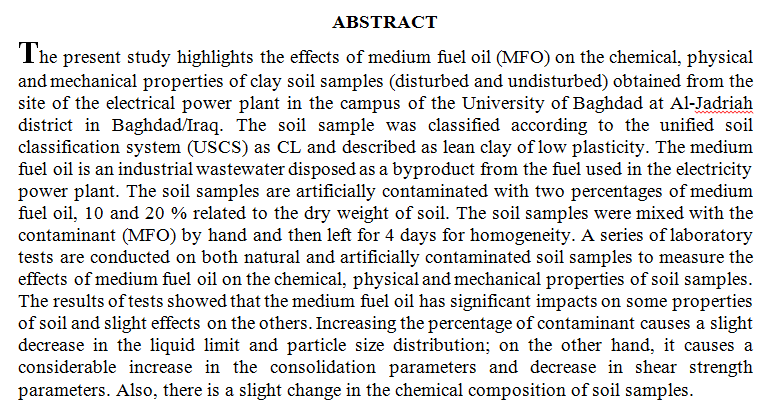
Effects of Fuel Oil on the Geotechnical Properties of Clay Soil
...Show More Authors

View Publication Preview PDF
Quick Preview PDF
Publication Date
Sun Jul 09 2023
Journal Name
Journal Of Engineering
Effect of Ferric Oxide on Electricity Generation and Waste Water Treatment Using Microbial Fuel Cell Technology
...Show More Authors

The aim of research is to show the effect of Ferric Oxide (Fe2O3) on the electricity production and wastewater treatment, since 2.5% of Ferric Oxide (Fe2O3) (heated and non heated) nanoparticles has been used. Characterization of nanoparticles was done using X-ray Diffraction (XRD) and Scan Electron Microscopy (SEM). The influence of acidity was also studied on both wastewater treatmenton the Chemical Oxygen demand (COD) and Biological Oxygen Demand (BOD) and voltage output was studied. From the results, it was infused that the dosage of 0.025 g/l and an initial pH 7 were founded to be optimum for the effective degradation of effluents. The results concluded that the treatment of anaerobic sludge wastewater using Ferric Oxide (Fe2O3) in

... Show More
View Publication Preview PDF
Crossref (1)
Crossref
Publication Date
Sun Mar 30 2025
Journal Name
Iraqi Journal Of Chemical And Petroleum Engineering
Determination of petrophysical properties of Sadi Formation in Halfaya oil field, southern Iraq
...Show More Authors

   This study aimed to evaluate the reservoir petrophysical properties (porosity, water saturation, and permeability) for optimal flow unit assessment within the Sadi Formation. Utilizing open hole logging data from five wells, the Sadi formation was divided into two rock units. The upper unit (A) is 45-50 meters thick, mainly consisting of limestone, mainly consisting of shaly limestone at the lower part. The lower unit (B) has a thickness of approximately 75-80 meters and is primarily composed of limestone, further subdivided into three subunits (B1, B2, B3). The average water resistivity is 0.04 ohm-m, and the average mud filtrate resistivity is 0.06 ohm-m. The Pickett plot was utilized to determine Archie parameters (tortuosit

... Show More
View Publication Preview PDF
Crossref
Publication Date
Sun Mar 01 2009
Journal Name
Baghdad Science Journal
Investigation of the Porosity of Certain Iraqi Clay Deposits by Mercury Porosimeter
...Show More Authors

Pore volume, pore diameter, and pore volume distribution of three of Iraqi natural clay deposites were measured using mercury intrusion porosimetry .The clays are white kaolin, colored kaolin, and bentonite .The results showed that the variation of the pore area of the clay deposites followed the following order :- Coloured Kaolin > White Kaolin > Bentonite While the pore volume may be arranged as in the following sequence:- White Kaolin > Coloured Kaolin >Bentonite Also , Bentonite exhibits the narrow range pore size distribution than the white and coloured kaolin.

View Publication Preview PDF
Crossref
Publication Date
Sun Sep 02 2012
Journal Name
Baghdad Science Journal
Preparation of PVC composite using reinforced Iraqi Bentoniet clay as a filler & study their mechanical and thermal properties
...Show More Authors

In this study , Iraqi Bentonite clay was used as a filler for polyvinyl chloride polymer. Bentonite clay was prepared as a powder for some certain particle size ,followed by calcinations process at (300,700,900) OC ,then milled and sieved. The selected sizes were D ~75 µm and D ~150. After that polyvinyl Al-Cohool solution prepared and used as a coated layer covered the Bentonite powder before applied as a filler ,followed by drying , milling and sieving for limited recommend sizes. polyvinyl chloride solutions were prepared and adding of modified Bentonite power at certain quantities were followed .Sheet of these variables on the mechanical and thermal properties of the prepared reinforced particular polyvinyl chloride composite

... Show More
View Publication Preview PDF
Crossref
Publication Date
Sun Oct 01 2023
Journal Name
Baghdad Science Journal
Effects of Water Stress, Nitrogen, Magnesium and their Interactions on Some Growth Characteristics and Essential Oil content of Rosemary (Rosmarinus officinalis L.)
...Show More Authors

A factorial experiment was applied with four replicates on rosemary plants (Rosmarinus officinalis L.) grown in pots inside the glasshouse of the Department of Biology, College of Science, Salahaddin University, Erbil, Iraq, during April, 2019 to July, 2020, to determine the effects of soil moisture content ( SM1: 100% and SM2: 60% field capacity), nitrogen fertilizer (N1: 100, N2: 200 and N3: 300kg/hectare), and magnesium fertilizer (Mg1: 0.0, Mg2: 30 and Mg3: 60kg/hectare) and their interactions on some growth characteristics  and essential oil content of rosemary plants. Two cuttings were taken from rosemary shoots (on March, 2020 and July, 2020) after 12 and 15 months of planting respectively. Results showed that cutting 1:

... Show More
View Publication Preview PDF
Scopus (1)
Crossref (1)
Scopus Crossref
Publication Date
Sat Feb 01 2020
Journal Name
Optik
Composition effects on formation energies, electronic and vibrational properties of ZnCdS wurtzoid molecules: A DFT study
...Show More Authors

View Publication
Scopus (8)
Crossref (7)
Scopus Clarivate Crossref
Publication Date
Tue Oct 30 2018
Journal Name
Iraqi Journal Of Physics
Annealing effects on optical and structural properties of chromium oxide thin film deposited by PLD technique
...Show More Authors

Optical properties of chromium oxide (Cr2O3) thin films which were prepared by pulse laser deposition method, onto glass substrates. Different laser energy (500-900) mJ were used to obtain Cr2O3 thin films with thickness ranging from 177.3 to 372.4 nm were measured using Tolansky method. Then films were annealed at temperature equal to 300 °C. Absorption spectra were used to determine the absorption coefficient of the films, and the effects of the annealing temperature on the absorption coefficient were investigated. The absorption edge shifted to red range of wavelength, and the optical constants of Cr2O3 films increases as the annealing temperature increased to 300 °C. X-ray diffraction (XRD) study reveals that Cr2O3 thin films are a

... Show More
View Publication Preview PDF
Crossref
Publication Date
Fri Jul 01 2022
Journal Name
Iop Conference Series: Earth And Environmental Science
Evaluation of Soil Quality and Health Indices in Relation to Soil Physical Properties of Fedak Farm in Holly Najaf Province
...Show More Authors

Fadak farm project was selected to conduct this study in and to evaluate the state of quality and health indices in term of soil physical properties, where this farm is located in Holly Najaf Governorate. Some physical properties (soil texture, mean weight diameter, bulk density, porosity, infiltration rate, saturated hydraulic conductivity and available water) were selected to assess the quality then health indices, Results showed that classes of moderate and poor soil health were dominated in lands of this farm for physical properties It was noted that the class good of soil health wasnot collaterally appeared in areas for the physical characteristics.

View Publication Preview PDF
Scopus (3)
Crossref (1)
Scopus Crossref
Publication Date
Sun Jul 11 2021
Journal Name
Sustainable Civil Infrastructures
Field Soil Electrical Resistivity Measurements of Some Soil of Iraq
...Show More Authors

View Publication
Scopus (2)
Crossref (1)
Scopus Crossref
Publication Date
Sun Jul 09 2023
Journal Name
Journal Of Engineering
The Effect of Ceramic Coating on Performance and Emission of Diesel Engine Operated on Diesel Fuel and Biodiesel Blends
...Show More Authors

In this work, the effect of ceramic coating on performance, exhaust gas temperature and gases emissions of diesel engine operated on diesel fuel and biodiesel blends was investigated. A conventional four stroke, direct injected, single cylinder, diesel engine was tested at constant speed and at different load conditions using diesel fuel and biodiesel blends. The inlet and exhaust valves, the head of piston and cylinder head of the engine were coated by ceramic materials. Ceramic layers were made of (210-240) μm of Al2O3 and (30-60) μm of 4NiCr5Al as a bond coat for inlet and exhaust valves and (350-400) μm of YSZ and (50-100) μm of 4NiCr5Al as a bond coat for head of piston and (280-320) μm of Sic and (40-80) μm of 4NiCr5Al as a b

... Show More
View Publication Preview PDF
Crossref