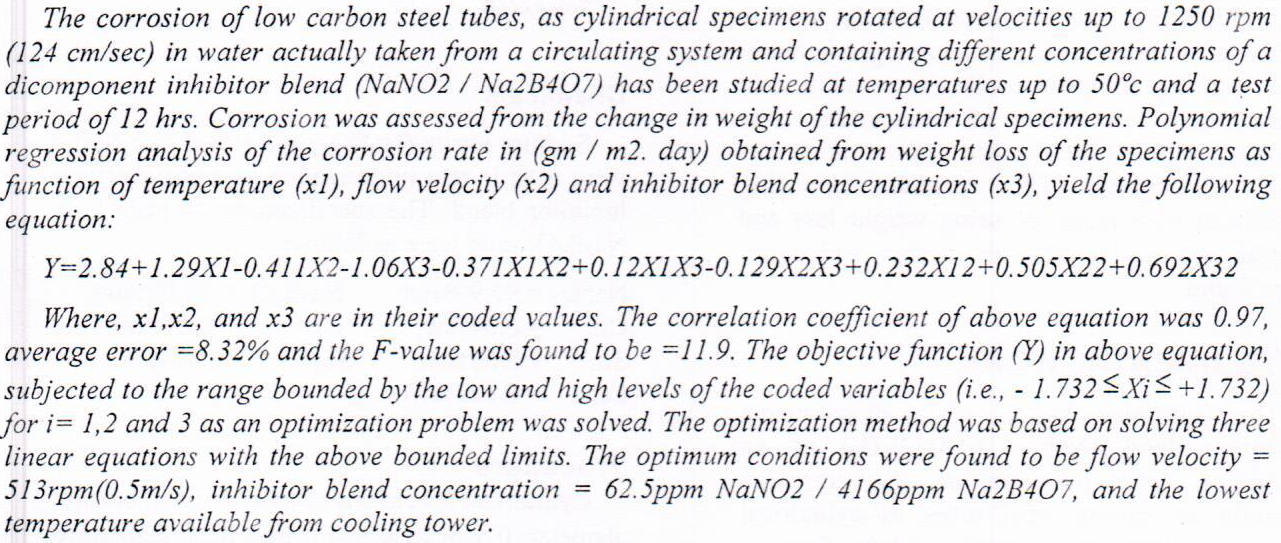
The Influence of Temperature and Flow Velocity on the Corrosion Inhibition of Low Carbon Tubes in Recirculating Water System by a Dicomponent Inhibitor Blend

Rainwater harvesting could be a possible solution to decrease the consequences of water scarcity and energy deficiency in Iraq and the Kurdistan Region of Iraq (KRI). This study aims to calculate the water and energy (electricity) saved by rainwater harvesting for rooftops and green areas in Sulaimani city, KR, Iraq. Various data were acquired from different formal entities in Sulaimani city. Moreover, Google Earth and ArcMap 10.4 software were used for digitizing and calculating the total rooftop and green areas. The results showed that for the used runoff coefficients (0.8 and 0.95), the harvested rainwater volumes were 2901563 and 12197131 m³ during the study period (2005 – 2006) and (2019-2020). Moreover, by compa
... Show More (2)
(2)
 (1)
(1)

 (5)
(5)
Renewable energy resources have become a promissory alternative to overcome the problems related to atmospheric pollution and limited sources of fossil fuel energy. The technologies in the field of renewable energy are used also to improve the ventilation and cooling in buildings by using the solar chimney and heat exchanger. This study addresses the design, construction and testing of a cooling system by using the above two techniques. The aim was to study the effects of weather conditions on the efficiency of this system which was installed in Baghdad for April and May 2020. The common weather in these months is hot in Baghdad. The test room of the design which has a size of 1 m3 was situated to face the geographical south. The te
... Show More
(5)
(2)
Carbon Nanopowder was fabricated by arc discharge technique at deposition pressure of 10-5 mbar Argon gas on glass substrates. The prepared carbon nano- powder was collected from chamber and purified with nitric acid at 323K .The morphology and crystalline structure of the prepared powder was examined by X-Ray Diffraction (XRD), Atomic Force Microscope (AFM), and Scanning Electron Microscope (SEM). XRD spectrums showed that the powder exhibits amorphous structure and after purification, the powder showed hexagonal structure with a preferential orientation along(002) direction ,where AFM and SEM gave very compatible estimation on the grain size and shape of the nanopowder.
Beta-irradiation effects on the microstructure of LDPE samples have been investigated
using Positron Annihilation Lifetime Technique (PALT). These effects on the orthopositronium
(o-Ps) Lifetime t3, the free positron annihilation lifetime 2 t , the free-volume
hole size (Vh) and the free volume fraction (fh) were measured as functions of Beta
irradiation - dose up to a total dose of 30.28 kGy.
The results show that the values of t3, Vh and fh increase gradually with increasing Beta
dose up to a total dose of 1.289 kGy, and reach a maximum increment of 17.4%, 32.8% and
5.86%, respectively, while t2 reachs maximum increment of 211.9% at a total dose of 1.59
kGy. Above these doses, the values show nonlinear changes u
In this study, the effects of different loading doses of cerium in the prepared NaY zeolite from Iraqi kaolin were investigated. Al-Duara refinery atmospheric residue fluid catalytic cracking was selected as palpation reaction for testing the catalytic activity of cerium loading NaY zeolite. The insertion of cerium in NaY zeolites has been synthesized by simple ion exchange methods. Three samples of modified zeolite Y have been obtained by replacing the sodium ions in the original sample with cerium and the weight percent added are 0.35, 0.64, and 1.06 respectively. The effects of cerium loading to zeolite Y in different weight percent on the cracking catalysts were studied by employing a laboratory fluidized
... Show MoreA Multiple System Biometric System Based on ECG Data
(1)
The development of the perforated fin had proposed in many studies to enhance the heat transfer from electronic pieces. This paper presents a novel derivative method to find the temperature distribution of the new design (inclined perforated) of the pin fin. Perforated with rectangular section and different angles of inclination was considered. Signum Function is used for modeling the variable heat transfer area. Set of parameters to handle the conduction and convection area were calculated. Degenerate Hypergeometric Equation (DHE) was used for modeling the Complex energy differential equation and then solved by Kummer’s series. In the validation process, Ansys 16.0-Steady State Thermal was used. Two geometric models were consider
... Show More
(3)
(2)
IN this work, a titanium dental implant was modified by electro-polymerized of 4-allyl-2-methoxyphenol (Eugenol) using direct current lower than 3.5 volt. The modification of titanium dental implant was achieved to improve its corrosion resistant. Fourier transform infrared spectroscopy (FTIR) was employed to confirm the electro-polymerization of Eugenol to Poly Eugenol (PE) on pure titanium. Deposition of PE on titanium was confirmed by X-ray diffraction and was characterized by thermogravimetric analysis (TGA). The surface morphology of polymeric film were examined through scanning electron microscopy (SEM). Coated titanium by (PE) revealed a good corrosion protection efficiency even at temperature ranged (293-323)K in artificial saliva.
... Show More
(18)
(5)

This research involves study effect of chloride ions in concentration range (0.01 – 0.50 mol.dm-3) on the corrosion behavior of Al-Zn alloy in basic media of 1x10⁻³ mol.dm-3 NaOH at pH=11 and four different temperatures in the range (298-313 K). Cathodic and anodic Tafel slopes (bc &ba) and transfer coefficients (αc & αa) were calculated and the results interprets according to the variation of the rate – determining steps. The results also indicate that the chloride ions are bonded chemically in the interface as an initial step of formation of different mixed oxohydroxy – and chloro complexes. Polarization resistance (Rp) is calculates
... Show More