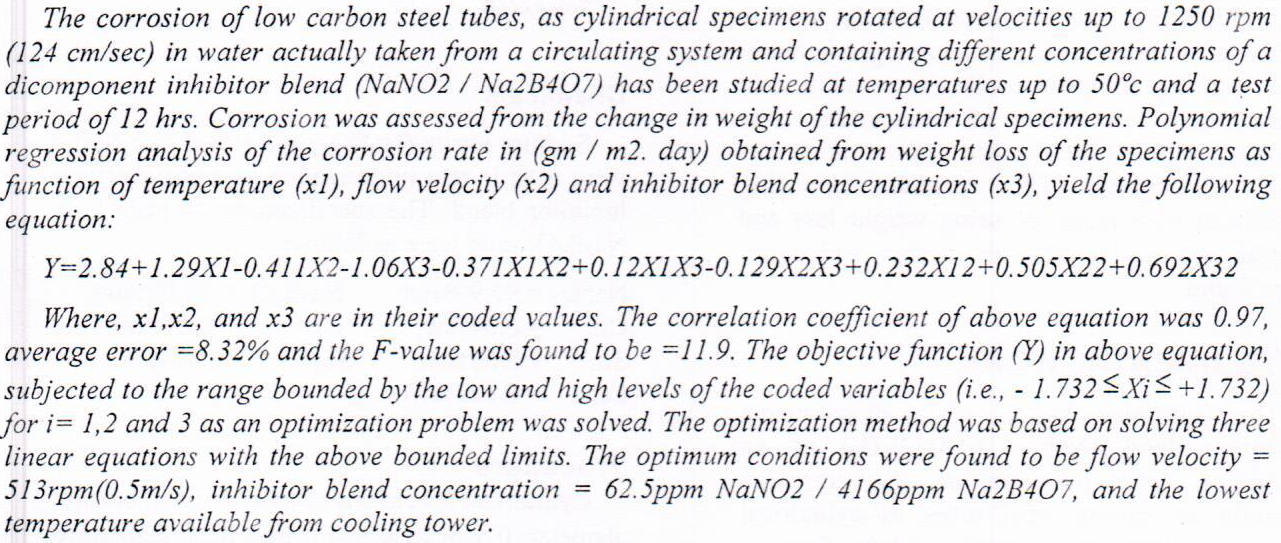
The Influence of Temperature and Flow Velocity on the Corrosion Inhibition of Low Carbon Tubes in Recirculating Water System by a Dicomponent Inhibitor Blend

 (7)
(7)
 (4)
(4)


Self- curing is the potential of lightweight aggregate to absorption great amount of water thru mixing which prominently can moves to the paste during hydration process. Self- curing empowers a water to be distributes more evenly act out the cross section. Whereas, the external curing water is only able to penetrate several millimetres into concrete with low water cement ratio. Brick dust accumulates in the demolish site creates serious environmental contamination. This study investigates the effect of brick dust recovered from construction site on the Properties of mortar cured in three curing conditions. Mortar in this study produced using BD as cement additive with (2, 4, 6, and 8) % by weight of cement. BD was used a
... Show More
A total of 48 experiments were conducted to investigate the impact of slit weir dimensions and locations on the maximum scour depth and scour area created upstream. The slit weir model was a 110 mm slit opening, and it was installed at the end of the working section in a laboratory flume. The flume was 10.0 m long, 30 cm wide, 30 cm deep, and almost middle. It includes a 2 m working section with a mobile bed with 110 mm in thickness. In the mobile bed, two types of nonuniform sand (with a geometric standard deviation of 1.58 and 1.6) were tested separately. The weir dimensions and location were changed with flow rates. Then dimensions of the slit weir were changed from 60 x 110 mm to 60 x 70 mm (width x height), while th
... Show More
(1)
Carbon nanospheres (CNSs) were successfully prepared and synthesized by Catalytic Chemical Vapor Deposition (CCVD) by using camphor as carbon source only, over iron Cobalt (Fe-Co) saturated zeolite at temperature between (700 oC and 900 °C), with different concentrations of camphor, and reaction time. The synthesized CNSs were characterized using Scanning Electron Microscopy (SEM), X-ray diffraction spectroscopy (XRD), and Fourier Transform Infrared (FTIR). The carbon spheres in different sizes between 100 nm and 1000 nm were investigated. This work has done by two parts, first preparation of the metallic catalyst and second part formation CNSs by heat treatment.
(2)
Context and its influence in direction of reference by Abi Hussein Al Basri
Focusing on the negative role of default risk on banks, as it is one of the most important risks facing banks, which are difficult to determine accurately, and its reflection on the indicators of profitability of cash flows. The increasing competition between banks led to an increase in the credit facilities granted by banks, and was accompanied by an increase in exposure to the risks of default, which led to an impact on the level of performance of banks in terms of achieving the required return according to the levels of high competition. Therefore, the problem of this study focused on the extent to which the risk indicators of default affect the profitability indicators of the cash flows of the banks research sample in the profit
... Show More
Gas adsorption phenomenon on solid surface has been used as a mean in separation and purification of gas mixture depending on the difference in tendencies of each component in the gas mixture to be adsorbed on the solid surface according to its behaviour. This work concerns to study the possibilities to separate the gas mixture using adsorption-desorption phenomenon on activated carbon. The experimental results exhibit good separation factor at temperature of -40 .
Background: Ceramic veneers represent the treatment of choice in minimally invasive esthetic dentistry; one of the critical factors in their long term success is marginal adaptation. The aim of the present study is to evaluate the marginal gap of ceramic veneers by using two different fabrication techniques and two different designs of preparation. Material and methods: A typodont maxillary central incisor used in the preparation from which metal dies were fabricated, which were in turn used to make forty stone dies. The dies divided into four experimental groups, each group had ten samples: A1: prepared with butt-joint incisal reduction and restored with IPS e.max CAD, A2: prepared with overlapped incisal reduction and restored with IPS e.
... Show MoreRate of zinc consumption during the cathodic protection of copper pipeline which carries saline water was measured by weight loss technique in the absence and presence of bacteria. Variables studied were solution flow rate, temperature, time and NaCl concentration. It was found that within the present range of variables; the rate of zinc consumption increases with the increase of all operating conditions. The presence of bacteria increases the zinc consumption. Fourth order multi-term model and one-term model were suggested to represent the consumption data. Nonlinear regression analysis was used to estimate the coefficients of these models, while statistical analysis was used to determine the effect of each coefficient. Both models were re
... Show More
(36)
The semiconductor ZnO is one of II – VI compound group, it is prepare as thin films by using chemical spray pyrolysis technique; the films are deposited onto glass substrate at 450 °C by using aqueous zinc chloride as a spray solution of molar concentration 0.1 M/L. Sample of the prepared film is irradiating by Gamma ray using CS 137, other sample is annealed at 550°C. The structure of the irradiated and annealed films are analyzed with X-ray diffraction, the results show that the films are polycrystalline in nature with preferred (002) orientation. The general morphology of ZnO films are imaged by using the Atomic Force Microscope (AFM), it constructed from nanostructure with dimensions in order of 77 nm.
The optical properties o