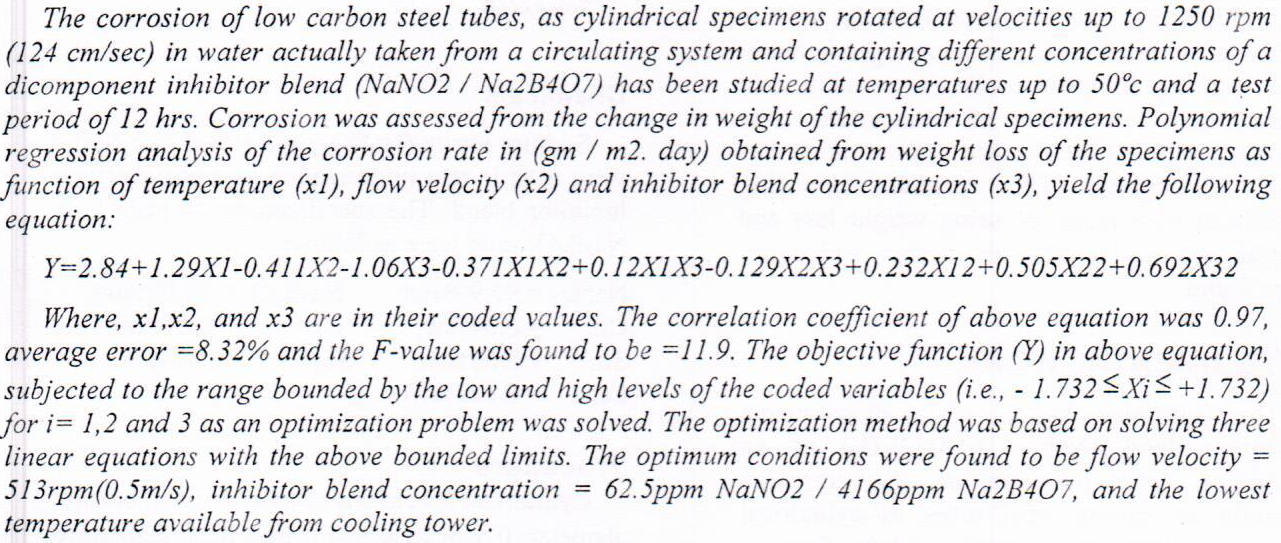
The Influence of Temperature and Flow Velocity on the Corrosion Inhibition of Low Carbon Tubes in Recirculating Water System by a Dicomponent Inhibitor Blend

Understanding the compatibility between spider silk and conducting materials is essential to advance the use of spider silk in electronic applications. Spider silk is tough, but becomes soft when exposed to water. Here we report a strong affinity of amine-functionalised multi-walled carbon nanotubes for spider silk, with coating assisted by a water and mechanical shear method. The nanotubes adhere uniformly and bond to the silk fibre surface to produce tough, custom-shaped, flexible and electrically conducting fibres after drying and contraction. The conductivity of coated silk fibres is reversibly sensitive to strain and humidity, leading to proof-of-concept sensor and actuator demonstrations.
 (143)
(143)
 (142)
(142)



In this study, the effects of blending the un-branched acrylate polymer known as Poly (n-decyl acrylate), and the branched acrylate polymer known as Poly (iso-octyl acrylate), on the viscosity index (VI), and the pour point of the Iraqi base stocks 40, and 60 respectively, were investigated. Toluene was used as a carrier solvent for both polymer types. The improvement level of oils (VI, & pour point) gained by blending the oil with the acrylate derived polymers was compared with the values of (VI, and pour point) gained by blending the oil with a commercial viscosity index, and pour point improver. The commercial lubricant additive was purchased and used by Al-Daura Refineries. It consisted of an un-known olefin copolymer dissolved i
... Show More
Iraq suffers from lack of water resources supply because the headwaters of the rivers located outside its borders and the influence of upstream countries on the quantities of flowing water, in addition to the increase of pressure on available water as a result of population increase and not adopting the principle of rationalization where misuse and wastage and lack of strategic vision to treat and manage water use in accordance with the economic implications fall. This is reflected fallout on water security and subsequently on national and food security, while the issue of using water resources is development top priority in different countries in the world because of the importance of water effect on the security of indivi
... Show More
A phytoremediation experiment was carried out with kerosene as a model for total petroleum hydrocarbons. A constructed wetland of barley was exposed to kerosene pollutants at varying concentrations (1, 2, and 3% v/v) in a subsurface flow (SSF) system. After a period of 42 days of exposure, it was found that the average ability to eliminate kerosene ranged from 56.5% to 61.2%, with the highest removal obtained at a kerosene concentration of 1% v/v. The analysis of kerosene at varying initial concentrations allowed the kinetics of kerosene to be fitted with the Grau model, which was closer than that with the zero order, first order, or second order kinetic models. The experimental study showed that the barley plant designed in a subsu
... Show More
(10)
A phytoremediation experiment was carried out with kerosene as a model for total petroleum hydrocarbons. A constructed wetland of barley was exposed to kerosene pollutants at varying concentrations (1, 2, and 3% v/v) in a subsurface flow (SSF) system. After a period of 42 days of exposure, it was found that the average ability to eliminate kerosene ranged from 56.5% to 61.2%, with the highest removal obtained at a kerosene concentration of 1% v/v. The analysis of kerosene at varying initial concentrations allowed the kinetics of kerosene to be fitted with the Grau model, which was closer than that with the zero order, first order, or second order kinetic models. The experimental study showed that the barley plant designed in a subsu
... Show More
(14)
(10)
(24)
(17)
(24)
(17)
(5)
Derivational word formation process is one of the most substantial linguistic procedures that solves many problems in the translation of the language new vocabulary and helps to comprehend the smallest language component that not simply semantically and structurally explain the elements of both Russian and Arabic but also enables translators to comprehend the derivational method procedures of both languages. It also reveals the structural aspects of translation equivalences, cognitive and semantic foundations of translation. The rapid development of languages and the appearance of a new vocabulary like ṭabaʿa "print → ṭābiʿat "printer", kataba "to write" → kātib → kātibat, rafaʿa "to raise" → rāfiʿat "a crane" d
... Show More
Experiments have been conducted to study the local and average heat transfer by mixed
convection for hydrodynamically fully developed, thermally developing and fully developed
laminar upward air flow in an inclined annulus with adiabatic inner cast iron tube and uniform
heated outer aluminum tube with an aspect ratio ( Ω = 0.72) and (L/Dh≈40) for both calming and
test sections). A wide range of Reynolds number from 859 to 2024 has been covered, and heat
flux has been varied from 159 W/m2 to 812 W/m2 (these values of heat flux and Reynolds
number gave Richardson number range from 0.03 to 0.٣٨), with angles of annulus inclination
φ =0o (horizontal position), φ =60o (inclined position), and φ =90o (vertical posi