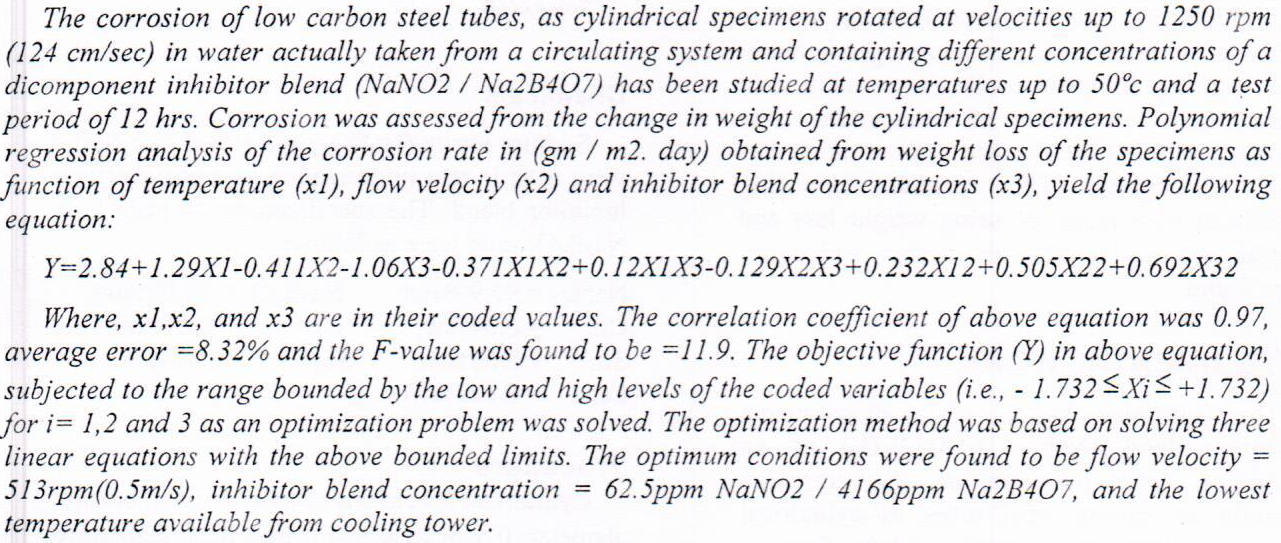
The Influence of Temperature and Flow Velocity on the Corrosion Inhibition of Low Carbon Tubes in Recirculating Water System by a Dicomponent Inhibitor Blend




The aim of the present work to study the effect of changing velocity (Reynold's number) on oxygen cathodic polarization using brass rotating cylinder electrode in 0.1, 0.3 and 0.5N NaCl solutions (PH = 7) at temperatures 40, 50 and 600 C. Cathodic polarization experiments were conducted as a function of electrode rotational speed and concentration.
Abstract- Plasma parameters in a planar dc-sputtering discharge in argon were measured by cylindrical electrostatic probe (Langmuir probe).Electron density, electron temperature, floating potential, and space potential were monitored as a function of working discharge pressure. Electrostatic probe and supporting circuit were described and used to plot the current – voltage characteristics. Plasma properties were inferred from the current-voltage characteristics of a single probe positioned at the inter-cathode space. Typical values are in the range of (10-16 -10-17) m-3 and (2.93 – 5.3) eV for the electron density and the electron temperature respectively.
This paper studies the influence of temperature on the corrosion rate of coated AA6111 aluminum alloy used in vehicle bodies under static and vibration states. The vibration test system was collected laboratory and used for testing of five different types of paints (EASI, Numix, Lesonal, DENSO and Polaron paints) in the 5 % NaCl solution using immersion test method. Lesonal paint provided the best corrosion protection, while DENSO paints show large values of corrosion rate, other coatings exhibit moderate values. Model of paints corrosion was developed to characterize the corrosion processes occur at the surfaces. It is found that corrosion rate obtained at vibration cases is larger than static cases and vibration effect
... Show More
Reclaimed (recycled) asphalt pavement (RAP), the most recycled material worldwide, is the mostly reclaimed material utilized in hot mix asphalt. Polymer (Crumb rubber) incorporation frequently leads to enhanced durability and resistance to heat cracking and rutting, two forms of permanent deformation. It also relieves stiffness and minimizes fatigue damage. This study aims to gather all previous RAP-related research and crumb rubber CR, so that the impact of using these materials on mechanical, physical properties of asphalt pavement, environmental effect and cost effective are clarify and explained. The finding of this research proved that the use of RAP and CR provide considerable structural and financial enhancements to the const
... Show More (11)
(11)
 (1)
(1)
The need for renewable energy sources is higher than ever due to rising global warming, climate change, and ozone depletion. For refrigeration and air conditioning applications, adsorption refrigeration systems are viable alternatives cooling techniques. This study is a topic and part of the M.Sc. thesis. A field solar-powered ice maker unit was created, studied, tested, and evaluated on the 13th and 30th of May, 2022. Activated carbon and methanol pair was used to set up a refrigeration system in Baghdad (Al Dora). Experimental tests were carried out outdoors to determine the coefficient of performance COP and specific cooling power SCP of the system. The results showed that the lowest temperature
... Show More
(10)
(7)
An electrolytic process for the removal of Zn(II) from aqueous solution using a parallel amalgamated copper screens cathode operated in the flow through mode is proposed. The current-potential curves recorded at a rotating amalgamated copper disc electrode were used to determine diffusion coefficient of Zn(II). The performance of electrolytic reactor was investigated by using different flow rates at initial zinc ion concentration(48 mg/L). Taking into account the residential Zn(II) concentration, the best results were obtained for cathode potential of (-1.35 V vs. SCE) at flow rate (320 L/h). Zinc ion concentration was found to decrease from 48 mg/L to 1 mg/L during 120 min. of electrolysis. The experimental data are well correlate
... Show More
(4)
Polymer electrolytes were prepared using the solution cast technology. Under some conditions, the electrolyte content of polymers was analyzed in constant percent of PVA/PVP (50:50), ethylene carbonate (EC), and propylene carbonate (PC) (1:1) with different proportions of potassium iodide (KI) (10, 20, 30, 40, 50 wt%) and iodine (I2) = 10 wt% of salt. Fourier Transmission Infrared (FTIR) studies confirmed the complex formation of polymer blends. Electrical conductivity was calculated with an impedance analyzer in the frequency range 50 Hz–1MHz and in the temperature range 293–343 K. The highest electrical conductivity value of 5.3 × 10⁻³ (S/cm) was observed for electrolytes with 50 wt% KI concentration at room
... Show More
(3)
The stability and releasing profile of 2:1 core: wall ratio ibuprofen microcapsules prepared by aqueous coacervation (gelatin and acacia polymers coat) and an organic coacervation methods (ethyl cellulose and sodium alginate polymers coat) in weight equivalent to 300mg drug, were studied using different storage temperatures 40°C, 50°C ,60°C and refrigerator temperature 4°C in an opened and closed container for three months (releasing profile) and four months (stability study).It was found that, these ibuprofen microcapsules were stable with expiration dates of 4.1 and 3.1 years for aqueous and an organic method respectively.Aqueous prepared ibuprofen microcapsules were found more stable than those microcapsules prepared by or
... Show More