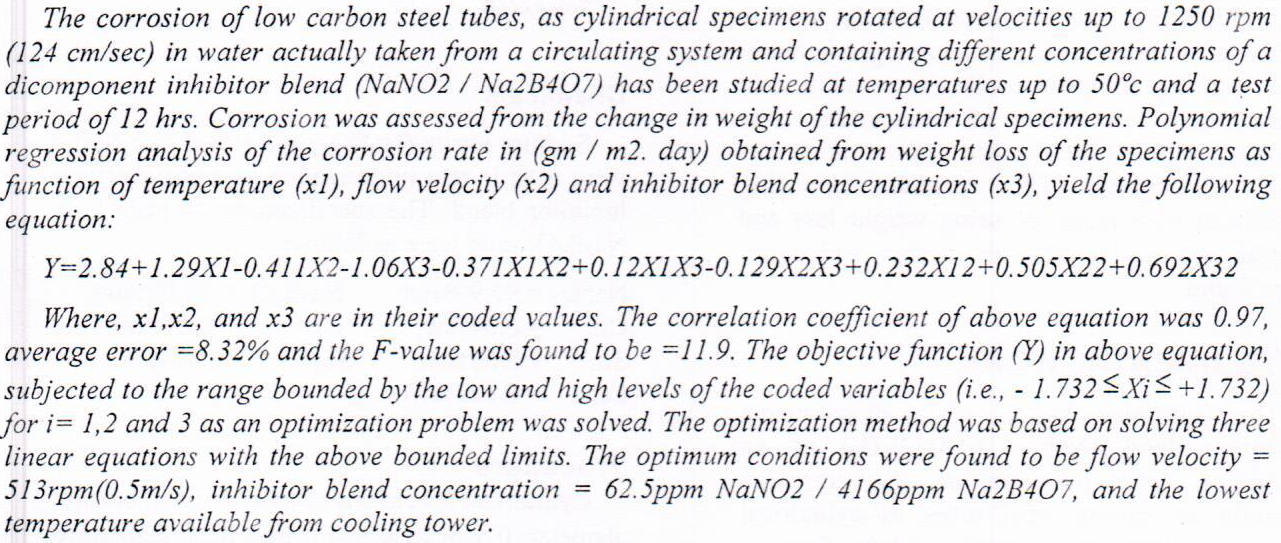
The Influence of Temperature and Flow Velocity on the Corrosion Inhibition of Low Carbon Tubes in Recirculating Water System by a Dicomponent Inhibitor Blend

 (6)
(6)

A comparison between the resistance capacity of a single pile excited by two opposite rotary machines embedded in dry and saturated sandy soil was considered experimentally. A small-scale physical model was manufactured to accomplish the experimental work in the laboratory. The physical model consists of: two small motors supplied with eccentric mass 0·012 kg and eccentric distance 20 mm representing the two opposite rotary machines, an aluminum shaft with 20 mm in diameter as the pile, and a steel plate with dimensions of (160 × 160 × 20 mm) as a pile cap. The experimental work was achieved taking the following parameters into consideration, pile embedment depth ratio (L/d; length to diameter) and operating freq
... Show More (14)
(15)
(14)
(15)


The present study analyzes the effect of couple stress fluid (CSF) with the activity of connected inclined magnetic field (IMF) of a non-uniform channel (NUC) through a porous medium (PM), taking into account the sliding speed effect on channel walls and the effect of nonlinear particle size, applying long wavelength and low Reynolds count estimates. The mathematical expressions of axial velocity, stream function, mechanical effect and increase in pressure have been analytically determined. The effect of the physical parameter is included in the present model in the computational results. The results of this algorithm have been presented in chart form by applying the mathematical program.
(1)
(13)
Stereo lithography (SLA) three-dimensional (3D) printing process is a type of additive manufacturing techniques that uses digital models from computer-aided design to automatically produce customized 3D objects. Around 30 years, it has been widely utilized in the manufacturing, design, engineering, industrial sectors and its applications in dentistry for manufacturing prosthodontics are very important. The stereo lithography technology is highly regarded because it can produce items with excellent precision especially when selecting the best process parameters. This review article offers a useful and scientific summary of SLA three-dimensional printing technology and its brief history. The specific type of 3D printers which is SLA t
... Show More
(20)
(19)
Stereo lithography (SLA) three-dimensional (3D) printing process is a type of additive manufacturing techniques that uses digital models from computer-aided design to automatically produce customized 3D objects. Around 30 years, it has been widely utilized in the manufacturing, design, engineering, industrial sectors and its applications in dentistry for manufacturing prosthodontics are very important. The stereo lithography technology is highly regarded because it can produce items with excellent precision especially when selecting the best process parameters. This review article offers a useful and scientific summary of SLA three-dimensional printing technology and its brief history. The specific type of 3D printers which is SLA type b
... Show More
(20)
(19)
(9)
(13)
(9)
In this work, functionally graded materials were synthesized by centrifugal technique at different
volume fractions 0.5, 1, 1.5, and 2% Vf with a rotation speed of 1200 rpm and a constant rotation time, T
= 6 min . The mechanical properties were characterized to study the graded and non-graded nanocomposites
and the pure epoxy material. The mechanical tests showed that graded and non-graded added alumina
(Al2O3) nanoparticles enhanced the effect more than pure epoxy. The maximum difference in impact strength
occurred at (FGM), which was loaded from the rich side of the nano-alumina where the maximum value was
at 1% Vf by 133.33% of the sample epoxy side. The flexural strength and Young modulus of the fu
(4)
(2)