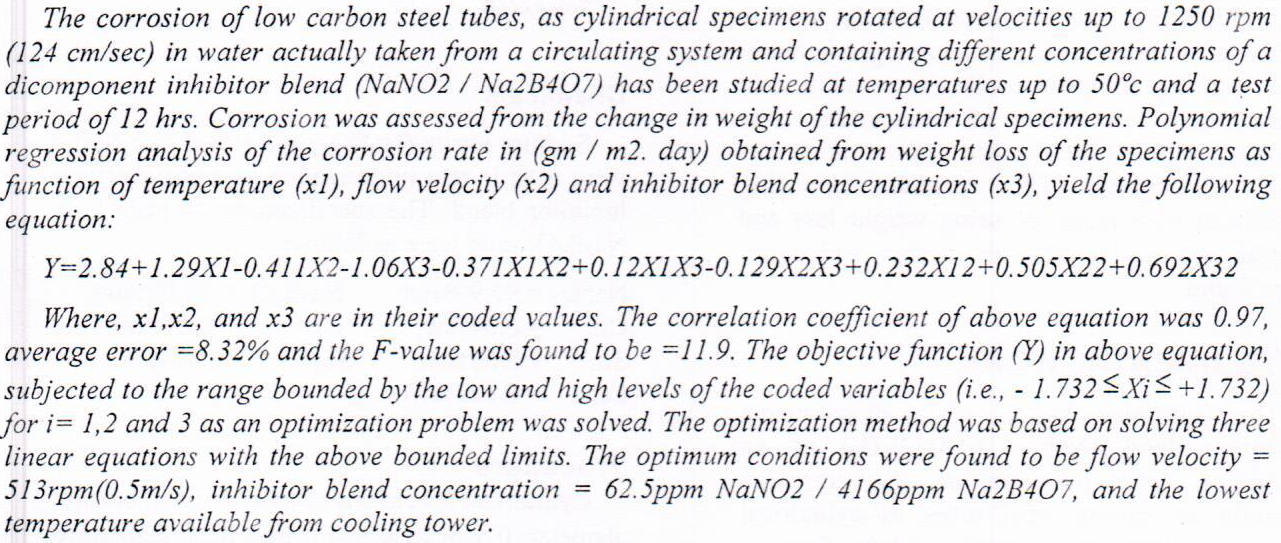
The Influence of Temperature and Flow Velocity on the Corrosion Inhibition of Low Carbon Tubes in Recirculating Water System by a Dicomponent Inhibitor Blend

This study aimed to evaluate the effectiveness of a novel concrete-encased column (CE) using small circular steel tubes filled with cementitious grouting material (GFST) as the primary reinforcement instead of traditional steel bars. The research involved three different types of reinforcement: conventional steel bars, concrete-filled steel tubes with 30% of the reinforcement ratio of steel bars, and concrete-filled steel tubes with the same reinforcement ratio as steel bars. Twenty-four circular concrete columns were tested and categorized into six groups based on the type of reinforcement employed. Each group comprised four columns, with one subjected to concentric axial load, two subjected to eccentric axial load (with eccentrici
... Show More (9)
(9)
 (9)
(9)



A reliable and environmental analytical method was developed for the direct determination of tetracycline using flow injection analysis (FIA) and batch procedures with spectrophotometric detection. The developed method is based on the reaction between a chromogenic reagent (vanadium (III) solution) and tetracycline at room temperature and in a neutral medium, resulting in the formation of an intense brown product that shows maximum absorption at 395 nm. The analytical conditions were improved by the application of experimental design. The proposed method was successfully used to analyze samples of commercial medications and verified throughout the concentration ranges of 25–250 and 3–25 µg/mL for both FIA and batch procedures, respecti
... Show More
(5)
(4)
Background: Diabetes and periodontitis are considered as chronic diseases with a bidirectional relationship between them. This study aimed to determine and compare the severity of periodontal health status and salivary parameters in diabetic and non-diabetic patients with chronic periodontitis. Materials and Methods: Seventy participants were enrolled in this study. The subjects were divided into three groups: Group I: 25 patients had type 2 diabetes mellitus with chronic periodontitis, Group 2: 25 patients had chronic periodontitis and with no history of any systemic diseases, Group 3: 20 subjects had healthy periodontium and were systemically healthy. Unstimulated whole saliva was collected for measurement of salivary flow rate and pH.
... Show More
(6)
(6)
(2)
(3)
(3)
The importance of the present work falls on the pitting corrosion behavior investigation of 304 SS and 316 SS alloys in 3.5 wt% of aqueous solution bearing with chloride and bromide anion at different solutions temperature range starting from (20-50)oC due to the pitting corrosion tremendous effect on the economic, safety and materials loss due to leakage. The impact of solution temperatures on the pitting corrosion resistance at 3.5wt% (NaCl and NaBr) solutions for the 304 SS and 316 SS has been investigated utilizing the cyclic polarization techniques at the potential range -400 to1000 mV vs. SCE at 40 mV/sec scan rate followed by the surface characterization employing Scanning Electron&nbs
... Show MoreAtmospheric transmission is disturbed by scintillation, where scintillation caused more beam divergence. In this work target image spot radius was calculated in presence of atmospheric scintillation. The calculation depend on few relevant equation based on atmospheric parameter (for Middle East), tracking range, expansion ratio of applied beam expander's, receiving unit lens F-number, and the laser wavelength besides photodetector parameter. At maximum target range Rmax =20 km, target image radius is at its maximum Rs=0.4 mm. As the range decreases spot radius decreases too, until the range reaches limit (4 km) at which target image spot radius at its minimum value (0.22 mm). Then as the range decreases, spot radius increases due to geom
... Show MoreThe aim of the research is to measure the change in the impact of the factors of the Corona pandemic on psychological sensitivity and COVID-19 phobia in a sample of Bisha University students and to detect the differences in the phobia (phobia) Covid-19 among the sample members in the measurement before the ban and after the ban was opened, in addition to the differences in psychological sensitivity of The sample has between sizes before and after the spread of the Corona pandemic, as well as the differences in them according to the gender variable (male, female). The researcher relied on the comparative approach. The scale of psychological sensitivity and COVID-19 phobia was applied to a sample of (62) male and female respondents.
... Show More