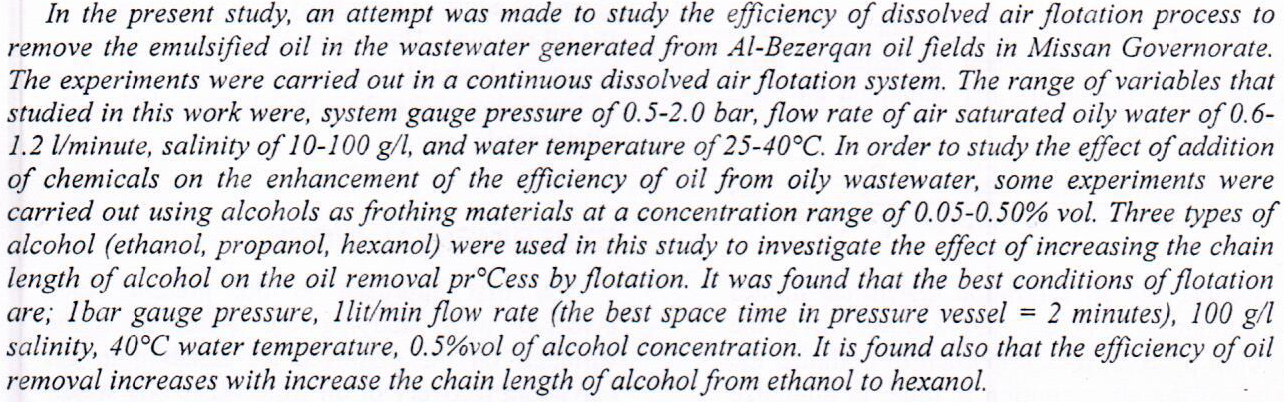
Oil Removal from Wastewater of Al-Bezerqan Crude Oil Fields by Air Flotation

New heterocyclic compounds derived from 2-Morpholino-1,8-naphthyridine-4-carboxylic acid such as oxadiazolo, thiadiazolo – thione and triazolo-thione have been prepared and characterized on the basis of IR and 1H NMR spectra data. The hydrizide compound was utilized as a starting material for preparing of these compounds. The second part of this study involves the biological studies of some of these naphthyridine derivatives by using three different kinds of bacteria namely: Staphylococcus aureus, Pseudomonas aeruglnosa and Escherichia coli. The data indicated that some of these compounds have a good activity against the tested bacteria in comparison to antibiotics.
 (1)
(1)

The aim of this study was to identify the level of critical thinking skills among fourth-grade middle school students and to determine the performance level of the underhand volleyball pass, with the assumption that there is a positive relationship between critical thinking and skill performance. The study population included 281 students from Basra Preparatory School for Girls under the Second Baghdad Education Directorate for the 2024/2025 academic year, of whom 275 students were intentionally selected as the research sample (97.865% of the population). The experimental procedure involved applying a critical thinking scale and a technical performance test for the underhand pass on 25 students per day over 11 days, from February 9
... Show More
The work involves synthesis of new Schiff bases ([V] a, b and [VI] a, b), pyrazoles [VII] a, b and pyrazolines [VIII] a, b derivatives containing isoxazoline unit starting with chalcones. 4-bromoacetophenone was reacted with 4-hydroxybenzaldehyde or 4-hydroxyacetophenone was reacted with 4-bromobenzaldehyde in basic medium to give chalcone by Claisen-Schemidt reaction. The chalcons [I] a, b was reacted with hydroxylamine hydrochloride to form isoxazolines [II] a, b. which were reacted with ethyl chloro acetate in basic medium to get ester compounds [III] a, b. The condensation new ester [III] a, b with hydrazine hydrate80% yieldedacid hydrazide [IV] a, b. The later compound refluxing with 4-substituted benzaldehyde in dry benzene to give Sc
... Show MoreIn this article, new Schiff base ligand LH-prepared Mn(II), Co(II), Ni(II), Cu(II), Zn(II), Cd(II), Hg(II), Pd(II), and Pt(II) materials were analyzed using spectroscopy (1 Metal: 2 LH). The ligand was identified using techniques such as FTIR, UV-vis, 1H-13C-NMR, and mass spectra, and their complexes were identified using CHN microanalysis, UV-vis and FTIR spectral studies, atomic absorption, chloride content, molar conductivity measurements, and magnetic susceptibility. According to the measurements, the ligand was bound to the divalent metal ions as a bidentate through oxygen and nitrogen atoms. The complexes that were created had microbicide activity against two different bacterial species and one type of fungus. DPPH techniques were bei
... Show MoreIn the light of what is witnessing in the advertising arena of new ways and methods in delivering advertising message to consumers by finding new outlets to communicate with them especially through social networking sites, which became the first choice of advertising companies in order to spread its goods and services. These companies now are relying gradually on celebrities to appear with their products and goods to drive the audience's attention towards them. The thesis aims to find out the attitudes of young people towards the the advertisements that show famous celebrities on social networking sites. The researcher used survey method which aims to record, analyze and interpret the phenomenon after collecting the necessa
... Show More
(11)
 (31)
(36)
(31)
(36)


Effects of Ozonated Water on Micro Leakage between Enamel and Fissure Sealants Prepared by Different Etching Technique (An in vitro Study), Baraa M Jabar*, Muna S Khalaf
(11)
(12)
The goal of this investigation is to prepare zinc oxide (ZnO) nano-thin films by pulsed laser deposition (PLD) technique through Q-switching double frequency Nd:YAG laser (532 nm) wavelength, pulse frequency 6 Hz, and 300 mJ energy under vacuum conditions (10-3 torr) at room temperature. (ZnO) nano-thin films were deposited on glass substrates with different thickness of 300, 600 and 900 nm. ZnO films, were then annealed in air at a temperature of 500 °C for one hour. The results were compared with the researchers' previous theoretical study. The XRD analysis of ZnO nano-thin films indicated a hexagonal multi-crystalline wurtzite structure with preferential growth lines (100), (002), (101) for ZnO nano-thin films with different thi
... Show More
(4)
(1)