Oil Removal from Wastewater of Al-Bezerqan Crude Oil Fields by Air Flotation
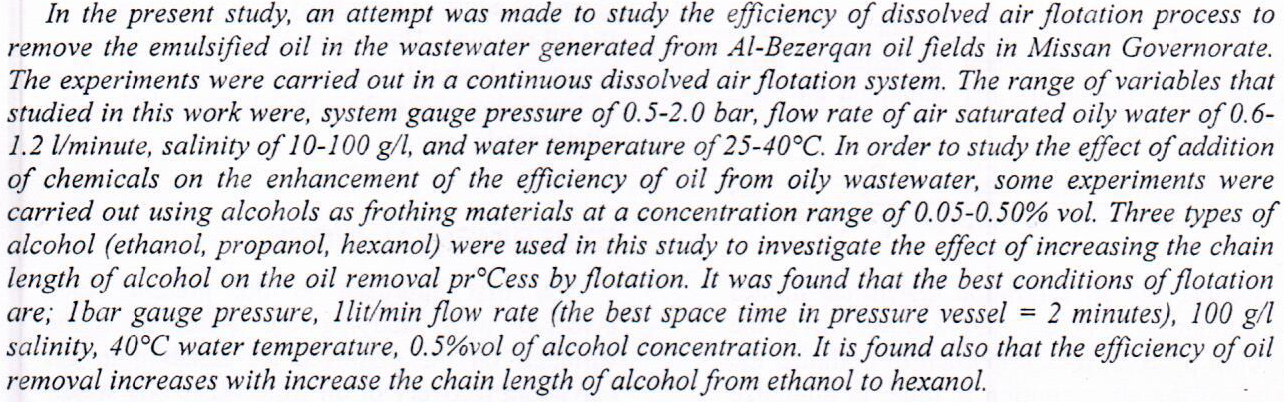

In this research paper, two techniques were used to treat the drill cuttings resulting from the oil-based drilling fluid. The drill cuttings were taken from the southern Rumaila fields which prepared for testing and fixed with 100 gm per sample and contaminated with two types of crude oil, one from Rumaila oilfields with Sp.gr of 0.882 and the other from the eastern Baghdad oilfield with Sp.gr of 0.924 besides contamination levels of 10% and 15% w/w in mass. Samples were treated first with microwave with a power applied of 540 & 180 watts as well as a time of 50 minutes. It was found that the results reached below 1% w/w in mass, except for two samples they reached below 1.5% w/w in mass. Then, the sample of 1.41% w/w in mass,
... Show More
In this paper investigate the influences of dissolved CO2/H2S gases, crude oil velocity and temperature on the rate of corrosion of crude oil transmission pipelines of Maysan oil fields southern Iraq. The Potentiostatic corrosion test technique was conducted into two types of carbon steel pipeline (materials API 5L X60 and API 5L X80). The computer software ECE electronic corrosion engineer was used to predict the influences of CO2 partial pressure, the composition of crude oil, flow velocity of crude oil and percentage of material elements of carbon steel on the rate of corrosion. As a result, the carbon steel API 5L X80 indicates good and appropriate resistance to corrosion compared to carbon steel API
... Show More (3)
(3)
 (5)
(3)
(5)
(3)
 (3)
(3)
(3)
(3)
This study aims to assess the removal efficiency andestablish the BOD5 and COD statisticalcorrelation of the sewage flowing in Al-Diwaniyah wastewater treatment plant in Iraq during the study period (2005-2016). The strength of the influent wastewater entering the plant varied from medium to high in strength. High concentrations of BOD5 and COD in the effluent were obtained due to the poor performance of the plant. This was observed from the BOD5 /COD ratios that did not confirm with the typical ratios for the treated sewage. To improve the performance of this plant, regression equations for BOD5 and COD removal percentages were suggested which can be used to facilitate evaluation of liquid waste and optimal control process. The equations
... Show MoreThe present work aimed to study the efficiency of nanofiltration (NF) and reverse osmosis (RO) membrane for heavy metal removal from wastewater and study the factors affecting the performance of these two membranes: feed concentrations for heavy metal ions, pressure, and flow rate. The experimental results showed, heavy metals concentration in permeate increase with raise in feed concentrations, decline with increase in flow rate. The raise of pressure, heavy metals concentration decreases for RO membrane, but for NF membrane the concentration decrease and then at high pressure increase. The rejection percentage for chromium in NF and RO is 99.7% and 99.9%, for copper is 98.4% and 99.3%, for zinc is 97.9% and 99.5%, for nickel is 97.2% and
... Show More
(3)
This paper investigated the treatment of textile wastewater polluted with aniline blue (AB) by electrocoagulation process using stainless steel mesh electrodes with a horizontal arrangement. The experimental design involved the application of the response surface methodology (RSM) to find the mathematical model, by adjusting the current density (4-20 mA/cm2), distance between electrodes (0.5-3 cm), salt concentration (50-600 mg/l), initial dye concentration (50-250 mg/l), pH value (2-12 ) and experimental time (5-20 min). The results showed that time is the most important parameter affecting the performance of the electrocoagulation system. Maximum removal efficiency (96 %) was obtained at a current density of 20 mA/cm2, distance be
... Show More
(8)
This study focused on treatment of real wastewater rejected from leather industry in Al-Nahrawan city in Iraq by Electrocoagulation (EC) process followed by Reverse Osmosis (RO) process. The successive treatment was applied due to high concentration of Cr3+ ions (about 1600 ppm) rejected in wastewater of this industry and for applying EC with moderate power consumption and better results of produced water. In Electrocoagulation process (EC), the effect of NaCl concentration (1.5, 3 g/l), current density (C.D.) (15-25 mA/cm2), electrolysis time (1-2 h), and distance between electrodes (E.D.) (1-2 cm) were examined in a batch cell by implementing Taguchi experimental design. According to the results obtained from multiple regression and signa
... Show More
(22)
(17)
Antibiotics must be fully eliminated before they are released into the environment. In most cases, conventional wastewater treatment systems are not built to handle polar microcontaminants such as antibiotics. Oxytetracycline (OTC) is one of these antibiotics, an environmental hazard contaminant in aqueous solutions. Therefore, an advanced treatment method is needed for wastewater contaminated with antibiotics. In this study, we employed zinc oxide nanoparticles (ZnO), and the catalytic ozonation procedure was employed to increase the ozonation efficiency. A continuous experiment was carried out to compare the effectiveness of catalytic and single ozonation in degrading OTC in a continuous reactor. The flow rate of OTC solution, the initial
... Show More
(2)
The injection of Low Salinity Water (LSWI) as an Enhanced Oil Recovery (EOR) method has recently attracted a lot of attention. Extensive research has been conducted to investigate and identify the positive effects of LSWI on oil recovery. In order to demonstrate the impact of introducing low salinity water into a reservoir, simulations on the ECLIPSE 100 simulator are being done in this work. To simulate an actual reservoir, an easy static model was made. In order to replicate the effects of injecting low salinity water and normal salinity, or seawater, the reservoir is three-phase with oil, gas, and water. It has one injector and one producer. Five cases were suggested to investigate the effect of low salinity water injection with differen
... Show More
(2)